



What you’ll have achieved, time required, and assumed skill level
By the end of this guide you will have a concrete, month-by-month training plan to raise and maintain your credit score: you will know how to check and fix errors, build a positive payment history, manage credit utilisation, use credit-builder products safely, and maintain a strong score over years. Realistic time to see measurable improvement: 3–12 months for visible gains, 12–36 months for a robust, long-term score. This guide assumes you are comfortable using email, online banking and spreadsheets, and that you can set up direct debits; no prior credit management training is required.
Before you start
- Government ID (driver licence or passport) — one copy for identity verification when ordering credit reports.
- Recent utility bill or bank statement (within 90 days) — for address verification.
- Access to your online banking and any credit card portals (username/password).
- A simple spreadsheet or budgeting app (Google Sheets or Excel) to log balances, payment dates and limits.
- Phone and email for contacting lenders; set aside 2–3 hours to make initial enquiries and order reports.
- A small emergency buffer: at least $500 in a separate savings account to prevent new late payments while you reorganise.
Overview: core concepts and exact thresholds to target
These are the score drivers you must control and the numeric targets you should aim for:
- Payment history — target: 100% on-time payments for 12 months; any payment more than 30 days late reduces score substantially. Aim never to be 7 days late.
- Credit utilisation — target: total utilisation ≤30%; ideal target ≤10% for cards you plan to use for applications. For example, on a card with $10,000 limit, keep balance ≤$1,000 (10%) for best effect.
- Length of credit history — target: keep oldest account open for at least 24 months after improvements; average account age >36 months helps.
- New credit and enquiries — target: ≤1 hard enquiry in the last 12 months; avoid more than 2 enquiries in a 24-month period if you plan a mortgage application.
- Credit mix — target: at least one revolving account (credit card) and one instalment loan (personal loan, car loan, or mortgage) showing timely payments.
Step-by-step training plan
Below is the numbered procedure I follow with clients. Each step begins with a bold action-first phrase then precise instructions, numbers and timelines. Use the plan as a checklist across 12 months.
-
Order and review your credit reports now — Order one report from each Australian credit reporting body: Equifax, Experian, and illion. You can request them online; expect delivery as PDF within 24–72 hours. Note: keep copies for at least 12 months. Look specifically for: account names, account opening dates, credit limits, balances, payment history lines and hard enquiries. Mark any differences in a three-column spreadsheet: Report Source / Item / Notes.
Exact checklist while reviewing: 1) Are all accounts actually yours? 2) Does each account show the correct limit? 3) Are there any balance errors > $50? 4) Does any payment show 30+ days late? 5) How many hard enquiries appear in the last 24 months?
-
Identify and correct errors immediately — For any incorrect item, file a dispute with the credit reporting body and with the relevant lender. Use these timelines and actions:
- Send an email or online form to the reporting agency within 7 days of discovery, including ID and a scanned copy of your supporting document (bank statement, contract, or proof of payment).
- The agency must investigate; expect a response within 14 business days. If they cannot verify the item, it must be removed within 30 days.
- If the lender refuses, escalate to the Australian Financial Complaints Authority (AFCA); lodging a complaint typically requires that you have attempted internal dispute resolution first and AFCA will respond within 45 days.
Example wording for your dispute email subject line: “Dispute — account number XXXX — incorrect balance and payment dates”. Keep your message under 200 words and include scanned ID and the exact line from the report you contest. Track dates on a dispute log: Date lodged / Agency / Lender / Reference number / Outcome / Date resolved.
-
Set up payment automation for all recurring debts — Automate payments to prevent late payments. Actions and timings:
- Set direct debits to pay at least the full minimum payment on the due date; if you can, set them to pay the full statement balance.
- If a lender won’t permit full balance auto-pay, set two automatic transfers: one for the minimum on the due date and another weekly transfer to a “card payment” account to build the balance needed to cover off full payments within 7 days.
- Immediate setup time: 15–45 minutes per account. Confirm the first payment clears and note the date in your spreadsheet.
If a card has a $2,000 limit and a typical monthly spend of $800, set the auto-pay to clear $800 within 7 days of the statement date and keep an additional $200 buffer in your transfer account.
-
Lower credit utilisation to under 30% immediately; target 10% within 3 months — Use this worked example and tactics:
Worked example: You have two cards — Card A limit $12,000 and balance $6,600; Card B limit $3,000 and balance $900. Total limit = $15,000; total balance = $7,500. Current utilisation = 7,500 / 15,000 = 50%.
To hit 30% overall, total balance must be ≤$4,500. To hit 10%, total balance ≤$1,500.
Tactics with exact numbers:
- Pay saved funds: transfer $3,000 immediately to reduce total balance to $4,500 (exactly 30%).
- Ask for a credit limit increase: request a $3,000 increase on Card A; if granted, new total limit = $18,000 and utilisation becomes 4,500 / 18,000 = 25% (target hit). Do not accept if the lender performs a hard enquiry — ask for a soft credit check first.
- Split payments across cards: move $600 from Card A to Card B by using balance transfer promotions with a fee only if the long-term benefit is >12 months. Balance-transfer fees are often 1.5%–3.0% of the transferred amount; calculate break-even: fee / monthly interest saved ≤ 12 months.
- Pay twice a month: for example, pay $2,250 on the 1st and $2,250 on the 15th to keep statements low.
-
Control statement closing dates and payment posting — Statement closing date determines the balance that lenders report. Actions:
- Find your card’s statement date and keep it visible in your spreadsheet. If your statement date is the 25th and you make a big purchase on the 26th, it won’t appear until next month.
- To minimise reported balances, pay down the card 3–5 days before the statement closing date. Example: statement closes on 25th — schedule a payment on the 21st.
- If you cannot move purchases, split the payment so that at least 80% of the high purchase is paid before the closing date.
This small timing strategy can reduce reported utilisation and trigger an improved score within one billing cycle (typically 28–31 days).
-
Mix in a secured or credit-builder product if you have thin credit — If your report shows less than 24 months of credit history or no revolving accounts, use a secured credit card or a credit-builder loan for 6–12 months. Specifics:
- Secured card: deposit equal to the credit limit (example deposit $1,000 => limit $1,000). Make monthly payments on time for at least 6 months; many lenders will graduate you to an unsecured card after 6–12 on-time months. Fees: expect an annual fee $20–$100 and a deposit $300–$2,000.
- Credit-builder loan: typical structure — you pay $100–$300 per month into a blocked savings account for 6–12 months; the lender reports payments and releases the funds at maturity. Choose a product with total fees <10% of the saved amount.
Use these products only for credit-building, not spending. For example: secured card with $1,000 deposit, spend $50 per month and pay $50 in full to report low utilisation and prompt positive history records.

-
Keep older accounts open and avoid unnecessary closures — Average account age is weighted; closing an old credit card reduces that average and can lower your score. Actionable rules:
- If an account is older than 36 months, keep it open unless it costs more than $120/year in fees. If it does, ask the provider to waive or reduce the fee for 12 months and re-evaluate.
- If you have accounts opened within the last 12 months, avoid closing them for at least 12 months after improving other metrics; closing during that period can amplify the effect of new credit on your average age.
-
Limit new applications: no more than 1 new credit account in 12 months — Every hard application in Australia may remain visible for up to 24 months; new accounts reduce average age. Specific rule: submit at most one hard application per 12 months for non-mortgage credit, and limit mortgage-related enquiries to the shortest possible window before applying for a loan.
If you’re rate-shopping for a mortgage, collect pre-approvals within one 30-day window and tell lenders you are rate-shopping — many providers use “multiple enquiries in a short period” rules, but confirm if they treat pre-approval as a soft or hard check.
-
Track and reduce revolving balances with weekly check-ins — Set a recurring 20-minute weekly session to check balances and move funds. Use exact thresholds for alerts:
- Create alerts that notify you when any card balance increases by more than $250 in a week, or when utilisation on any card exceeds 20%.
- Weekly action: move $100–$500 from your buffer savings to pay down balances if any threshold is exceeded.
This frequency keeps balances off statements and prevents creeping utilisation spikes that hurt your score.
-
Establish and maintain at least one instalment loan on schedule — If you have no instalment history (personal loan, car finance), consider a small personal loan of $2,000–$5,000 with a fixed term of 12–36 months and an APR <12%. Actions:
- Use the loan only for planned purposes and budget the repayments into your spreadsheet. Example: $3,000 over 24 months at 9% APR ≈ $138/month.
- Make payments on time and show 12 consecutive payments to affect credit mix positively. Do not take an instalment loan you cannot comfortably service for the entire term.
-
Use authorised user arrangements selectively and document them — Becoming an authorised user on a primary account with excellent history can boost your profile quickly. Rules:
- Only accept authorised user status from someone with 36+ months of spotless payments and low utilisation (<10%).
- Verify the primary account will report authorised users to credit reporting bodies (ask the lender in writing) and stay on the account for at least 6 months before expecting a measurable change.
If you remove yourself from the authorised user status within 3 months, the benefit may not be recorded; aim for at least 6–12 months stable placement.
-
Deal with a missed payment or default immediately
If you miss a payment:
- Call the lender within 7 days and ask for a “hardship arrangement” or to “bring the account current” by making a catch-up payment within 30 days. Script: “I had a temporary cash-flow issue; can we set a one-off catch-up payment and keep my account from being reported as 30+ days late?” Keep the call to 5–10 minutes and take the representative’s name and reference number.
- If you cannot pay the full overdue amount, propose a payment plan with the minimum catch-up payment equal to the missed minimum plus 10% buffer, and insist on written confirmation that payments will be reported as “paid as agreed” once completed.
- If a default has already posted, request a “goodwill adjustment” in writing if you had a long history of on-time payments prior to the missed payment. Expect low success rates, but always request it; lenders sometimes remove a single 30+ day late mark after 12 months of perfect behaviour.
If a default listing is lodged, note that in Australia a default may remain on your report for up to 5 years; paying the default doesn’t always remove the listing but will show as “paid” which is preferable.
-
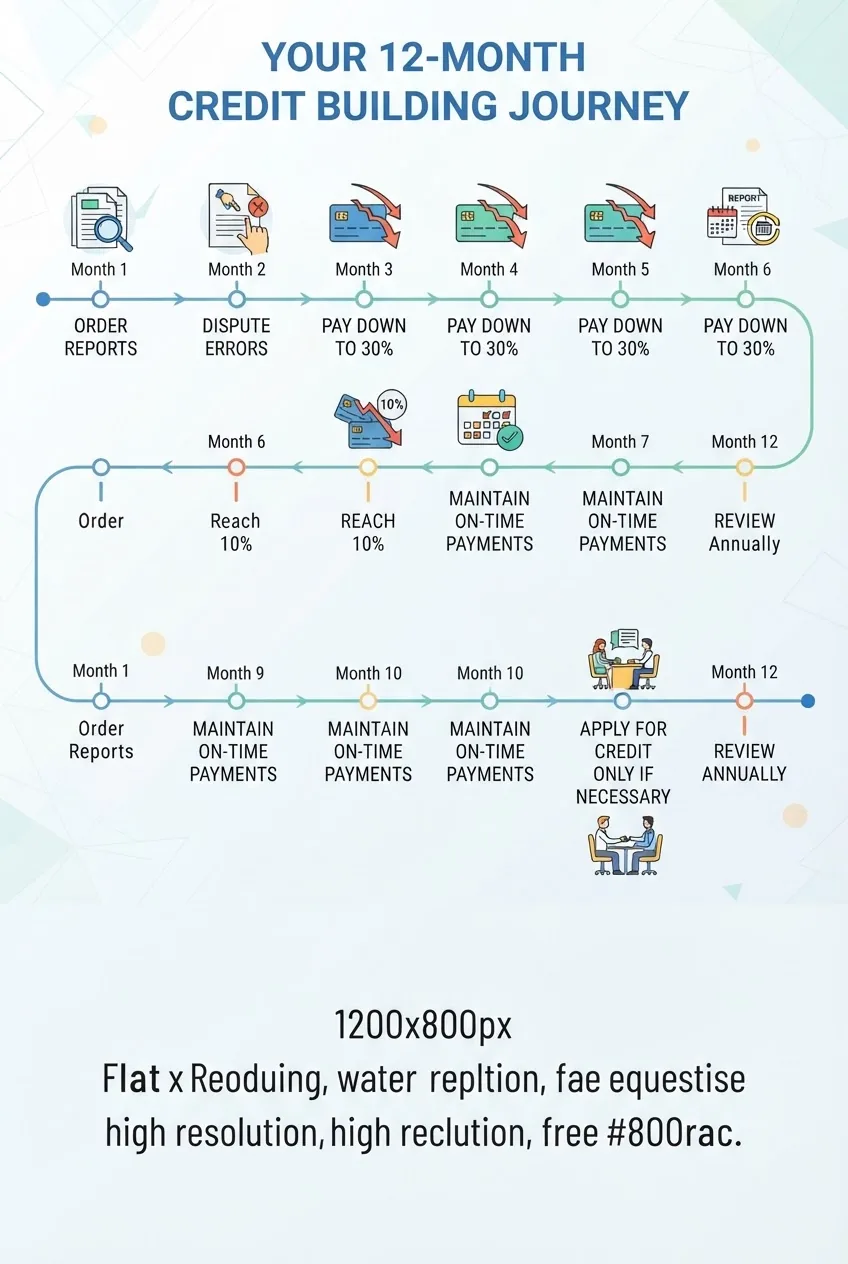
Plan a 12-month monitoring and improvement calendar with exact milestones — Example calendar:
- Month 0 (Now): Order reports, dispute errors, set up automation, pay down balances to hit ≤30% utilisation overall.
- Month 1: Reduce utilisation to ≤20% through extra payments; request one soft-limit increase; set up weekly checks and balance alerts.
- Months 2–3: Achieve ≤10% utilisation on at least one card; maintain 100% on-time payments; consider a secured credit-builder product if your history is <24 months.
- Months 4–6: Keep all on-time, keep oldest account open, review fees and ask for waivers if annual fees exceed $120. Apply for one new unsecured product only if it will lower average interest costs and you can keep utilisation low.
- Months 6–12: Re-check reports for improvements; maintain 100% on-time payments and low utilisation. Expect visible scoring benefits by month 3–6 and meaningful improvements by month 12.
Print or save a copy of the calendar and attach it to your household budget so these steps become routine.
- Use soft credit checks and pre-approvals when shopping for products — Always ask the lender whether a product will use a soft or hard credit check. If a lender insists on a hard check and you are just comparing, decline and use a different provider. Soft checks do not impact your score. If you must allow hard checks, concentrate them into a 14–30 day window and only for essential products.
-
Refinance high-interest revolving debt when savings exceed fees — Example calculation: you have $6,000 at 22% APR on a retail card. A 24-month personal loan at 10% APR will reduce interest. Compare total cost:
- Retail card interest for 24 months (approx, compounding ignored): 6,000 * 0.22 * 2 = $2,640.
- Personal loan at 10% APR: 6,000 * 0.10 * 2 = $1,200 + origination fee 2% = $120. Net saving ≈ $1,320.
- Refinance if net saving over the loan term > $300 after fees and you can service the loan comfortably.
-
Create a “credit health” dashboard and review quarterly — Columns to include in your spreadsheet:
- Date
- Account Name
- Type (Revolving/Instalment)
- Limit / Original loan amount
- Current balance
- Utilisation %
- Last payment date
- Next payment due & amount
- Hard enquiries in last 24 months
Review this dashboard every quarter and update it after each major transaction or dispute resolution.
-
Maintain the improvements: annual maintenance rules
Once you reach your target, follow these maintenance rules:
- Keep revolving utilisation ≤30% overall and ≤10% on the card used for new lending applications.
- Make at least one on-time payment per account every month; automated direct debits simplify this.
- Review credit reports annually and after any major life event (job change, large purchase, divorce).
- Ask your oldest-card issuer for a fee waiver rather than closing it if annual fees exceed $120.
- Limit new credit to only necessary events (moving house, vehicle purchase, or mortgage refinance); avoid casual applications for store cards and BNPL products unless you can keep utilisation low.
-
Plan for major life events that affect credit — If you expect a mortgage application within 12–24 months, lock down behaviour now:
- No new credit applications for at least 12 months before applying.
- Maintain utilisation under 10% on the card you will nominate for household expenses during mortgage checks.
- Save a deposit buffer: lenders typically like to see 3–6 months of living expenses in savings; target an emergency buffer ≥ 3 × monthly living expenses.
Worked examples and calculators (practical, exact numbers)
Example 1 — Reducing utilisation from 60% to 25% in 3 months
Starting point: total credit limit $20,000, total balance $12,000 (utilisation 60%). Goal: 25% utilisation = $5,000 balance.
- Immediate payment: move $4,000 from savings to reduce balance to $8,000 (new utilisation 40%).
- Month 1–2: allocate $1,500 per month from surplus income to pay balances: after two months, balance = $5,000 (utilisation 25%).
- If your surplus is only $800/month, combine with a $2,000 limit increase requested with a soft check to reach 25% sooner. Example: $8,000 balance / $22,000 new limit = 36% — still short; continue payments until 25%.
Example 2 — Credit-builder secured card plan
Product: secured card requiring $1,000 deposit; monthly app fee $5. Plan:
- Deposit $1,000 and set the card limit to $1,000.
- Spend $50/month and pay $50 in full each month, always 3 days before statement closing date.
- After 6 months of on-time payments, request graduation to unsecured card; track the lender’s reporting on your credit file after 30 days.
Common mistakes and how to avoid them
I once had a client who thought closing a $0-balance, 12-year-old credit card would improve their profile because it “reduced risk.” It actually lowered their average account age and pushed their score down by 12–18 points. Avoid closing long-standing accounts unless fees exceed $120/year and the issuer refuses a waiver.
I also saw a borrower open five buy-now-pay-later (BNPL) accounts in six months to manage cash flow; the sudden surge in new accounts and hard checks (in some cases) lowered their creditworthiness before they realised. My rule now: do not open more than one BNPL or retail credit account in any 12-month window unless absolutely necessary and repayment can be guaranteed.
A common error: waiting until the due date to start payments. I watched someone miss a payment by two days because a weekend and public holiday delayed a bank transfer. Set autopay or schedule payments 3 business days before the due date.
Compact verification checklist
- Ordered credit reports from Equifax, Experian, illion and saved PDFs.
- No unresolved errors — disputes lodged with tracking numbers documented.
- Automated payments set for all accounts (minimum or full) and verified with test transactions.
- Total credit utilisation ≤30% and at least one card ≤10% (if planning lending).
- Oldest account kept open and active for at least 24 months after improvements.
- Hard enquiries limited to ≤1 in the last 12 months; no more than 2 in 24 months.
- At least one instalment loan or evidence of credit mix (if possible/applicable).
- Saved “credit health” dashboard updated in the last 7 days.
When to call in a professional
Call a credit counsellor or a financial adviser when:
- You have multiple defaults or a bankruptcy on your record and need a negotiated plan — contact a registered financial counsellor or AFCA if disputes fail.
- Your total unsecured debt (credit cards, personal loans, BNPL) exceeds 60% of your annual income and you cannot propose a realistic repayment plan to creditors.
- You receive a default notice you cannot afford to settle and need help negotiating a hardship arrangement; a registered financial counsellor can negotiate and provide documented plans acceptable to lenders.
- You’re planning a mortgage within 12 months and your credit report shows complex errors or multiple defaults — get professional assistance to present a clean file to lenders.
Further reading and internal resources
For context on ranges and what constitutes “good” credit, see our detailed guide to credit score ranges and good credit at 735 Credit Score Guide with Range and Good Credit Info. If you need fast boost strategies after following this training, read How to Improve Credit Score — Fast Boost Strategies. For practical building techniques and longer-term history establishment, see How to Build Credit Guide — Tips for Good Credit History. For holistic personal finance preparation before applying for major loans, consult our pillar resource Personal Finance Tips and Money Management Advice Guide.
Frequently Asked Questions
How long does it take to build a credit score from scratch?
Expect measurable improvements in 3–6 months with disciplined payments and low utilisation; a robust, stable credit profile typically requires 12–36 months of consistent on-time payments and account activity to reach strong scoring bands.
What is the single fastest way to improve my credit score?
Lower your credit utilisation immediately: pay down revolving balances to reach ≤30% overall and ≤10% on cards lenders will check; this often yields a visible score rise within one billing cycle (28–31 days).
Should I close old credit cards to improve my credit score?
Generally no — closing an old account reduces average account age and can lower your score. Keep accounts open if fees are under $120/year or negotiate a fee waiver with the issuer.
Do hard enquiries always lower my credit score?
Hard enquiries can cause a small, temporary drop; limit them to necessary applications and try to use soft checks for rate comparisons. Aim for no more than one hard enquiry in 12 months if you plan major lending.
Is a secured credit card a good option to establish credit?
Yes — a secured card with a deposit of $300–$1,000 reported for 6–12 months can build positive history if you pay on time and keep reported utilisation low (<10% ideally).
How often should I check my credit report to maintain a good score?
Check reports from major bureaus quarterly and after major life events; set alerts for new accounts, enquiries, or balance changes > $500 and maintain a saved annual copy for reference.