



What you’ll have by the end, time required and skill level
By the end of this guide you will have a complete, actionable plan for how to build wealth: a written 1–5 year cashflow and savings plan, a 10–30 year investment allocation with dollar examples, tax-aware saving steps for Australian (Melbourne) residents and clear decision thresholds for when to change strategy. Realistic time to implement the initial plan: 4–8 hours to set up and 30–60 minutes per month to maintain. Skill level: beginner–intermediate financial literacy; no professional licence required, but basic spreadsheet and online banking skills are necessary.
Before you start
- Bank statements for last 3 months (download CSVs) and current balances
- Pay slips or income statements showing gross and net income
- List of liabilities: credit cards, loans, mortgages with interest rates and minimum payments
- Access to an online brokerage or superannuation account credentials (view-only is OK)
- A spreadsheet (Excel, Google Sheets) or budgeting app
- Calculator, and optionally a basic tax-rate table for Australia (ATO) or the USA if you need US-specific examples
- Patience: expect initial friction while setting up automated transfers and rebalancing rules
Step-by-step plan: core steps to build wealth
-
Assess your starting point — collect incomes, assets, debts
Time: 1–2 hours. What to do: create a single-sheet net worth statement and a 3-month cashflow summary.
- Record all assets with current market values: bank cash, investment accounts, property equity, vehicles — write exact amounts (e.g. Cash: $8,250; Brokerage A: $12,340; Home equity: $120,000).
- Record liabilities with balances and annual interest rates (e.g. Credit card: $3,200 @ 19.95% APR; Home loan: $360,000 @ 3.5% p.a.).
- Compute net worth = total assets minus total liabilities. Note the figure and save the spreadsheet as “NW YYYYMMDD”.
Why this matters: you cannot grow what you cannot measure. I always update net worth quarterly; doing it once reveals overlooked fees and low-return cash balances.
-
Set specific, measurable financial goals with timelines
Time: 30–60 minutes. Use SMART criteria: specific, measurable, achievable, relevant, time-bound.
Examples you should write down (exact numbers):
- Emergency fund: build $15,000 (3 months expenses) in 12 months — save $1,250 per month.
- Mortgage reduction: pay extra $500 per month to cut loan term by ~5 years (run amortisation to confirm).
- Investment goal: accumulate $200,000 in taxable and tax-advantaged accounts in 10 years by investing $800/month at 7% annual return.
- Retirement target: grow superannuation to $800,000 by age 65 — estimate current balances and required annual contributions.
Worked example: To reach $200,000 in 10 years with monthly deposits, solve FV = PMT*((1+r)^n -1)/r. With r=0.07/12, n=120, PMT=$800 → FV ≈ $144,000 from contributions + growth ≈ $200,000 (use a calculator to verify). I check the math in a spreadsheet to prevent optimistic rounding.
-
Create a zero-based monthly budget and free up cash
Time: 1–2 hours to set up, 30 minutes monthly to maintain. Action: allocate every dollar of income to expense, saving or investing.
- List fixed monthly incomes (e.g. Salary net $5,200).
- List essential expenses: rent/mortgage $2,000, utilities $220, groceries $650, transport $120, insurance $110.
- List discretionary and subscriptions: streaming $25, gym $18, phone $70 — cancel what you won’t miss for a month.
- Assign remaining to pockets: Emergency fund $1,250; Investment account $800; Debt repayment $500; Fun $150.
Tip: automate. Set 1st of month transfers: $1,250 to high-yield savings, $800 to brokerage via BPAY or direct debit, $500 extra to loan. Automation reduces temptation. I learned to automate after missing deposits for two months and losing momentum.
-
Build a 3–6 month emergency fund in a high-interest savings account
Time: 3–12 months depending on target. Target amount: 3 months for salaried single person, 6 months for sole income families — calculate exact monthly essential expenses and multiply by 3 or 6.
Where to put it: a high-interest savings account with instant access. Look for accounts yielding at least 3.0% p.a. (Australia rates as of 2026 vary; pick the top 4 options and compare APYs).
Exact plan: If your essential monthly expenses are $5,000, a 6-month fund = $30,000. Save $1,250 per month → target met in 24 months. If you can front-load via bonus/income spikes, do so.
-
Clear high-interest debt before heavy investing
Time: depends on debt size; typical acceleration 6–24 months. Priority: any consumer debt over 8% APR (credit cards, BNPL, personal loans).
Strategy and thresholds:
- Make minimum payments on all debts. Then allocate surplus to the highest-rate debt (debt avalanche) — this saves the most interest. Example: pay extra $500/month to a credit card at 19.95% with $3,200 balance; expected payoff ~7 months and saved interest ≈ $160.
- Alternative: use debt snowball (smallest balance first) if you need psychological wins — I switch to snowball when clients stall despite good maths.
- Consider balance transfers or 0% promotional rates only if you can pay the balance before the promotional period ends; write the date and calculate monthly required payment precisely (balance / months remaining).
-
Set up tax-efficient accounts and maximise Employer contributions
Time: 1–3 hours to review and change settings. For Melbourne readers, check your superannuation fund and salary sacrifice options. For US readers, check 401(k) match and IRAs.
Exact steps (Australia):
- Confirm your employer’s Superannuation Guarantee contribution (currently 11% as of 2024–2026 trends; verify with ATO). If your employer offers matching salary sacrifice, decide how much to sacrifice — typical salary sacrifice reductions are $200–$500 per fortnight.
- Open a Low-fee MySuper or industry fund if your current fund charges >1.0% p.a. Shift accounts only after evaluating exit fees. If fees exceed 1%, move funds; even 0.5% difference on $200,000 over 20 years can cost tens of thousands.
- Use concessional contributions up to the cap (currently $27,500 p.a. in Australia) if it fits your tax situation. I recommend checking with an accountant for high-income earners due to Division 293 rules.
Exact steps (USA):
- Maximise employer 401(k) match first — contribute at least the match percentage (e.g. 5% to get a 4% match). This is immediate 100%+ return.
- If eligible, fully fund Roth or Traditional IRA up to $6,500 (2024–2025 base; check latest) — pick Roth if you expect higher tax rates in retirement.
External reference: For exact ATO caps and policy, check the ATO website for current contribution caps and Super rules.
-
Build a diversified investment allocation using target percentages
Time: 2–4 hours to set up, 15–30 minutes monthly to monitor. Action: pick a target mix across equities, fixed income, property, and cash; use percentage targets and dollar thresholds for rebalancing.
Sample target mixes by risk profile (use exact percentages):
Profile Equities Fixed Income/Bonds Property/REITs Cash Conservative 40% 35% 15% 10% Balanced 60% 20% 15% 5% Growth 80% 10% 8% 2% 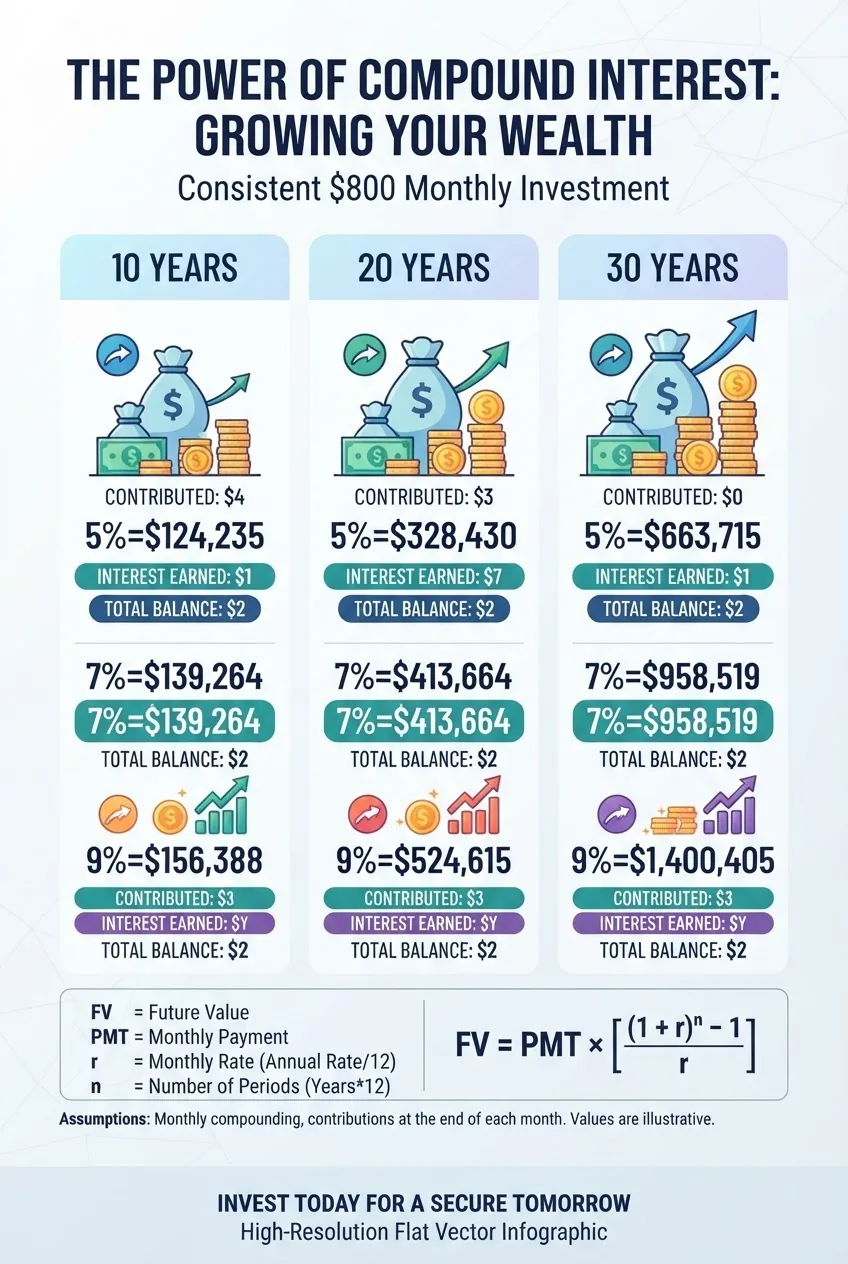
How to choose vehicles (exact guidance):
- Use low-cost index ETFs or managed funds for equities. Target ETF MER ≤ 0.30% for broad-market exposures; avoid active funds with fees >1.2% unless you can demonstrate consistent outperformance after fees.
- For bonds, consider government bond ETFs or short-term corporate bond funds with duration ≤ 6 years if you anticipate rising rates; aim for yield that beats cash by at least 1.0%.
- Property exposure: use listed REITs for liquidity or direct property when you can commit >20% deposit and accept leverage and transaction costs.
Worked allocation example: You have $50,000 to invest today and $800 monthly. For a Balanced target (60/20/15/5): Invest $30,000 equities (buy VAS or an ASX 200 ETF or allocate across US ETFs), $10,000 bonds, $7,500 REITs, $2,500 cash. Then set monthly buys: $480 equities, $160 bonds, $120 REITs, $40 cash.
-
Implement dollar-cost averaging and set rebalancing rules
Time: 1–2 hours to set up automations. Dollar-cost averaging (DCA) reduces timing risk: invest a fixed dollar amount each month regardless of market moves.
Exact rules I use with clients:
- DCA monthly on the 1st business day: set $800 debit order to a brokerage with buy instructions or automatic ETF purchases.
- Rebalance when any allocation drifts by ±5 percentage points from target (for example, equities target 60%; rebalance when it hits 65% or 55%).
- Annual forced rebalance in December to realign and harvest tax lots if needed.
Example: You start with $60,000 portfolio at 60% equities ($36,000). After 18 months equities grow to $50,000 and total portfolio $80,000 → equities = 62.5%. No rebalance yet. If equities reach 65% ($52,000 on $80,000), trigger rebalance: sell equities worth $4,000 and buy bonds/REITs per target split.

-
Use tax-loss harvesting and tax-efficient withdrawals
Time: 1–3 hours per year for review. Tax-aware investing increases after-tax returns; use specific actions and thresholds.
Practical rules:
- Sell losing positions only when loss is >2% and you have an offsetting capital gain this tax year — avoid selling for tiny tax benefits that incur trading costs.
- Hold assets for >12 months to qualify for long-term capital gains discounts (US) and similar Australian CGT discount (50% discount for assets held >12 months for individuals). Keep a log of acquisition dates in your spreadsheet.
- When drawing down, withdraw from taxable accounts first if you expect lower tax rates now and want to preserve concessionally taxed superannuation for later — this varies by country and income; run a simple marginal tax comparison with exact rates.
Example: You realised $15,000 capital gains this fiscal year. You have a $4,000 loss lot you can sell to reduce CGT; selling reduces taxable gain to $11,000. If selling costs $20 and loss lot would likely recover in 6 months, compare tax saved vs expected recovery — I generally harvest only when tax saved > fees by at least 5x.
-
Increase income streams: optimise salary, side income and passive returns
Time: ongoing. Action: apply three simultaneous strategies — negotiate pay, build a side business, and create passive income.
Specific targets and actions:
- Salary negotiation: prepare a 6–8 week file of achievements and benchmark salaries using exact comparators (seek 5–15% uplift). Ask HR for pay review with a two-week notice — practice your script and set a fallback plan if declined.
- Side income: aim for $500–$2,000/month incremental after tax within 12 months. Choose marketable skills: freelance digital marketing, tutoring, property management. Document hours expected per month (e.g. 8–15 hours) and projected revenue per hour.
- Passive returns: aim for a 3–6% cash-on-cash yield from dividend ETFs, peer-to-peer lending, or property. For example, a $200,000 property yielding 4% net income gives $8,000 p.a. gross — calculate net yield after mortgage and expenses precisely before committing.
Note: I have seen clients delay asks for pay rises for years — negotiating earlier can compound into much larger retirement balances due to higher salary-based super contributions.
-
Create a written investment policy statement (IPS) and check it quarterly
Time: 2–4 hours. The IPS is a one-page document with your objectives, horizon, risk tolerance, asset allocation, rebalancing rules and tax considerations.
Template sections — write exact entries:
- Objective: Accumulate $200,000 in 10 years and retire with $800,000 super by 65.
- Time horizon: 10–30 years for growth assets; 0–5 years for cash and emergency fund.
- Risk tolerance: Medium-High (can tolerate a 25% drawdown and maintain monthly contributions).
- Allocation: Balanced 60/20/15/5 (equity/bonds/REITs/cash), rebalance threshold ±5% or annual.
- Review schedule: Quarterly performance review, annual IPS review in December.
Why it works: An IPS prevents emotional changes during market volatility. I require clients to initial the IPS and keep it visible; it reduces reactive selling that costs >2% in returns historically.
-
Monitor performance and adjust using exact KPIs
Time: 30–60 minutes monthly. Use clear KPIs and thresholds to judge progress and whether to adjust strategy.
Key Performance Indicators (set and track these exact metrics):
- Net worth growth rate: target +6–10% annual increase for growth portfolios — flag if <0% for two consecutive quarters.
- Savings rate: target ≥20% of net income monthly — flag if <12% for 3 months.
- Investment return vs benchmark: portfolio 1-year return should be within ±2% of chosen benchmark (e.g. ASX200 + global ex-Australia index), otherwise investigate fees or allocation issues.
- Emergency fund level: maintain >=3 months essential expenses; replenish within 3 months if spent below threshold.
Example monitoring workflow: each month I export brokerage, bank, and super balances, update net worth spreadsheet, compute % change, and annotate any large cash flows (tax refund, bonus). If savings rate drops below 12% for more than one month I run a discretionary spend audit within 7 days.
-
Protect wealth with insurance and estate basics
Time: 2–4 hours. Protection prevents a single event from destroying years of accumulation.
Minimum protections to arrange with exact coverage targets:
- Income protection: 70% of gross monthly income, deferred period 30 days to 90 days depending on budget, benefit period 2 years or to age 65 for key earners.
- Life insurance: cover equal to 8–10x net annual income or enough to clear mortgage and leave $50,000–$200,000 for dependents.
- Total and Permanent Disability (TPD): target 3–5 years of living expenses or a lump sum equal to outstanding debt plus relocation costs.
- Home & contents: insure for replacement value, not market value; check policy excess and flood/earthquake exclusions; set a maximum single-item cover threshold and increase if needed.
Estate steps: write a simple will, name superannuation beneficiaries (binding nomination if required), and establish an enduring power of attorney for health and finances. I have seen family disputes cost >$40,000 in legal fees when wills are unclear — invest a few hundred dollars to avoid this.
-
Scale with debt sensibly: mortgages and leverage only when numbers are clear
Time: 1–3 hours to model, variable to execute. Using leverage can accelerate wealth but increases risk — only use when: you have 20% deposit, emergency fund fully funded, and debt service ratio under 35% of gross income.
Exact checks before taking investment property or margin:
- Loan-to-value (LVR) ≤ 80% for investment property to avoid LMI; if LVR >80% calculate LMI cost and include in cash-flow model.
- Rental yield net of expenses and mortgage: aim for ≥3.5% net positive cashflow in Melbourne suburbs (after mortgage interest at current rate + 2% buffer).
- Stress test rate increases: model mortgage at current rate + 3 percentage points (e.g. if current 3.5% model at 6.5%) and ensure cashflow stays positive or manageable for 12 months.
- Margin trading: limit to <10% of liquid net worth; set automatic stops (e.g. 20% loss) — I avoid margin for most clients unless they are seasoned traders.
Example model: Purchase price $700,000, deposit 20% = $140,000, loan $560,000. Interest-only payment at 6.5% = $3,033/month. If monthly rent expected $3,200, net before other costs ~ +$167 — after property management (7.7%), rates, maintenance expect -$200 to -$500 per month. If that negative aligns with your cash buffer, proceed; otherwise wait or increase deposit.
-
Review and adjust strategy annually and after major life events
Time: 2–4 hours annually; immediately after events. Life events that require immediate review: marriage, birth, divorce, job loss, inheritance, major healthcare event.
Annual checklist actions with exact timing:
- December: Rebalance portfolio, review IPS, adjust next year’s contribution amounts. Update net worth snapshot and compute year-over-year % change.
- March & September: Check tax-loss harvesting opportunities and capital gains positions using exact acquisition dates and amounts.
- After pay rise: increase automated savings by 50% of the net increase immediately; keep 50% for lifestyle — this preserves quality of life improvements while accelerating wealth.
Case study: A client had a new baby and failed to update beneficiary nominations; after two years this caused friction when the primary earner passed away. We fix nominations and add life insurance within 2 weeks of the birth.
-
Learn continuously and use curated resources
Time: 1–2 hours per week. Practical learning reduces costly mistakes; read targeted materials, not general news.
Resources I recommend and how to use them:
- Follow the pillar page “Personal Finance Tips and Money Management Advice Guide” for basics and link it in your bookmarks: personal finance tips & money management.
- Read specific sibling guides for deep dives: “How to Invest in Stocks” for stock selection how to invest in stocks and “Investment Basics” for vehicle differences investment basics.
- Join one curated forum or paid course and apply exercises — limit to one to avoid analysis paralysis. I recommend starting with a half-day workshop on superannuation and tax rules.
-
Automate tax and compliance: receipts, records and tax estimates
Time: 1–2 hours to set up, 30 minutes monthly. Keep a tax folder with exact records: dividend slips, brokerage statements, rental P&L, donation receipts.
Practical rules:
- Scan receipts >$100 and save PDFs in a cloud folder with structure: TaxYear/Category. Filename pattern: YYYYMMDD_Vendor_Amount.
- Estimate tax quarterly if you run a side business: save 25–30% of net side income to cover tax obligations; for PAYG employees check marginal rate to exact %.
- For rental properties: keep accurate records of interest, repairs and capital expenses. Separate capital improvements (capitalised) vs repairs (deductible immediately).
Note: I underreported freelance income once and paid penalties — always estimate conservatively and set aside funds monthly.
-
Plan exits and income phase-in for retirement
Time: 4–8 hours to model; revisit every 2 years. When you near retirement, plan the withdrawal order and safe withdrawal rate precisely.
Common withdrawal rules and exact thresholds:
- Use a dynamic safe withdrawal approach tied to Portfolio Value and living expense inflation. A conservative starting rule: 3.5% of initial portfolio in the first year with subsequent adjustments for inflation and portfolio returns for older retirees.
- Sequence withdrawals: use taxable accounts first for tax smoothing, then tax-deferred and finally tax-advantaged accounts depending on country rules. For Australia, consider transition-to-retirement strategies and account-based pensions; consult an adviser for exact tax modelling.
- Model for longevity: run scenarios to age 95 with a nominal return assumption 1.5% above inflation for conservative planning. E.g., with $800,000 and a 3.5% withdrawal = $28,000 first year; model subsequent adjustments.
Common mistakes and how to avoid them
I have seen these mistakes on repeat in practice — I describe what went wrong and exactly how I fixed or would have avoided it.
- Ignoring small fees: I once recommended a fund that charged 1.2% instead of an index ETF at 0.15% because the active manager “might outperform”. Over 20 years that 1.05% difference cost more than a yearly salary increase. Fix: always compare MERs and project fee drag on $100k over 20 years at your expected return.
- Skipping emergency savings: I had a client who invested 100% and then had a car failure. They liquidated equities at a loss to pay $6,200 for repairs. Fix: create a separate easy-access account and treat it sacrosanct until the fund is fully built.
- Over-leveraging property without stress testing: A borrower bought a second property at LVR 90% during low rates. Interest rose, rents softened, and they faced negative cashflow of $900/month. Fix: always model with a +3% rate stress and a 25% rental vacancy buffer.
- Tax chase without context: I have seen people sell winners to “avoid tax” or buy complex structures for marginal savings; the cost of trades and lost growth outweighed tax benefits. Fix: only harvest losses for values >$2,000 unless you have clear gains to offset.
- Reacting to headlines: In 2008–2009 many clients sold at the bottom after panicked calls; later they missed the recovery. Fix: rely on IPS and rebalance rules; keep at least one month’s contributions in cash to maintain discipline during shocks.
Checklist — verify your work
- Net worth statement completed and saved as “NW YYYYMMDD”.
- SMART goals documented with exact dollar and timeline targets.
- Zero-based budget created and automated transfers scheduled for emergency, investment and debt payments.
- Emergency fund target set and >0% funded; automation scheduled.
- High-interest debts identified and repayment plan documented; extra payments scheduled.
- Super/retirement accounts reviewed and employer contribution set; salary sacrifice if applicable decided (exact $ amounts).
- Investment allocation chosen (exact percentages) and initial trades completed; monthly DCA automated.
- Rebalancing rules set: ±5% trigger and annual forced rebalance date noted.
- Insurance and will/power of attorney in place or scheduled within 60 days.
- Quarterly KPI tracking spreadsheet created with targets: net worth growth, savings rate, portfolio vs benchmark.
When to call in a professional
Call an authorised professional if any of the following apply:
- You have >$1 million in investable assets and need tax structuring or estate planning — use a financial adviser and tax solicitor.
- Your tax situation is complex (rental portfolios, international income, business ownership) — call a registered tax agent/accountant before making moves.
- You plan to use substantial leverage (LVR >80%) for property or margin >10% of liquid net worth — consult a mortgage broker and financial planner to model worst-case scenarios.
- You are unsure about insurance needs for complex family arrangements (blended families, trusts) — speak to an estate specialist.
If you do call a professional, ask for written deliverables: exactly what they will do, fees in dollars (not percentages alone) and a timetable with milestones. I request a short engagement letter with specific KPIs and a maximum fee cap.
Frequently Asked Questions
How long does it take to build wealth from scratch?
Building meaningful wealth typically takes 10–30 years, depending on starting capital, savings rate and investment return. With disciplined saving (20%+ of net income) and investing at 6–8% real return, you can materially change your net worth within a decade.
Can I build wealth from nothing in Australia?
Yes. Start with a 3–6 month emergency fund, eliminate high-interest debt, automate a savings rate of at least 15–20% of income, and invest in low-cost diversified ETFs. With consistent contributions, compounding will produce large differences over 10–30 years.
What are the keys to building wealth through investments?
The primary keys are time in market, diversification, low fees and disciplined contributions. Use an IPS, automate monthly investing, rebalance at ±5% drift, and prefer low-cost index ETFs or broad funds with MER ≤ 0.30%.
How should I allocate assets as an investor starting now?
Choose allocation by risk tolerance: Balanced 60% equities / 20% bonds / 15% REITs / 5% cash is a common default. Rebalance when allocations drift ±5% and dollar-cost average monthly contributions to reduce timing risk.
What is a safe withdrawal rate for retirement?
A conservative starting withdrawal rate is 3.5% of portfolio value in year one, adjusted for inflation and actual portfolio returns. Modify this rate based on your health, other income sources and market conditions to avoid depleting capital prematurely.
How do I avoid costly investment mistakes?
Maintain an IPS, automate contributions, avoid high-fee active funds (>1.0% MER), stress-test debt at +3% interest, and rebalance only on clear rules. Keep a 3–6 month emergency fund to avoid forced sales in downturns.