



A credit score is affected by five core areas: payment history, credit utilisation, length of credit history, credit mix and new credit; additional factors include public records, enquiries, and report errors — each influences lenders’ risk assessment and how favourably they price loans or approve credit.
What is a credit score and why does it matter?
Answer: A credit score is a numeric summary of a person’s credit risk used by lenders to decide approval and pricing; it matters because it affects loan access, interest rates, insurance premiums and rental applications.
Term: Credit score: a three-digit number derived from credit report data that predicts the likelihood of repaying borrowed money.
Credit scores condense financial behaviour into a single value lenders use alongside income and employment. In Australia common scoring models rank from around 0–1,000 or 300–850 depending on the bureau; higher scores indicate lower perceived risk. Lenders may set score cut-offs for mortgages, personal loans and credit cards.
Beyond approval, a better score usually unlocks lower interest rates, larger credit limits and faster underwriting — poor scores can trigger security deposits, higher fees or outright refusals.
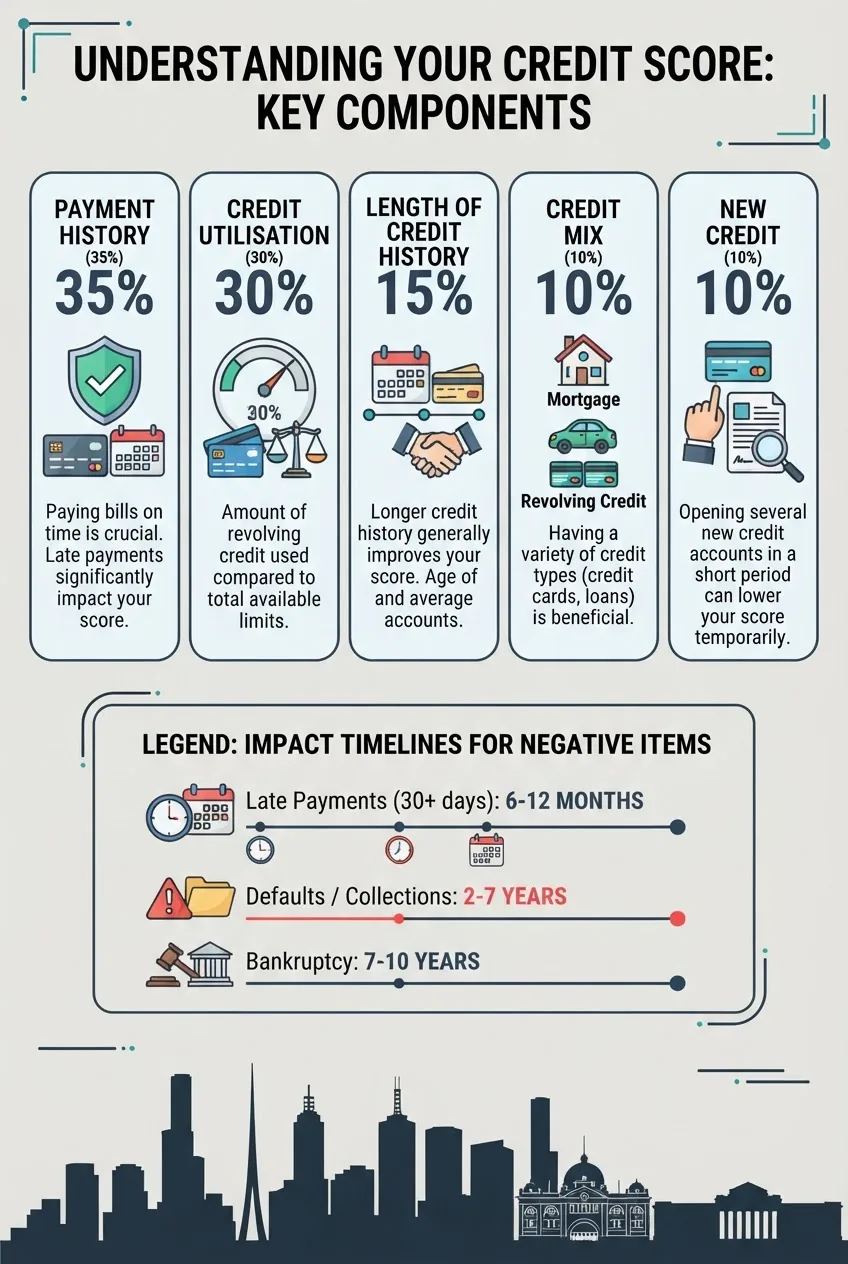
What affects your credit score most — which factors are weighted highest?
Answer: Payment history and credit utilisation typically carry the most weight, together often accounting for around 60–70% of many scoring models; late payments and high balances cause the largest, fastest drops.
Term: Payment history: the record of on-time and late payments listed on your credit report.
Payment history (missed and late payments, defaults) shows how reliably you repay. Credit utilisation (balance relative to limit) signals short-term repayment capacity: high utilisation implies strain. Length of credit history, credit mix and new accounts are secondary but still meaningful; recent negative events can outweigh older positive history.
| Factor | Typical weight (approx.) | How it affects score |
|---|---|---|
| Payment history | 35–40% | Missed payments and defaults cause steep drops; consistent on-time payments build score. |
| Credit utilisation | 25–35% | High balances relative to limits lower scores quickly; low utilisation improves score. |
| Length of history | 10–15% | Longer average account age helps; many recent accounts lower it. |
| Credit mix | 10–15% | A healthy mix (revolving and instalment) can improve score modestly. |
| New credit and enquiries | 5–10% | Multiple hard enquiries and many new accounts can lower scores temporarily. |
How does payment history specifically impact credit score?
Answer: Payment history impacts your score directly and heavily: each late payment can reduce your score depending on severity (30, 60, 90+ days) and frequency, with recent delinquencies causing larger penalties.
Term: Delinquency: a recorded late payment on an account, usually logged at 30, 60, 90 days past due.
Scoring models penalise the age and frequency of missed payments; a single 30-day late might reduce a score modestly if you otherwise have a strong history, while a 90+ day default results in a larger drop and additional public record consequences. Lenders also view pattern — repeated small delinquencies are worse than one isolated late payment.
- 30-day late: usually first reported and causes an initial score drop.
- 60-day late: larger penalty and may trigger creditor collections activity.
- 90+ day default: severe score hit and may lead to listing as defaulted debt or legal action.
To minimise damage: make payments as soon as possible, ask creditors for hardship arrangements, and document any agreed changes so credit reports reflect updated statuses where applicable.
How does credit utilisation affect my credit score and what targets should I aim for?
Answer: Credit utilisation measures how much of your available revolving credit you use and should be kept below 30% overall and per-card; lowering utilisation typically raises your score quickly within one or two billing cycles.
Term: Credit utilisation ratio: the percentage of revolving credit limits currently used (balance ÷ credit limit × 100).
High utilisation signals higher short-term default risk; reducing balances, requesting higher limits, or adding a low-balance authorised user can lower utilisation. Be careful: requesting a credit limit increase may trigger a hard enquiry, which temporarily affects score.
- Calculate utilisation per card and overall to identify problem accounts.
- Prioritise paying down highest-utilisation cards first for fastest score gain.
- Aim for under 10% for optimal scoring benefit in many models; under 30% is a reasonable minimum target.
Do credit enquiries affect my credit score and what’s the difference between hard and soft enquiries?
Answer: Hard enquiries (when a lender checks your report for a credit decision) can lower your score slightly for a short period; soft enquiries (background checks, pre-approved offers) do not affect your score.
Term: Hard enquiry: a lender-initiated credit check visible to other lenders and used in scoring; Soft enquiry: a non-lending-related check not used in scoring.
Multiple hard enquiries in a short window can be interpreted as higher risk, though rate-shopping for a single loan type (like a mortgage) is often treated as a single enquiry within a defined window by many scoring models. In Australia, enquiries are recorded on your credit file and lenders can see recent activity.
Practical steps: limit applications, research pre-approval conditions, and group loan applications into a short timeframe when possible to minimise cumulative impact.
How does the length of my credit history affect my credit score?
Answer: Longer average account age improves your score because it provides a larger, more reliable sample of behaviour; closing old accounts can shorten average history and reduce your score.
Term: Average account age: the mean age of your open credit accounts used by scoring models to gauge stability.
Opening new accounts reduces average age and can temporarily lower your score; conversely, maintaining older accounts — even with low activity — supports longevity metrics. If considering closing an unused card with a long history, weigh the potential score reduction against security or cost reasons.
What effect does credit mix have on my credit score?
Answer: Credit mix (types of credit like mortgages, cards, personal loans) has modest influence: a varied mix can slightly help the score if managed responsibly, but it’s less important than payments and utilisation.
Term: Credit mix: the composition of different types of credit accounts on your report (revolving vs instalment).
Having both instalment loans (like a car loan) and revolving credit (credit cards) demonstrates the ability to manage different obligations. However, obtaining new account types solely to improve mix is not recommended because new accounts and enquiries can temporarily lower your score.
How do public records and serious negative events affect my score?
Answer: Public records — bankruptcy, court judgments, and defaults — cause large, long-lasting damage to your credit score and remain on credit reports for several years, often 5–7 or more depending on the event and local law.
Term: Public record: official filings such as bankruptcies, court judgments, or insolvency notices that appear on a credit file.
Defaults and judgments signal acute risk; bankruptcy is typically the most damaging and long-lasting entry. Each event’s presence influences both automated scoring and manual lender decisions and usually requires years of consistent on-time behaviour to offset.
| Event | Typical reporting period | Typical score impact |
|---|---|---|
| Late payment (30–89 days) | 2–7 years (varies by bureau) | Moderate; repeated occurrences compound impact |
| Default / Collections listing | 5–7 years | Large, prolonged negative effect |
| Bankruptcy | 7–10 years (depending on Australia state & bureau) | Severe and long-lasting |
How do mistakes or fraud on my credit report affect my score and what can I do?
Answer: Errors and identity theft can artificially lower your score; you should file disputes with the credit bureau, contact the lender reporting the error, and if fraud is present, lodge a police report and a fraud alert with bureaus.
Term: Credit dispute: the formal process by which you challenge incorrect entries on your credit report with the credit bureau and reporting creditor.
Common errors include wrong balances, incorrect personal details, duplicated debts, and fabricated accounts. Keep records (statements, correspondence) and use each bureau’s dispute mechanism. Timely disputes often result in corrections within 30–45 days, improving scores once removed.
- Check all three major reports annually and after major life events (move, identity theft).
- Document phone calls and send written follow-ups where possible.
- Consider a credit monitoring product for ongoing protection if you suspect identity theft.
What does a ‘terrible credit score’ mean and what can you expect?
Answer: A terrible credit score is a low numeric band indicating high default risk; consequences include declined credit, high interest rates, deposit requirements, restricted products and tougher rental or employment screening.
Term: Terrible credit score: a colloquial term for a credit score in the lowest range of a scoring model that signals extreme risk to lenders.
Exact thresholds vary by scoring model; lenders set their own cut-offs. Someone labelled ‘terrible’ may still access credit but at punitive rates or via specialised lenders. Recovery requires correcting errors, clearing delinquent accounts where possible, and rebuilding positive activity over months and years.
How long does it take to fix a credit score and what realistic timelines apply?
Answer: Timelines vary: minor improvements (reducing utilisation) can show within 1–2 billing cycles; correcting delinquencies and rebuilding may take 6–24 months; recovery from defaults or bankruptcy often takes 3–7+ years.
Speed depends on the root cause. Examples:
- Lowering card balances to under 30%: visible lift within 30–60 days.
- Bringing a late payment current and on-time thereafter: gradual recovery over 6–12 months.
- Paying off a default or settled collection: improves prospects but the negative history remains for several years.
- Bankruptcy: long-term recovery with improved access after 3–5 years in some cases, full record removal only after statutory period.
What step-by-step plan improves a terrible credit score — worked example?
Answer: A stepwise plan: obtain reports, fix errors, prioritise delinquencies, reduce utilisation, negotiate payoffs, add positive accounts, and monitor progress; a three-phase plan can move a low score upward significantly within 12–24 months.
Worked example (practical numbers):
- Obtain three credit reports and identify items: a $2,800 credit card balance at 90% utilisation, one 60-day late entry, and a small collections account of $420.
- Phase 1 (0–2 months): Dispute any errors; contact the collection agency to request a pay-for-delete or settlement in writing for $300; bring the 60-day late current by making the minimum payment.
- Phase 2 (1–6 months): Pay down the $2,800 card to $560 (20% utilisation) using a repayment plan or balance transfer; avoid new applications. Expect a measurable score increase after the next reporting cycle.
- Phase 3 (6–24 months): Keep all payments on time, avoid balances above 10–30%, and add a small secured credit card or credit-builder loan if appropriate to demonstrate positive activity.
Result: within 6 months, the score typically improves due to lower utilisation and current payments; continued progress over 12–24 months depends on absence of new negatives and consistency.
Can paying off a loan or closing accounts hurt my score?
Answer: Paying off debt usually helps but closing accounts can reduce available credit and shorten average account age, potentially lowering your score; keep paid accounts open unless fees or security reasons require closure.
When you pay off a revolving account, utilisation drops which often raises your score. However, if you then close that card, your total available credit shrinks and utilisation could rise, harming the score. For instalment loans, paying off shows positive behaviour but reduces credit mix benefit slightly.
How often should I check my credit score and reports?
Answer: Check your credit reports at least annually from each major bureau and your score quarterly; check immediately after major financial events, identity theft suspicion, or before applying for significant credit to catch errors and plan improvements.
In Australia, free or low-cost access to your credit report is available via bureaus and accredited services; use those channels and subscribe to alerts if you expect activity. Frequent checks help you spot fraud early and time loan applications for the best possible score.
What do lenders look at beyond the credit score?
Answer: Lenders evaluate income, employment history, savings, current debt levels, loan purpose and assets; credit score is one input — affordability and verified documentation often determine actual lending decisions.
Underwriting includes assessing serviceability (ability to repay), typically via income proof, living expenses and debt-to-income ratios. For mortgages in Australia, lenders may use different stress test rates and scrutinise informal income or gig work more heavily. Always present accurate, up-to-date documentation.
Are credit scoring models different and does that change what affects your credit score?
Answer: Yes — models (e.g., bureau-specific scores) weight factors differently and use different ranges, so the same credit report can produce different scores at different bureaus; core factors remain consistent across models, however.
Term: Scoring model: an algorithm used by a credit bureau or provider to convert credit file data into a numeric score.
Examples include bureau proprietary scores; some models emphasise recent delinquencies more, others use deeper utility of credit mix. Because lenders may use different models, your score reported by a comparison site may differ from a lender’s internal score.
How does moving house, changing jobs or life events affect my score?
Answer: Life events themselves don’t directly change a numeric score, but associated behaviours (missed payments during a financial shock, new credit applications, or utility changes) can influence it; address transitions proactively to protect your score.
Examples:
- Moving: may require new utility accounts that create new entries; avoid opening many accounts simultaneously.
- Job loss: income loss can cause missed payments — contact creditors early for hardship options.
- Marriage or separation: shared accounts affect both parties’ reports and require coordinated management.
Which actions give the fastest credit score improvement?
Answer: The fastest improvements usually come from lowering revolving balances (credit utilisation) and correcting reporting errors; both can produce measurable score gains within one to two reporting cycles (30–60 days).
Steps for rapid impact:
- Pay down high-utilisation cards to under 30% (ideally under 10%).
- Ensure recent late payments are brought current and automated payments are set up.
- Dispute and remove incorrect negative items on your report.
What are common myths about what affects your credit score?
Answer: Common myths include: checking your own score hurts it (it doesn’t), carrying a small balance improves score (it doesn’t — lower balances are better), and closing old accounts always helps (it can hurt). Know the facts before acting.
Clarifications:
- Soft enquiries (including your own checks) are invisible to scoring.
- Paying in full each month is better than carrying a small balance.
- Closing unused cards can decrease available credit and raise utilisation.
How should Melbourne residents approach credit repair differently?
Answer: Residents should use local credit reporting rules, check reports from Australian bureaus, understand regional time limits for public records, and engage local hardship or financial counselling services when needed.
In Australia, regulations govern reporting periods and dispute processes; free community legal centres and government financial counselling can support negotiations with lenders. Always request written confirmations of any agreements to ensure correct reporting to credit bureaus.
For broader personal finance context and related tips, see our pillar guide on Personal Finance Tips and Money Management Advice Guide and the practical score-improvement steps in How to Improve Credit Score.
What documentation should I collect when disputing credit report items?
Answer: Collect account statements, payment receipts, settlement letters, identity documents, and any written communications with lenders; provide clear supporting evidence when filing disputes to speed resolution.
Keep digital and physical copies, note dates and contact names, and send registered post or secure messages where possible. Credit bureaus typically require specific details of the disputed item and supporting evidence for an effective investigation.
How do lenders use credit scores differently for mortgages, personal loans and credit cards?
Answer: Mortgages usually require higher score thresholds and intensive affordability checks, personal loans balance score with income, and credit cards are more sensitive to utilisation and recent inquiries; each product has different risk tolerances.
Lenders combine scores with serviceability tests; mortgage underwriters apply stress-test interest rates and verify expenses. For risky credit card applicants, issuers may approve but limit the credit line or set higher rates. Understanding product-specific criteria helps you time applications better.
When is it worth paying a debt collector or settling a debt to improve my credit?
Answer: Settling or paying a collection is worth it when the cost improves your long-term financial position, removes legal exposure, or is part of a negotiated pay-for-delete that will be documented and reported as resolved; evaluate offers and get terms in writing.
Ask the collector to confirm in writing the terms, impact on your credit file, and whether they will request removal of the listing. Keep proof of payment and any settlement letters to show to future lenders.
How should I plan credit applications to minimise negative effects?
Answer: Space out credit applications, group rate-shopping for the same loan type into a short period, and research pre-approval criteria before applying; avoid simultaneous multiple hard enquiries from different product types.
Rate-shopping windows vary by model, but aiming to complete similar loan enquiries within 14–45 days reduces the cumulative penalty. Use pre-qualification tools that run soft checks where possible so your score is not affected.
What are the best ongoing habits to maintain a strong credit score?
Answer: Pay on time, keep card utilisation low, maintain older accounts, avoid unnecessary applications, monitor reports regularly, and correct errors promptly — these habits together sustain a strong score over years.
- Automate payments for at least minimum amounts to avoid late records.
- Keep no more than 10–30% utilisation across revolving credit.
- Check credit reports annually and after major life events.
Frequently Asked Questions
What affects your credit score the most?
Payment history and credit utilisation affect your credit score the most; missed payments and high balances relative to limits cause the largest, most immediate drops, while length of history, mix and enquiries play smaller roles over time.
How quickly can I improve a terrible credit score?
You can see improvements within 1–2 billing cycles by reducing credit utilisation or correcting errors, but meaningful recovery from defaults or bankruptcy usually takes 6–24 months to begin and several years for full recovery.
Does checking my own credit score hurt it?
No — checking your own credit via a soft enquiry does not affect your credit score; only hard enquiries from lenders during credit applications can lower it temporarily.
Will paying off a default remove it from my credit report?
Paying a default does not automatically remove the historic default entry, but it changes the status to paid or settled and may improve lender perception; removal requires successful disputes or a pay-for-delete agreement in writing.
How often should I check my credit reports in Australia?
Check your credit reports at least annually from each major bureau and again before major applications; check more often if you suspect identity theft or have active disputes to track progress.
What is the fastest action I can take to increase my credit score today?
The fastest action is to reduce revolving balances to lower credit utilisation, ideally below 30% or closer to 10%, which often yields measurable score increases within 30–60 days.
Should I close unused credit cards to improve my credit score?
Not usually — closing unused cards can raise your utilisation ratio and shorten average account age, which may lower your score; keep them open unless fees or security concerns outweigh the benefits.