



What you’ll have achieved, time and skill level
By the end of this guide you will have: (1) verified your current credit score using a US FICO-style report, (2) compared it to the average credit score in America, (3) determined whether 624 is good for your goals, and (4) built a specific 90‑day action plan with measurable targets (payments, utilisation and dispute actions). Realistic time: a focused 60–120 minutes to read and run the checks listed here; 3–6 months to see material score changes from basic fixes, and 6–18 months for larger rehabilitations. Skill level: beginner to intermediate financial literacy — no accounting background required, basic comfort with online accounts and spreadsheets recommended.
Before you start
- Government-issued ID (passport or driver licence) for identity verification.
- Access to one email address and one smartphone for 2-step verification.
- Recent bank statements and credit card statements (last 6 months).
- Calculator or spreadsheet to total balances and compute utilisation.
- Pen, paper, or a note app to record account names, balances and due dates.
- Estimated time pockets: 60–120 minutes today, 15 minutes/week for follow-up for 3 months.
Step-by-step: How to check, interpret and act on the average credit score
-
Get your current credit score and report.
Go to a reputable credit reporting service that provides a FICO-style score (Experian, Equifax or TransUnion in the US). If you are outside the US but analysing American credit behaviour, use the bureau’s US option or a consumer portal that shows FICO ranges. Complete ID verification (ID + SMS code). Download or save the credit report PDF. Target: obtain a full credit report and the numerical score value — for example, “FICO Score 8: 624”.

-
Compare your number to recognized FICO ranges and averages.
Use the standard FICO ranges: 300–579 = Poor, 580–669 = Fair, 670–739 = Good, 740–799 = Very Good, 800–850 = Exceptional. The average FICO score in America (recent national reports) sits around 710–715; treat 711 as the midpoint benchmark. If your score is 624, it falls in the “Fair” 580–669 band and is ~87 points below an average of 711.
FICO band Range Poor 300–579 Fair 580–669 Good 670–739 Very Good 740–799 Exceptional 800–850 -
Identify the top three score drivers on your report.
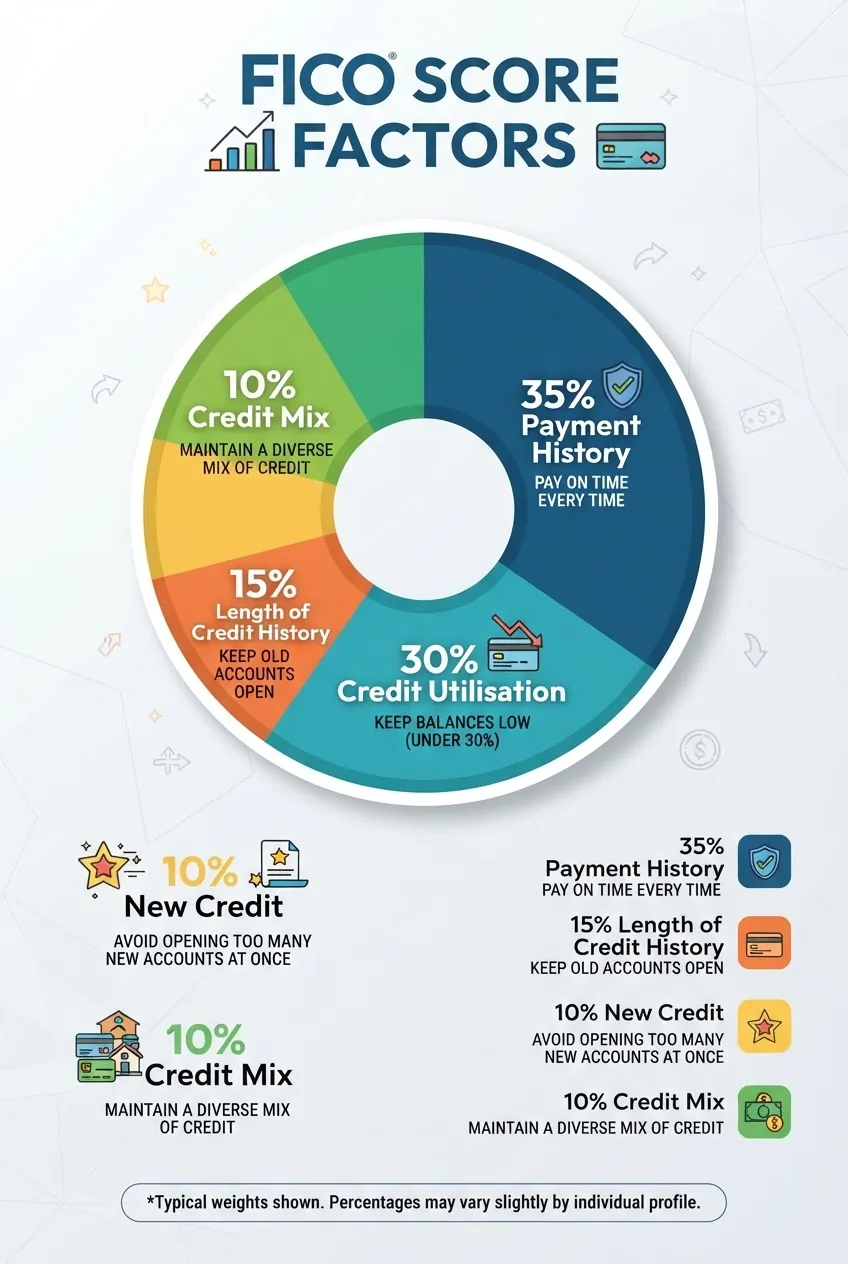
Open the “factors affecting score” or “reason codes” on your report and list the top three items with concrete numbers. Typical drivers are: payment history (e.g. 1 late payment 30 days in past 24 months), credit utilisation (calculate: total balances / total credit limits; target <30%, ideal <10%), and length of credit history (average account age in years). Write them down as: 1) Payment history — 1 late 30-day on Card A (Jan 2024); 2) Utilisation — 48% across credit cards; 3) New credit — 2 inquiries last 6 months.
-
Calculate exact credit utilisation and set target numbers.
On your spreadsheet, list each revolving account with its balance and credit limit. Sum balances and limits. Example: Balances = $6,200; Limits = $12,500 → utilisation = 49.6%. Targets: immediately reduce to ≤30% within 30 days; aim for ≤10% within 3 months for the largest short-term benefit. If you cannot pay down balances, plan to request a credit limit increase on one card (wait 30 days after last increase or payment).
-
Fix or dispute any incorrect negative items.
For each item you believe is incorrect (wrong balance, misreported late payment, identity error), prepare a one-page dispute: account name, account number, exact error, and supporting document (bank statement showing on-time payment). Submit disputes individually to the bureau(s) listing the item — Experian, Equifax, TransUnion — and to the creditor if possible. Use certified mail or the bureau’s online dispute portal. Timelines: bureaus must investigate within 30 days; follow up every 14 days if no update.
-
Bring accounts current and set automated payment rules.
Pay all past-due accounts to current status. Prioritise any accounts 60+ days past due first. Minimum payment schedule: pay enough today to clear 60–89 day delinquencies; for 30-day delinquencies, schedule auto-pay on due date + 1 day (set reminders 3 days before). Use autopay for at least minimums on all instalment and revolving accounts. Concrete target: reduce delinquencies to zero in 30–45 days for short-term improvement.
-
Strategically add positive credit activity.
If your file is thin (fewer than 5 tradelines), add 1 reliable tradeline: either a small secured credit card with $500 limit or a credit-builder loan of $300–$1,000 from a community bank. Make on-time payments for three consecutive months to create positive payment history. Avoid opening more than one new account in any 90‑day period to limit hard inquiries.
-
Request goodwill adjustments and negotiate with creditors.
For a single late payment recorded historically, draft a goodwill letter to the creditor asking removal of the late mark in exchange for current standing and proof of timely payments for X months (show at least 6 consecutive on-time payments). For balances you cannot pay, propose a settlement plan: get the settlement offer in writing, and request the creditor report the account as “Paid as Agreed” or remove negative remarks. Timeline: allow 30–90 days for any reporting updates to appear.
-
Monitor weekly for 12 weeks and log changes.
Set a weekly 10–15 minute review: check your score, verify new enquiries or accounts, and confirm payments posted. Use a simple log: Week 0 score; Week 4 score; Week 8 score; Week 12 score. If you see no movement after 12 weeks and you have followed steps 3–7, escalate to step 10 (call a professional). Expected change: tactical fixes (utilisation drops, removed errors) often move scores 20–50 points in 1–3 months.
-
Plan the 90‑day roadmap and set measurable milestones.
Create three 30‑day goals: Day 0–30: reduce utilisation to ≤30% and clear any 60+ day delinquencies; Day 31–60: achieve three consecutive on-time payments and request one credit limit increase; Day 61–90: reach utilisation ≤10% on at least one card and confirm dispute resolutions. Track with dates and dollar amounts: e.g., pay $1,800 by Day 30 to lower utilisation to 28%.
Common mistakes and how to avoid them
I once saw a client assume closing a credit card improved their score quickly; instead it raised utilisation overnight because the limits fell and their utilisation spiked from 22% to 48%. Don’t close accounts you rely on for available credit — pay balances down instead and leave the account open if there’s no fee.
I’ve observed people pay the minimums only; their delinquencies go away but utilisation stays high. I now tell everyone: pay extra on the highest-utilisation card until you hit ≤30%, then spread extra payments to other cards. Small extra payments of $25–$50 weekly add up — $25/week = $1,300/year.
I also saw clients open multiple new cards at once hoping to increase available credit, but three hard inquiries in 60 days produced an immediate score dip. I advise one new account every 90 days maximum unless you need a specific product immediately.
Compact checklist to verify your work
- I’ve downloaded and saved my full credit report PDF from at least one US credit bureau.
- I’ve calculated my overall credit utilisation and have it below 30% (target ≤10% for fastest gains).
- All accounts show zero current delinquencies; any 60+ day delinquencies are on a repayment plan.
- I’ve submitted disputes for any incorrect items with supporting documentation and recorded submission dates.
- I’ve set up automated payments for minimums and scheduled additional payments for principal reduction.
- I’ve logged score and report changes weekly for 12 weeks and recorded results in a spreadsheet.
When to call in a professional
Contact a certified credit counsellor or a licensed consumer law attorney when: (1) you discover identity theft affecting multiple accounts; (2) creditors refuse to remove demonstrably incorrect reporting after 60 days; (3) you face imminent legal action such as wage garnishment or a lawsuit; or (4) your credit problems result from complicated bankruptcy or court orders. For typical repair and improvement, a not-for-profit credit counselling session (often free or low-cost) is appropriate. If you choose a paid credit repair company, demand a written, itemised plan and beware of firms promising specific score numbers within short timeframes.
Contextual resources
For broader reading and next steps, see our guide to higher credit band strategies and fast boosts in the cluster: 735 Credit Score Guide, learn how to improve quickly in How to Improve Credit Score, and for repair procedures read How to Fix Credit Score. For broader money management linked to credit goals, see the pillar resource: Personal Finance Tips and Money Management Advice Guide.
Frequently Asked Questions
What is the average credit score in America right now?
The average credit score in America is roughly 710–715 according to recent national reports. Use 711 as a practical midpoint when comparing your own FICO-style score. Regional and bureau-specific averages can vary by ±5–10 points, so compare against the same bureau when possible.
Is 624 a good credit score?
No — 624 is in the “Fair” FICO band (580–669). It is below the US average and may result in higher interest rates and fewer premium credit offers. With concrete actions (reduce utilisation to ≤30%, correct errors) you can typically move into the “Good” band (≥670) within 3–6 months.
How quickly will my score change after paying down debt?
Scores often show movement within one billing cycle (30–45 days) after significant balance reductions. Practical target: reduce utilisation by at least 10–20 percentage points within 30 days to expect a 10–40 point score increase; larger decreases and dispute wins can yield bigger gains over 2–3 months.
Which factor affects my credit score the most?
Payment history is the largest factor at roughly 35% of a FICO score, followed by credit utilisation (~30%). Length of history, credit mix and new credit account for the remaining ~35%. Correcting late payments and lowering utilisation produce the fastest measurable improvements.
How do I dispute a wrongly reported late payment?
Collect proof (bank statement, cleared cheque, confirmation email). Submit a dispute to the bureau listing the item and to the creditor, include the evidence and a one-page explanation. The bureau must investigate within 30 days; follow up every 14 days and keep all correspondence copies.