


What you’ll achieve, time and skill level
By the end of this session you will have written a concise working definition of recreational activities meaning, created a 20-item, localised example list categorised into four clear types, and prepared a 3–5 minute classroom-style explanation and two short exercises to test understanding. Realistic time: 90–120 minutes. Assumes basic writing and facilitation skills (beginner–intermediate).
Before you start
- Quiet workspace and notepad or laptop with a text editor.
- Timer or phone (settable to 10, 20 and 30 minutes).
- Reference sources: one dictionary (Oxford or Macquarie) and one government or community recreation page.
- Access to local examples: list of parks, community centres, sports clubs in Melbourne (print or browser tabs).
- Printer (optional) for a one-page handout — print 1 copy per participant if delivering a short workshop.
Step-by-step training procedure
-
Gather authoritative definitions (10–15 minutes):
Open two reliable sources and extract single-sentence definitions. Example targets: Oxford Dictionary entry for “recreation”, a government recreation page. Copy the definitions into your document and time this step at 10–15 minutes. Keep each quoted definition under 30 words.
-
Draft your working definition (15–20 minutes):
Write a one-sentence working definition that starts with the phrase “Recreational activities meaning:” and totals 20–30 words. Example template to adapt: “Recreational activities meaning: voluntary, enjoyable activities undertaken during free time that refresh physical, mental or social well‑being, without primary financial or occupational motive.” Aim for 25 words; revise for clarity in two passes (5 minutes each).
-
List 20 local examples (20 minutes):
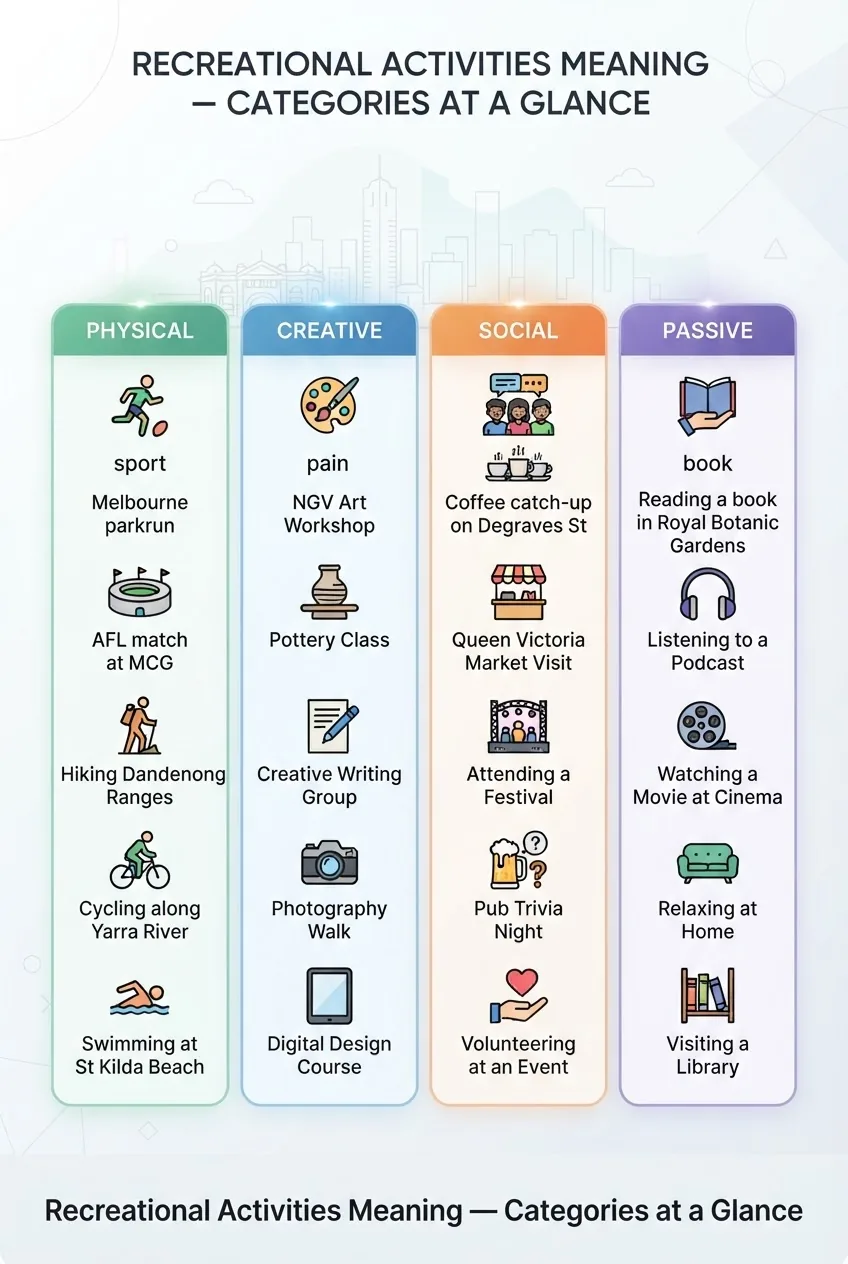
Create an ordered list of 20 specific recreational activities available to people in Melbourne — include locations where relevant (e.g., “cycling along the Yarra River”, “tai chi at Fitzroy Park”). Use exact names where possible and keep each item to 3–8 words. Time: 20 minutes maximum.
-
Categorise into four types (15 minutes):
Sort your 20 examples into exactly four categories: Physical, Creative, Social, and Passive. Put 4–8 items in each category. Use simple category headers and no more than one sentence explaining the criterion for each category (10–15 words). Recommended distribution: Physical 6, Creative 5, Social 5, Passive 4.
-
Write a 150–250 word explanatory paragraph (20–25 minutes):
Draft a single explanatory paragraph that expands the working definition and links the four categories to health or wellbeing outcomes. Use concrete metrics where possible: “30 minutes of moderate physical recreation, three times a week, reduces stress markers” (cite a generic source phrase rather than a URL). Keep the paragraph 150–250 words and perform two 5-minute edits for concision and local relevance (mention “Melbourne” at least once).
-
Create two short exercises (10–15 minutes):
Design: A) a 5-minute individual sorting exercise where participants label 8 mixed activities into the four categories; B) a 10-minute paired discussion prompt asking “Which recreational activity would you add to your weekly routine and why?” Provide answer keys and timing instructions exactly (5 and 10 minutes). Keep instructions to one to two sentences each.
-
Prepare a one-page handout (10 minutes):
Lay out a single A4 page with your one-sentence working definition at the top, the four-category infographic or list in the middle, and the two exercises at the bottom. Use 18–24pt headline size for your definition and 11–12pt body text. Print at 100% scale or export as PDF. If you expect 12 participants, print 15 copies (3 extras).
-
Rehearse a 3–5 minute delivery (10–15 minutes):
Run through your 3–5 minute explanation aloud twice with a timer. First pass: cover the working definition and one example from each category in 3 minutes. Second pass: deliver with the two exercises introduced and confirm timings: exercise A = 5 minutes, exercise B = 10 minutes. Adjust language to be under 5 minutes on the second try.
-
Publish or file materials and link to resources (5–10 minutes):
Save your materials in a single folder named “Recreation_Definition_[date]” and include links to the pillar article and two related guides for further reading. Suggested internal links: link the phrase “examples guide” to Recreational Activities Examples Guide, and link “creative hobbies” to Creative Hobbies Guide. Also link “physical activity” to Physical Activity Definition and Exercise Guide.
Common mistakes and how to avoid them
I once handed out a “definition-only” handout and got blank faces — people needed examples. Now I always include 20 localised examples. I also formerly used vague category labels like “leisure” and “fun” which confused seniors; I now use clear types: Physical, Creative, Social, Passive. Another time I timed exercises badly: the sorting activity took 12 minutes, not five — test timings with a small group before full delivery.
Checklist — confirm before you finish
- Working definition written: one sentence, 20–30 words.
- 20 Melbourne-specific examples listed and spelled correctly.
- Examples categorised into Physical (≈6), Creative (≈5), Social (≈5), Passive (≈4).
- 150–250 word explanatory paragraph completed and edited twice.
- Two exercises written with exact timings: 5 minutes and 10 minutes.
- One-page handout exported/printed; folder saved as “Recreation_Definition_[date]”.
- Internal links added to the pillar and at least two related guides.
When to call in a professional
Hire a recreation planner, community development officer, or health promotion professional if you need a formal needs assessment, budgeting for facilities, or evidence-backed health claims for grant applications. Call a professional when your program will serve more than 100 participants, requires risk assessments for activities, or needs formal evaluation metrics (e.g., validated wellbeing scales). Expect consultancy quotes from AUD 1,500 for a one-day community session and AUD 5,000+ for full needs assessment and program design.
Frequently Asked Questions
What is the recreational activities meaning in one sentence?
Recreational activities meaning: voluntary activities pursued during free time that provide physical, mental or social refreshment and enjoyment without a primary work or financial motive; commonly local and repeatable.
How does recreation differ from exercise or sport?
Recreation differs because its primary purpose is enjoyment or relaxation; exercise or sport often prioritises performance, training or fitness outcomes. A recreational walk can be light and social, while exercise targets intensity and duration for fitness gains.
How do I teach others to define recreation in a 5-minute session?
Start with your one-sentence working definition, provide four local examples (one per category), then run a 5-minute sorting exercise where participants categorise mixed activities into Physical, Creative, Social or Passive.
How much time should someone spend on recreational activities weekly?
Aim for at least 150 minutes of moderate physical recreation weekly (e.g., 30 minutes × 5 days) plus regular creative or social activities twice weekly; adjust by age and mobility but use 150 minutes as a practical threshold for health benefits.
What if participants disagree on how to classify an activity?
Encourage pragmatic classification: ask whether the participant’s primary intent is social, creative, physical or passive. If mixed, label it by the primary intent for that session; keep categories flexible and document the reasoning for clarity.