



Credit history is the record of your borrowing and repayment behaviour held by credit reporting bodies; it shows loans, cards, defaults and enquiries and is used by lenders, landlords and utilities to assess risk and pricing quickly. A healthy history increases borrowing options and lower interest; a poor history limits access and raises cost.
What is credit history?
Credit history is the collection of past credit agreements, repayment events and account behaviours that form a chronological file used by lenders to evaluate how likely you are to repay new credit.
Term: Credit history: the record of an individual’s past and current consumer credit accounts, repayments, defaults, enquiries and public credit-related records maintained by credit reporting bodies.
A credit history is created when you enter a credit contract or give permission for a supplier to report activity about an account to a credit reporting body (CRB). Typical entries include loan opening dates, credit limits, payment status, defaults, listings and hard enquiries. This record exists independently of any single lender’s internal files — it is the shared historical dataset lenders access when deciding whether to lend to you and at what cost.
In Australia, three main commercial CRBs collect and hold credit histories: Equifax, Experian and illion; each may hold slightly different data and produce different reports for the same person because not every lender reports to every bureau.
How is credit history created?
Credit history is created when lenders, utilities or other reporting organisations provide account and payment information about you to a credit reporting body that stores it under your identity details.
Term: Credit reporting body (CRB): a company that collects and stores consumer credit information from lenders and other data suppliers and supplies credit reports to authorised users.
Data suppliers (banks, credit card issuers, telcos, utility companies and debt collectors) regularly send updates about account openings, balances, missed payments, defaults and closed accounts to CRBs. Each update becomes part of the file and is timestamped. Some entries are automatic (monthly reporting), others are one-off (a default listing after missed payments) and some are public records (court judgments or bankruptcy notices) that CRBs incorporate.
Key steps in creation:
- Identity match: your name, date of birth and address link the supplied data to your CRB file.
- Account reporting: lenders send account status updates (open, current, 30/60/90+ days overdue, closed).
- Public records: courts or insolvency registries provide judgments and bankruptcy records that CRBs add.
- Enquiries: when a lender requests your credit report for a new application, CRBs log a hard enquiry on the file.
What information is included in a credit report?
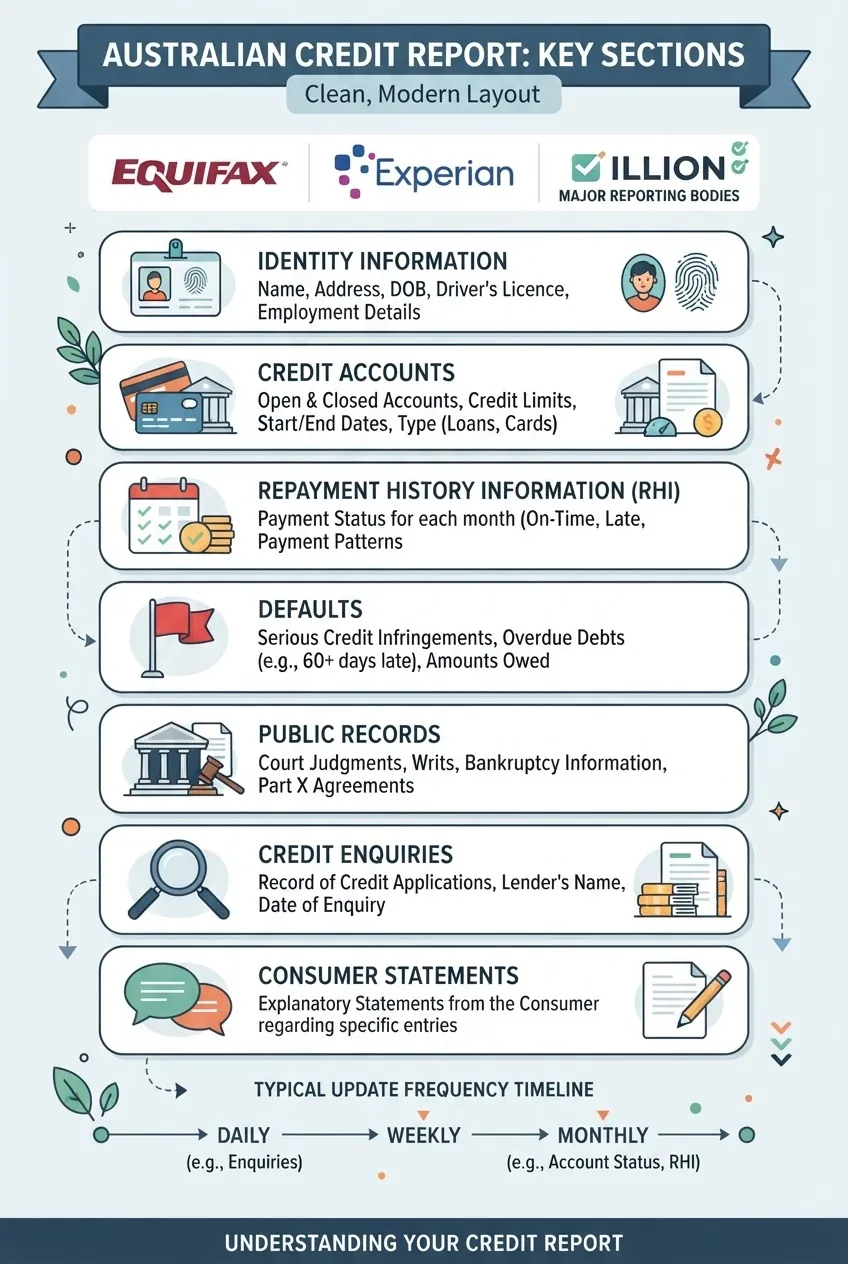
A credit report contains identity data, credit account details, repayment history, default or debt listings, public records and credit enquiries — together these items show how you manage credit.
Term: Credit report: the document or electronic file a CRB produces that summarises the credit history data it holds about a single individual.
Typical report sections (explained):
- Identity details — name, former names, current and past addresses, date of birth and identification numbers used for matching.
- Account details — type of account (credit card, personal loan, mortgage, store card), date opened, credit limit or original loan amount, balance and account status.
- Repayment history — regular snapshots or coded indicators that show on-time payments and late payments (often coded as 30/60/90+ days past due).
- Defaults and listings — formal default notices, statements of overdue debt placed on the file, and collection agency listings.
- Public records — court judgments, bankruptcy and insolvency notices, enforcement orders (if applicable).
- Credit enquiries — soft enquiries (pre-approvals, account reviews) and hard enquiries (applications for new credit) recorded by date and lender.
- Consumer statements — disputes or statements you add to explain circumstances (e.g., identity theft) that will appear with the file.
What is the difference between credit history and credit score?
A credit history is the raw record of accounts and behaviour; a credit score is a numeric summary calculated from that history to quantify credit risk.
Term: Credit score: a numeric value produced by a scoring model that predicts the likelihood a borrower will repay credit on time, derived from data in a credit history.
A credit history is qualitative and detailed — it lists dates, amounts and events; a credit score reduces that detail to a number (commonly 0–1,200 or 300–850 depending on the model) that lenders use in automated decisioning. Different scoring models and CRBs can produce different scores from the same history because they weight factors differently and some data may be absent from one bureau’s file.
| Feature | Credit History | Credit Score |
|---|---|---|
| Nature | Detailed chronological record | Numeric summary |
| Use | Lender review, dispute evidence | Automated scoring and pricing |
| Variability | Can differ by CRB reporting coverage | Varies by scoring model and CRB data |
How do lenders use credit history when assessing applications?
Lenders use credit history to assess default risk, set interest rates, determine credit limits and decide approval versus decline, combining it with income and employment data.
Key lending decisions influenced by credit history:
- Approval: serious defaults, recent bankruptcies or multiple recent hard enquiries commonly lead to declines.
- Pricing: a weaker history typically results in higher interest rates or fees to offset perceived risk.
- Credit limit: strong history and low utilisation often secure higher limits; poor history leads to lower limits or secured options only.
- Product fit: lenders may offer specialised credit builder products or secured loans when the history is limited or damaged.
Underwriting combines the credit file with documented income, living expenses and employment stability; some lenders run automated scoring rules first and then a manual review for borderline cases. Landlords and utility providers use simplified credit checks focusing on arrears, defaults and fraud indicators to decide tenancy or service bonds.
How long do negative items stay on a credit history in Australia?
Negative items remain on credit files for defined periods that vary by item type, commonly between five and seven years, after which they typically fall off automatically; exact terms depend on the item and reporting rules.
Common Australian timeframes (general guidance; confirm with your CRB):
| Item | Typical retention | Notes |
|---|---|---|
| Payment defaults / listings | Up to 5 years | Runs from listing or default date; may vary by CRB policy. |
| Court judgments | Commonly 5–7 years | Dependent on court registry reporting and state rules. |
| Bankruptcy/insolvency | Typically 3–7 years | Varies with type of insolvency and statutory periods. |
| Hard enquiries | Often 2 years visible, effect reduces sooner | Enquiries may remain visible but their scoring impact declines over time. |
If you believe an item remains on file beyond the permitted period, you should request the item be removed by disputing it with the CRB and the original data supplier; CRBs have obligations under privacy and credit reporting laws to correct or delete out-of-scope entries.
How can I check my credit history in Australia?
You can obtain your credit report from each credit reporting body—Equifax, Experian and illion—via online request; you are typically entitled to at least one free copy per year and after certain adverse actions.
Practical steps to check your file:
- Request your file from each CRB directly — use their online portals and verify your identity with driver licence or passport and past-address verification.
- Review identity details first to ensure there are no unfamiliar addresses or names that indicate a mixed or fraudulent file.
- Examine accounts for accuracy: check opening dates, balances, repayment history and whether closed accounts show as closed by you.
- Spot-check for duplicate entries, unfamiliar loans or hard enquiries that you did not authorise.
- Save or print copies and note dates to support any dispute you might lodge with the CRB or the data supplier.
If you have been refused credit, lenders must provide the reason and details of which CRB was used so you can request that specific report free of charge. Regularly checking all three CRBs reduces the risk of surprises because not all lenders report to every bureau.
How do I improve or build credit history?
You build or improve credit history by establishing and consistently managing a small number of credit accounts responsibly over time, using timely repayments and low utilisation to demonstrate reliability.
Step-by-step practical plan:
- Start with a low-risk account: a small credit card with a low limit or a credit-builder loan from a community lender; these create positive entries when managed well.
- Pay on time each month: set direct debits for at least the minimum payment; punctual payments are the single most influential behaviour.
- Keep utilisation low: aim to use less than 30% of available credit on revolving accounts, and ideally below 10% for best scoring outcomes.
- Maintain accounts long-term: length of credit history matters — keep older accounts open when they are cost-free.
- Limit hard enquiries: space new credit applications over months; multiple enquiries in a short period signal higher risk.
- Use alternative positive reporting: where available, ask rent, utility and phone providers to report positive payment history to CRBs.
- Monitor and adjust: check reports quarterly and adjust behaviour if late payments or high balances appear.
Example timeline (worked):
- Month 0: Apply for and open a secured or low-limit credit card; credit report shows new account.
- Months 1–6: Make full on-time payments and keep balance under 20%; two or three on-time payments generate early positive history.
- Months 7–12: Add a second small product (store card or small personal loan), continue timeliness; credit file begins showing payment patterns to scoring models.
- 12–24 months: Consistent behaviour typically produces measurable score improvements and increases lender confidence for larger products like car finance.
If you have little or no history, consider becoming an authorised user on a trusted family member’s card (where available) or taking a small, well-priced personal loan used as a savings-style credit-builder product; both accelerate the creation of recorded accounts.
How do I fix errors or disputed items on my credit history?
To fix errors, obtain the relevant credit report, identify incorrect entries, lodge a dispute with the CRB and the data supplier and follow the statutory complaint process if unresolved.
Clear steps to correct mistakes:
- Get a current copy of the credit report from the CRB that holds the item.
- Gather supporting evidence: account statements, proof of payment, identity documents, letters from lenders.
- Lodge the dispute online or in writing with the CRB, clearly identifying the item, why it’s incorrect and attaching evidence.
- Also notify the original data supplier (the bank or creditor) with your evidence and request a correction; this prompts a supplier-side investigation.
- CRBs and suppliers generally have statutory periods (often 30 days) to investigate and respond; request interim file notes documenting your dispute.
- If the CRB or supplier does not correct proven errors, escalate to the Office of the Australian Information Commissioner (OAIC) or your local financial ombudsman service for unresolved credit complaints.
Sample dispute points to include (short, factual): account number, date of disputed item, precise reason (e.g., “payment shown as late on 2024-03-12 — proof of payment attached”), and a request to correct or remove. Keep copies of every contact and confirmation number for escalation if needed.
How does credit history affect everyday outcomes beyond loans?
Credit history influences tenancy decisions, mobile and internet plan approvals, insurance pricing, employment background checks, rental bonds and utility connection conditions — not just loan approvals.
- Renting: landlords and property managers commonly check credit files for arrears and defaults; poor history can require a larger bond or decline tenancy.
- Utilities and phone plans: providers may require higher upfront deposits, temporary prepayments or refuse post-paid plans based on the credit file.
- Insurance: some insurers use credit-based insurance scores when pricing certain policies; a poor credit history can increase premiums.
- Employment checks: certain employers (especially in finance or security-sensitive roles) may request your credit file or a background check as part of hiring.
- Security clearances and leasing services: debt listings and recent insolvency records can be disqualifying for specific licences or contracts.
What are common myths about credit history?
Common myths include ‘checking my own credit hurts my score’, ‘closing old accounts improves my score’ and ‘you can erase negatives quickly’ — all are either false or only partly true.
Reality checks:
- Myth: Checking your own credit damages it. Fact: Soft checks you make yourself do not harm your score; only hard enquiries from lenders may have a small, temporary effect.
- Myth: Closing old accounts always improves your score. Fact: Closing long-standing accounts can reduce your average account age and available credit, sometimes lowering scores.
- Myth: Negatives can be removed instantly. Fact: Legitimate negatives remain until they legally expire or are proven incorrect; behaviour-based recovery requires time and consistent payments.
- Myth: Paying off a default removes it immediately. Fact: Paying the debt may not remove a default listing; it typically updates the status to ‘paid’ but the original event may remain visible for its retention period.
What are the typical costs for checking, monitoring or repairing credit?
Checking your official credit report is often free or low-cost; ongoing monitoring and paid repair services charge monthly or one-off fees with varying value — compare features and refund terms before buying.
| Service type | Typical cost | What to watch for |
|---|---|---|
| Single CRB report | Free–A$10 | Check identity verification rules and whether the copy is up-to-date. |
| All-bureau reports | A$10–A$40 (one-off) | Useful for comprehensive checks; confirm which bureaus are included. |
| Paid monitoring | A$10–A$30/month | Compare alert types, identity theft cover and cancellation terms. |
| Credit repair services | A$100–A$1,000+ (varies) | Many matters can be handled by you for free; only use reputable providers with clear guarantees. |
Tip: Free tools and DIY disputes typically resolve most errors; paid services are best for those who lack time or confidence but verify provider accreditation and complaint pathways before paying.
What legal protections exist for credit history and privacy?
Australian privacy and credit reporting laws give you rights to access your credit information, dispute incorrect data and require CRBs to correct or remove inaccurate entries within statutory timeframes.
Key protections and actions:
- Right to access: you can request your credit report and receive a copy, often for free under specific conditions (e.g., after a credit refusal).
- Correction obligations: if you show an entry is incorrect, CRBs must investigate and amend the file if the information is inaccurate.
- Complaint routes: unresolved disputes can be escalated to the OAIC or the relevant financial ombudsman for investigation and potential remedies.
- Identity protections: CRBs must implement reasonable steps to prevent identity mix-ups; always use proven identity documents when requesting reports.
Worked example 1: applying for a home loan with mixed credit history
Lenders evaluate the full file and your financial profile: a single historic default plus two years of clean payments may be acceptable at higher interest, while repeated recent defaults usually mean decline or strict conditions.
Scenario: Applicant A has one default from three years ago (A$2,000 defaulted card) and two years of on‑time mortgage and card payments since then. Income is stable and deposit is 20%.
- Lender assessment: automated decision flags the old default but sees two years of consistent on-time repayment and sufficient deposit; manual review required.
- Likely outcome: conditional approval at a higher rate (for example, 0.5–1.5% premium above prime offers) and a requirement for full documentation and explanation of the old default.
- What the applicant can do: provide evidence of paid or managed default, include a consumer statement on the file explaining mitigating circumstances and demonstrate strong savings behaviour to reduce perceived risk.
Worked example 2: renting with a short credit history
With limited credit history, property managers may ask for references, higher bond or a guarantor; demonstrating steady income, references and clean rental history often secures tenancy.
Scenario: Applicant B recently moved to Melbourne with two years of casual employment and minimal credit file (one small card opened six months ago).
- Landlord check: finds limited CRB data and some hard enquiries from recent applications; requests additional proof.
- Practical response: Applicant B supplies employer letter, pays a larger bond or offers a rent-in-advance arrangement, and produces character references to reassure the property manager.
- Outcome: tenancy approved with a modest additional bond; applicant continues to build file by paying utilities and the card on time to reduce future friction.
What should I do when I change address, name or close accounts?
Notify lenders and CRBs promptly when your identity details or addresses change, and keep accurate closure confirmations when closing accounts to avoid lingering active lines or mismatches.
Action checklist:
- Update lenders and service providers with your new address and request they correct their records with CRBs.
- When closing accounts, obtain written confirmation from the lender that the account is closed and paid in full; keep that document with your personal records.
- If you change name, provide certified identity documents to each CRB and lenders to prevent split or merged files.
- Regularly check your credit report after changes to confirm updates have been applied and no legacy entries persist.
How long does it take to build a good credit history?
Initial credit files form within months, meaningful credit histories typically require 12–24 months of consistent behaviour, and strongest histories often come after 3–5 years of on-time payments and low utilisation.
Typical milestones:
- 0–3 months: file created; lenders can see account openings and identity but scoring models have limited data.
- 3–12 months: repeat payments and at least several on-time records improve your profile enough for small loans or better card offers.
- 12–24 months: a routine of timely payment and diversified account types begins to produce more favourable scoring and lending outcomes.
- 3–5 years+: longevity, consistent repayment and responsible credit use are fully evident and attract the best rates and highest limits.
When should I contact a professional for credit help?
Contact a qualified financial counsellor, financial advisor or legal adviser when you face persistent debt, complex disputes, suspected identity theft or if a lender’s conduct appears unlawful; free community services exist for urgent help.
Who to contact and when:
- Financial counsellors: when you cannot meet repayments and need help negotiating with creditors — many services are free and community-based.
- Credit dispute specialists or a consumer lawyer: when complex errors, identity fraud or unresolved CRB complaints persist after initial steps.
- Community legal centres: for low-cost legal advice about bankruptcy, court judgments or enforcement actions.
Before paying for repair services, verify they are reputable, provide a written scope, and remember that you can lodge disputes and complaints yourself at no cost with CRBs and oversight bodies.
What should I monitor regularly on my credit history?
Regularly check identity details, new accounts, payment status updates, recent hard enquiries and any consumer statements or defaults so you can act quickly on errors or fraud.
Monitoring checklist (monthly/quarterly):
- New accounts or unexpected hard enquiries that could indicate identity misuse.
- Late payment codes or increases in balances approaching credit limits.
- Any new defaults or collection listings and the contact details of the data supplier.
- Accuracy of personal details — mismatched addresses or names may indicate file linking errors.
What internal resources can help me learn more about credit and improving it?
Use trusted educational guides and step-by-step resources to learn credit mechanics and build plans; read practical pages on building credit, understanding scores and credit repair from reputable financial literacy sites.
Recommended internal links for deeper reading:
- Personal Finance Tips and Money Management Advice Guide — broad money management guidance that complements credit work.
- How to Build Credit Guide with Tips for Good Credit History — practical, step-by-step actions to create positive credit entries.
- 735 Credit Score Guide with Range and Good Credit Info — explains score bands and what lenders typically view as ‘good’ credit.
Quick checklist: What to do this week to protect or improve your credit history
Do these five actions this week: get your current credit reports, set direct debits for all payments, reduce card balances, cancel unnecessary hard-application plans, and document any disputes.
- Request current reports from Equifax, Experian and illion and save copies securely.
- Set up automated payments for at least minimum amounts on every account.
- Pay down high credit card balances to lower utilisation.
- Pause new credit applications for three months unless essential.
- Make a dated file of any evidence you’ll need to dispute errors or support future loan applications.
When does credit history matter most?
Credit history matters most when applying for large or risk-assessed financial products — mortgages, car loans, business finance, rental agreements and some insurance or employment screenings.
Prioritise improving your file before:
- Making a mortgage application — even small improvements can affect interest rate and approval.
- Signing a long lease or entering finance for a car or household appliance.
- Opening multiple credit accounts in a short period, which can trigger lender caution.
How does identity theft affect credit history and what to do?
Identity theft can create unfamiliar accounts, missed payments or defaults on your credit file; respond immediately by disputing entries, freezing accounts if available and contacting creditors and CRBs.
Immediate actions:
- Request your credit report from all CRBs to identify fraudulent accounts or enquiries.
- Contact the affected lenders to freeze or close fraudulent accounts and ask them to notify CRBs.
- Lodge disputes with CRBs to flag the entries as fraud-related and attach identity-theft declarations and police reports if available.
- Consider a credit monitoring product while the situation is resolved and place additional identity protections (change passwords, notify businesses where identity was misused).
How does joint credit or a guarantor affect my credit history?
Joint credit and guarantor arrangements link your credit file to the other party’s account behaviour: missed payments or defaults can affect both parties’ histories and scores.
Important implications:
- Joint accounts: all named borrowers are recorded; diligent repayment by one party helps both, while defaults harm both.
- Guarantor roles: guarantors may be held liable and see entries on their file; lenders check guarantor credit histories before accepting responsibility.
- Before agreeing to joint credit or guarantor status, seek legal and financial advice and ensure you can manage potential liabilities.
How do lenders treat short-term missed payments versus long-term defaults?
Short-term missed payments (e.g., 30 days late) are usually tolerated if isolated and then remedied; long-term defaults and serial late payments signal higher risk and attract stronger lender responses.
Scoring and underwriting distinctions:
- Single short-term misses with subsequent recovery often reduce score a little but are outweighed by long-term positive behaviour.
- Repeated arrears or progression to 90+ days delinquency typically culminate in a default listing and substantial score penalties.
- Lenders prefer recent consistent performance; older negatives lose weight over time if followed by good behaviour.
How does immigration or moving countries affect credit history?
When you move to Australia, foreign credit histories usually don’t transfer — you will often start with a limited Australian credit file and need to build local credit evidence.
Practical steps for newcomers:
- Open a local bank account and apply for a modest credit product to start reporting positive activity to CRBs.
- Use utility accounts and mobile plans on your name where possible and ask providers if they report positive payment history.
- Provide foreign credit references to lenders if asked; some lenders consider international credit reports as supporting documentation but rely primarily on local data.
Summary: What is credit history and what should you do next?
Credit history is the factual record of how you manage credit and payments; to protect it, check reports from all CRBs, correct errors, build positive accounts responsibly and avoid repeated short-term borrowing spikes.
Immediate next steps recommended:
- Order your reports from Equifax, Experian and illion and review identity and account accuracy.
- Set up direct debits to prevent late payments and reduce credit utilisation.
- Plan any new credit applications carefully and spread them over time.
- Use the linked guides here to learn specific building and repair actions: How to Build Credit Guide and 735 Credit Score Guide.
Frequently Asked Questions
What is the difference between a credit report and a credit history?
A credit report is the document summarising the data a credit reporting body holds about you; credit history is the underlying sequence of events, accounts and behaviours that the report describes — the report is the snapshot, the history is the timeline behind it.
How often should I check my credit history?
Check your credit history from each major CRB at least annually and after any adverse credit decision, with quarterly checks considered best practice if you are actively applying for loans or concerned about identity theft.
Can paying off a debt remove a default from my credit history?
Paying a debt updates the item to show it is paid, but the original default entry may remain on the file for the statutory retention period; check your report after payment and dispute any incorrect or continuing listing with proof of repayment.
How long does it take to rebuild credit after a major negative event?
Recovery timelines vary: meaningful improvement often appears within 12–24 months of consistent on-time payments, while full restoration of a strong history commonly takes 3–5 years depending on the severity of the negative events.
Will checking my own credit history hurt my credit score?
No: soft enquiries or checks you initiate to view your own credit file do not harm your credit score; only hard enquiries from lenders during formal credit applications can have a small, temporary effect.
What should I do if I find identity theft on my credit history?
Immediately request full reports from all CRBs, contact the lenders with the fraudulent accounts, lodge disputes with CRBs marking items as fraud, file a police report if required, and consider credit monitoring until the issue is fully resolved.
Do utilities and phone bills appear on my credit history?
Utilities and phone companies do not always report positive payments but can report defaults or overdue accounts; some providers now offer positive reporting options — ask your provider if they contribute payment data to CRBs.
How many years of credit history do lenders usually care about?
Lenders typically evaluate the most recent three to five years in detail, focusing on recent repayment behaviour and any defaults or insolvency events; older positives still help but recent activity carries greater weight.