



Different credit scores happen because multiple scoring systems, credit bureaux and update schedules use slightly different data, formulas, and weightings; lenders may also use industry-specific or older scoring versions, so the same person can legitimately have several different numeric scores at the same time.
What exactly causes different credit scores?
Different credit scores are caused by variations in data, scoring models, timing of updates and lender-specific versions; each factor changes what information is included and how it is weighted, producing different numeric outcomes for the same borrower.
Credit score: a three-digit number that summarises credit risk based on a person’s credit report and a scoring formula.
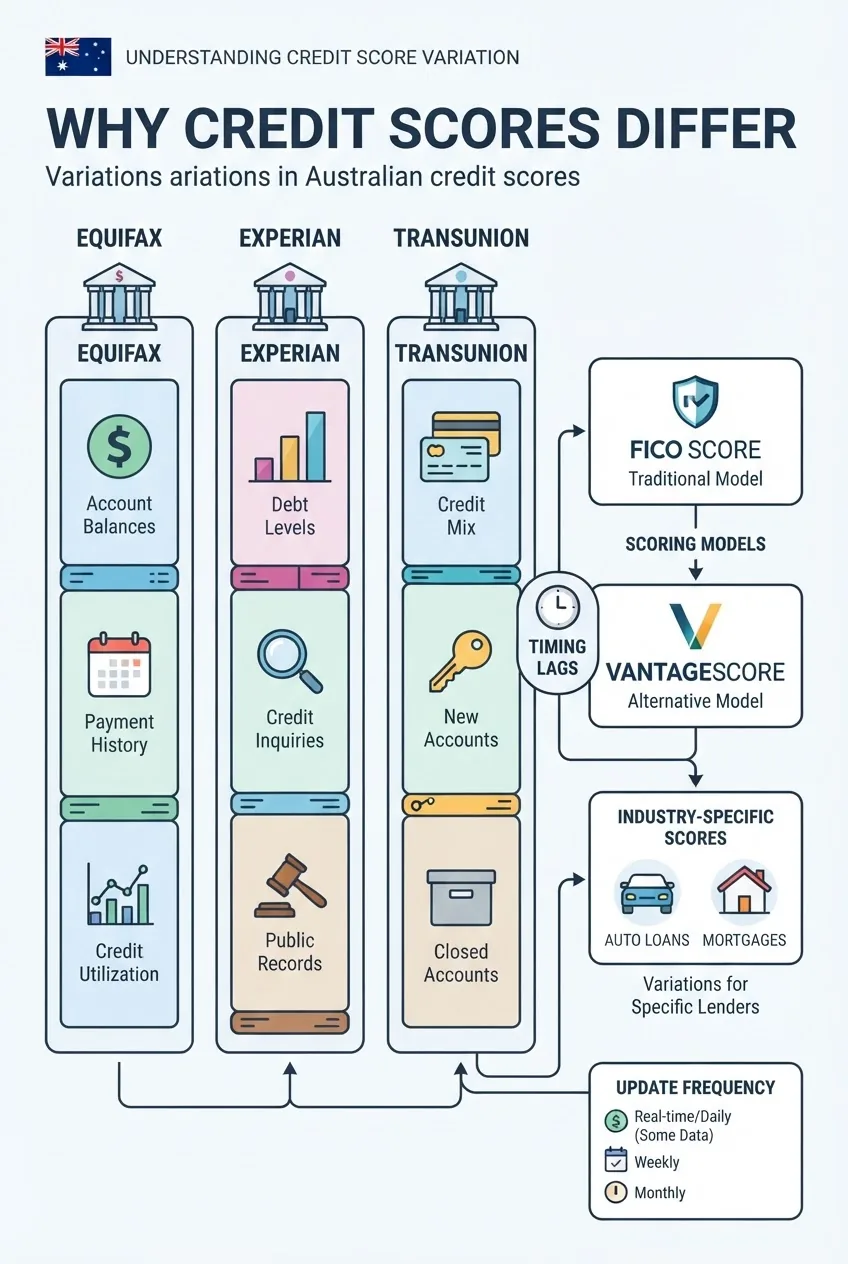
Elaboration: three main layers create differences. First, the raw data: each credit reporting bureau (Equifax, Experian, TransUnion in many markets) may hold slightly different accounts or payment histories because not all lenders report to every bureau and because of timing. Second, scoring models: FICO, VantageScore and proprietary lender models apply distinct formulas and weights to the same or similar data. Third, timing and updates: scores and reports update at different intervals, so a recent payment or new account may appear in one bureau’s file before another. Finally, lenders may use industry-adjusted scores (for auto loans, credit cards or mortgages) or older model versions, which intentionally shift weighting toward factors those lenders care about.
Which scoring models and score types create differences?
The main scoring models that produce different scores are FICO and VantageScore, plus bureau-specific and lender-specific proprietary scores and industry variants like FICO Auto Score or mortgage-specific versions.
FICO: a widely used credit scoring model developed by Fair Isaac Corporation with multiple versions tuned over time and by industry.
VantageScore: a competing scoring model created by the three major credit bureaux to provide an alternative, with its own versions and rules.
Comparison table: core score types, typical range and primary use. Rows have subtle zebra striping for readability.
| Score Type | Typical Range | Primary Use |
|---|---|---|
| FICO Score (general) | 300–850 | Most lenders for credit cards, personal loans |
| FICO Auto Score | 250–900 (varies by version) | Auto lenders; weighs repossessions, payment history differently |
| Mortgage-specific FICO (e.g., FICO 2, 4, 5) | 300–850 | Mortgage lenders and underwriting |
| VantageScore | 300–850 | Alternative model used by some lenders and services |
How do credit bureaux differences produce multiple scores?
Credit bureaux differences produce multiple scores because each bureau may contain different account lists, recorded payment dates, default notations and public-record entries, and they receive updates on varied schedules from lenders and courts.
Credit bureau: a company that collects and stores consumer credit data reported by lenders, utilities and public records.
Elaboration: not all lenders report to every bureau; for example, a local Australian lender or fintech may report to Equifax but not Experian. Some debts or defaults—like a court judgment, bankruptcy filing or utility arrears—are recorded differently or delayed. The technical result: your Equifax file might show a late payment from six months ago, while your TransUnion file shows the same account paid on time because one reports a corrected status later. When a scoring model reads these files, each model is applied to whatever data exists in that bureau’s file, producing different scores. Checking credit reports from all bureaus reveals which specific entries differ.”
What role do scoring model versions and weights play?
Model versions and weights change how score components are valued—newer versions may treat recent credit differently or penalise certain behaviour less—which means the same data can yield different scores under different model versions.
Model version: a numbered release of a scoring algorithm where factors and their weightings can change.
Elaboration: FICO has multiple versions (e.g., FICO 8, FICO 9, FICO 10) and speciality variants (Auto Score, Bankcard Score). Each version adjusts factor weights—how much payment history, credit utilisation, length of credit history, new credit and credit mix count—based on updated data science and lender feedback. For example, FICO 9 reduces the penalty for medical collections compared with FICO 8; FICO 10 adds trending calculations that emphasise recent behaviour. VantageScore likewise releases updated versions with different treatment for thin files or rent payments. Lenders choose which version to use based on their risk appetite, so identical borrower’s profiles can receive different numbers depending on the version applied.”
Do timing and update frequency change my reported scores?
Yes—timing and update frequency change scores because lenders report data at different intervals and bureaux process updates at varying speeds, so recent account activity may appear in one file before another, shifting scores temporarily.
Elaboration: typical reporting schedules vary—some lenders report monthly on a fixed day (statement closing date), others report irregularly; bureaux themselves index and refresh files on their own schedules. A new credit card opened and reported after your bank’s report date will increase your utilisation and decrease your score on that bureau until the other bureaux receive the same update. Similarly, paying off a balance or resolving a collection may not be reflected immediately everywhere. Expect temporary score spreads when accounts are opened, closed or when payments are recent; these spreads often resolve after one or two reporting cycles (30–90 days) once all systems are synchronised.”
How do hard inquiries, soft checks and promotional prescreens affect different scores?
Hard inquiries can lower scores and show on credit reports; soft checks do not affect scores but may be recorded differently across bureaux and services, contributing to apparent differences between your accessible score snapshots.
Hard inquiry: a credit check that occurs when a lender reviews your file for a new credit application and may lower your score slightly for a short time.
Soft check: a credit check for prequalification, account reviews or personal score checks that does not affect your credit score.
Elaboration: hard inquiries appear on the credit file that the lender chose to pull and will be visible to other lenders for up to two years, though their scoring impact fades in 3–12 months. Some scoring models treat multiple inquiries for the same loan type within a short window as a single inquiry (rate-shopping), but this window length varies by model. Soft checks—such as a background check by an employer or your own free score—often appear only on some bureau files or not at all. Because different services show different inquiry histories and because some lenders use versions that ignore certain inquiries, the visible inquiry count and the scoring impact can differ between files and models.”
Why do lenders sometimes report a different score than I see online?
Lenders may report a different score because they use a different bureau, model version, industry-specific scoring variant or purchase a score with proprietary adjustments, so their score and the free score you see can legitimately differ.
Elaboration: three pragmatic reasons explain this: 1) lender access: banks select which bureau to query and which scoring vendor to license; 2) model choice: mortgage underwriters commonly use older FICO versions like FICO 4 or 5 because those were historically validated for mortgage risk; 3) proprietary adjustments: some lenders layer internal risk factors or custom thresholds on top of the model to reflect business rules, pricing bands or regulatory requirements. Consequently, a prequalification score from a fintech may read 720 while the lender’s underwriting FICO says 690, and that difference can change the interest rate or approval decision.”
What is a credit report discrepancy and how does it create score differences?
A credit report discrepancy is any conflicting or inaccurate entry across bureau files—missing payments, wrong balances, duplicate accounts or identity mix-ups—and these discrepancies can materially change scores when models interpret the flawed data.
Credit report discrepancy: a mismatch or error on one or more credit bureau records that does not reflect the consumer’s accurate credit history.
Elaboration: common discrepancies include misreported late payments (dates or amounts), accounts listed as open when closed, old collections that should be removed, or even accounts that belong to someone else. Because scoring models heavily weight payment history and balances, a single misreported late payment or a wrongly flagged collection can move a score tens of points. Regularly pull and compare your reports from each bureau to find and dispute discrepancies; the dispute process requires documentation and can take 30–90 days to resolve. Correcting errors with a bureau typically updates that bureau’s file; other bureaux may need separate disputes if they hold different versions of the same error.”
How can I check and compare the different credit scores and reports I have?
Check and compare your different credit scores by requesting credit reports from every major bureau, noting the score type and version used, and keeping a dated log of account statuses and lender reporting dates to reconcile differences methodically.
Practical steps:
- Obtain your free credit reports from the bureaux that operate in Australia or the country of record; use the bureau’s consumer access portal or a central access service.
- Record the score number, model name (if shown) and the date the report was generated.
- List each account and compare balances, reported payment status and dates across the reports.
- Identify mismatches and prioritise disputes for items that have the largest scoring impact (late payments, active collections, bankruptcies).
- Maintain a calendar of lender statement dates and dispute deadlines to track when updates should appear.
Tools and services: many consumer platforms show an estimated VantageScore or a bureau-provided score, but they may not show the exact FICO version a particular lender uses; if you need the precise underwriting score, ask the lender which bureau and model they use and request a copy from that bureau.”
How do I dispute errors and which differences are urgent to fix?
Dispute errors by filing a claim with the bureau holding the incorrect data, providing supporting documents, and following up with the lender; urgent items to fix are late payments, active collections, identity errors and bankruptcies because they have the largest negative effect on scores.
Dispute process: the formal method for contesting a credit report entry with a bureau, which includes submitting evidence and waiting for investigation results.
Step-by-step dispute priorities:
- Urgent: identity theft or someone else’s account on your report—request immediate removal and provide proof of identity.
- High priority: active negative entries like recent late payments, defaults and collections—dispute with evidence of payment or correspondence.
- Medium: inaccurate balances or closed/open status mismatches—contact the lender directly and copy the bureau.
- Lower: older accurate negatives nearing statutory time limits—monitor for automatic removal but keep records.
Timing and evidence: include account numbers, screenshots of payment confirmations, bank statements and written letters; keep copies. Bureaux usually investigate within 30 days, but complex disputes or public-record corrections may take longer. If a bureau finds the item unverifiable, it must remove or correct it—this can change your score on that bureau immediately but may not alter other bureaux’ files unless they independently make corrections.”
Which score differences matter most for approvals and pricing?
The score difference that matters most is the score the lender uses for the decision—small spreads (5–20 points) rarely change outcomes, but gaps of 20–50+ points can move you between risk bands and change approval odds or interest rates materially.
Elaboration: lenders establish cut-offs and pricing tiers; moving across a threshold (for example, from “prime” to “near-prime”) can result in higher interest rates or declined credit. Industry-specific scores can be the decisive figure: an auto lender may rely on a FICO Auto version, while a mortgage lender uses mortgage-specific FICO versions. For big-ticket borrowing (mortgage, car loan) verify which bureau and score the lender will use early in the process and ask whether they apply overlays or manual underwriting that could negate the numeric difference.”
How can I reduce score variability across bureaux and models?
Reduce score variability by ensuring consistent, timely payments, lowering credit utilisation, keeping old accounts open, limiting new credit applications, and synchronising corrections across all bureaux through disputes and lender notifications.
Actionable tactics:
- Pay on time every month and, when possible, multiple times per cycle to reduce reported balances.
- Keep credit card utilisation under 30% and aim for under 10% for best outcomes across models.
- Avoid closing long-standing accounts; length of history matters to many models.
- Stagger applications and allow for rate-shopping windows when seeking a single loan to prevent cumulative inquiry effects.
- If you correct an error with a lender, ask them to re-report to all bureaus; follow up with separate disputes if necessary.
Are there costs or services that align scores faster?
Some paid services promise to align or boost scores faster by disputing errors, negotiating with creditors, or submitting proof of rent and utilities, but many changes simply require time and accurate reporting; chargeable services vary in cost and effectiveness.
Comparison table: common paid approaches, typical cost range and expected speed.
| Service | Typical Cost (AUD) | Expected Time to Impact |
|---|---|---|
| DIY disputes with bureaux | Free | 30–90 days per dispute |
| Paid credit repair firms | $100–$1,000+ one-off or monthly | 30–180 days depending on issues |
| Rent/utility reporting services | $10–$30/month | 1–3 months to reflect in scores |
| Experian/Equifax subscription scores | Free–$25/month | Immediate for the snapshot provided; may not match lender score |
Caveat: some paid services engage in tactics like repeatedly sending disputes that can sometimes produce removals but also lead to re-insertion of items if not substantiated; choose reputable providers and prioritise correcting factual errors directly with lenders when possible.”
Can I predict which score a lender will use before applying?
You can usually predict which score a lender will use by asking them directly which credit bureau and scoring model/version they access and whether they apply industry-specific variants or overlays, but some lenders treat this information as internal policy and may not disclose specifics.
Practical approach:
- Ask the lender: “Which credit bureau and scoring model/version will you use for underwriting?”—some will answer.
- Check the lender’s online application FAQ or terms; larger institutions often disclose the bureau (Equifax, Experian, TransUnion).
- Call or visit a branch and request the precise score name; if they refuse, ask whether credit decisions are automated or manually underwritten.
- For mortgages and cars, expect industry-specific FICO variants; for credit cards, expect general FICO or bureau-provided scores.
If you cannot get the exact model, use a conservative planning approach: assume a lender may use the lowest of your recent bureau-provided scores for risk-sensitive pricing and prepare accordingly.”
What are worked examples showing how the same data yields different scores?
Worked examples show how small data differences produce score spreads: a 30-day late payment, differing reported balances, or an extra hard inquiry can move scores by 10–50 points depending on model sensitivity and bureau file differences.
Example 1 — recent late payment:
- Borrower A has otherwise excellent history with 800+ scores on two bureaux but one bureau has a single 30-day late payment reported from last month.
- FICO 8 may subtract 25–45 points for a recent late payment depending on account size; VantageScore might treat that late as less severe, subtracting 10–30 points.
- Result: scores of 790, 760 and 775 across three bureaux/models are plausible.
Example 2 — high reported utilisation on one bureau:
- Borrower B uses two credit cards. One bureau shows a $4,500 reported balance (95% utilisation) because the card issuer reported before payment, while another bureau shows $300 (6% utilisation) because it received an updated balance post-payment.
- Utilisation is heavily weighted; the high reported balance can reduce scores by 30–80 points on that bureau until the lower balance is reported.
- Result: wide spread until reporting catch-up occurs after the next cycle.
Example 3 — multiple inquiries and loan shopping:
- Borrower C applies for several credit products in short order. Some models group similar-purpose inquiries for rate-shopping and count them as one, while others do not.
- A model that groups inquiries reduces the apparent inquiry penalty and may show a higher score compared with a model that counts each inquiry separately.
- Result: 5–15 point differences can appear depending on model grouping rules.
How long do differences usually take to converge into a single score?
Differences generally take 30–90 days to converge after corrective action or after a reporting cycle, but corrections to public records or dispute-driven removals can take longer—sometimes 3–6 months—depending on complexity and bureau workflow.
Timing factors:
- Routine updates: monthly lender reporting typically synchronises within one billing cycle (30–45 days).
- Disputes: bureau investigations usually complete in 30 days, but if the lender re-verifies or legal records are involved, expect 60–90 days or more.
- Public-record corrections: court or registry updates (bankruptcy, judgment rescindments) may take months to propagate.
- Staggered reporting by lenders: if a lender reports only quarterly or irregularly, convergence can take multiple months.
What should I tell a lender if my scores differ from my expectation?
Tell the lender you have reviewed your credit reports, describe any known discrepancies and request which bureau and score model they will use; supply documentation for corrected items and ask whether manual underwriting or additional factors will influence the decision.
Practical script:
- “I reviewed my credit report and found [describe discrepancy]; can you confirm which bureau and score model you’ll use for underwriting?”
- Provide proof of payments or corrected statements and ask the lender to consider those documents if manual review is possible.
- If the lender will not proceed, ask for eco-friendly alternatives: secured credit, a guarantor or re-application after 60–90 days once reporting has stabilised.
How do identity issues or mixed files create different credit scores?
Identity issues or mixed files (where another person’s accounts are linked to yours) can create materially different scores because one bureau file may include foreign accounts or derogatory items that the other bureaux do not, drastically altering model outputs.
Mixed file: a credit file that combines elements from two different consumers’ records due to similar names, addresses or identifiers.
Elaboration: mixed files often occur when names are common, addresses are reused or identification numbers are entered incorrectly. These errors can result in sudden score drops when an unexpected collection or bankruptcy appears on one bureau’s report. If you suspect a mixed file, collect identity evidence—driver licence, passport, utility bills—and contact the bureau immediately to request a merged separation or correction. Serious identity theft requires fraud alerts and sometimes police reports; bureau remediation processes differ, so begin with the bureau showing the incorrect items.”
Should I monitor multiple credit scores or focus on one?
Monitor multiple credit reports and at least one reliable score to understand the full picture, but focus your improvement actions on behaviours that benefit all models (on-time payments, low utilisation and accurate reporting) rather than chasing a single vendor’s snapshot.
Monitoring strategy:
- Obtain free reports from each bureau at least annually and after any major life change (new mortgage, loan, identity event).
- Use a reputable monitoring service or bureau subscription for monthly snapshots if you apply for credit frequently.
- Pay attention to the bureau and model a given service displays—if it’s not the lender’s model, treat it as an estimate.
- Focus on durable behaviours (payments, low balances) because these actions raise scores across all mainstream models and bureaux.
Where can I learn more about what affects my credit score?
Learn more by reviewing the factors used by major scoring models: payment history, credit utilisation, length of history, new credit and credit mix, and consult the pillar and sibling guides in this site’s financial literacy section for deeper tactics and examples.
Internal resources:
- Personal Finance Tips and Money Management Advice Guide — contextual pillar resource.
- 735 Credit Score Guide with Range and Good Credit Info — for score thresholds and what lenders view as good credit.
- How to Fix Credit Score Guide — step-by-step repairs and dispute guidance.
- What Affects Your Credit Score Guide — deep dive on factor weights.
Frequently Asked Questions
Why do I get different credit scores from Equifax and Experian?
You get different scores because Equifax and Experian hold slightly different data sets and may apply different scoring models or versions; timing of lender reports and the presence or absence of specific accounts or public records cause these numeric differences.
Can fixing one bureau’s errors improve all my credit scores?
Fixing one bureau’s errors improves that bureau’s score immediately after correction, but other bureaux may still hold the error until corrected separately; ask lenders to re-report to all bureaux and file disputes where necessary to achieve alignment.
How long after paying a debt will all my scores reflect the change?
Most bureaux update within 30–90 days after the lender reports the payment, but complex disputes or public-record corrections may take 60–180 days to propagate fully to every bureau and scoring model.
Do soft credit checks ever show up on lender reports and change decisions?
Soft checks usually do not affect credit scores and rarely influence lender underwriting, but they may appear on certain bureau files or prequalification tools; only hard inquiries are commonly used in risk calculations for new credit.
If the lender uses a different score, can I ask them to use mine?
You can request it, but lenders generally use their chosen bureau and scoring model for underwriting; providing documentation and requesting a manual review are more effective than asking them to accept a consumer-facing score.
Are industry-specific scores like FICO Auto or mortgage scores really different?
Yes—industry-specific scores are tuned to emphasise risk factors relevant to that loan type and can differ materially from general-purpose scores, so expect divergent outcomes between an auto score and a mortgage underwriting score.
What are the fastest actions that reduce score variability?
Fastest actions are paying down credit card balances before statement dates, making on-time payments, and correcting clear report errors with documentation; these steps typically reduce variability within one to two reporting cycles.