



A free financial advisor provides no-cost financial guidance and planning help from community services, workplace programs, robo-advisors with free tiers, or pro bono advisers; they can review budgets, suggest debt and savings actions, and point to next steps but may not offer full, regulated financial planning or product recommendations without charge.
What exactly is a free financial advisor and what can they do for me?
Answer: A free financial advisor gives financial guidance or limited advice at no monetary cost, typically for basic budgeting, debt management, or education, not always a full regulated financial plan.
Financial advisor: a professional who gives personalised recommendations on money matters such as budgeting, investments, insurance or retirement.
Free financial advice: guidance or recommendations delivered without a client fee (may be limited in scope or follow-up).
Free advisers operate across several models: community organisations and government services offer non-commercial guidance; employers or unions run workplace financial wellness programs; charitable clinics and universities provide supervised student advisers; some fintech companies and robo-advisors provide basic planning tools and algorithmic recommendations at no charge. Free advice commonly covers:
- Budget creation and cash-flow reviews.
- Debt prioritisation and repayment strategies.
- Superannuation basics and contributions guidance (high-level).
- Education on financial products and referral to regulated planners for complex needs.
Free advisers often do not provide regulated product advice (for example, recommending a specific managed fund or insurance policy) unless they are authorised and charge for that service; expect scope limitations and referral pathways to paid planners for complex strategies.
Who offers free financial advice in Melbourne and online?
Answer: Free financial advice in Melbourne is available from government services, community legal centres, non-profits, university clinics, employer programs, and some online platforms and robo-advisors with free tiers.
Robo-advisor: an automated online service that uses algorithms to recommend or manage investments.
Common providers and where to find them:
- Government and state financial counsellors (free, regionally delivered) — search local council and state community services.
- Community legal centres and financial counsellors — often offer free debt and hardship advice in-person and by phone.
- Non-profit organisations (e.g., financial capability charities) providing workshops and one-on-one sessions.
- University financial planning clinics — supervised student advisers give low-cost or free sessions.
- Employer financial wellness programs — company-run sessions for employees covering budgeting and superannuation.
- Online tools and fintech apps — budgeting apps and robo-advisors often provide free advice modules.
To locate Melbourne-specific services, contact your local council community support line, search for “financial counsellor Melbourne” or use the Australian Securities & Investments Commission (ASIC) and community legal centre directories for verified free services.
What specific services are commonly provided free and what’s usually excluded?
Answer: Free services usually include budgeting, debt prioritisation, basic superannuation guidance and referrals; excluded are detailed financial plans, tailored investment advice, insurance product recommendations and regulated product execution.
Typical free offerings:
- Budget worksheets and cash-flow review.
- Debt prioritisation plans and hardship negotiation guidance.
- High-level explanations of superannuation, tax basics and simple retirement modelling.
- Workshops, webinars and educational materials on financial literacy.
- Referrals to pro bono or low-cost regulated advisers when needed.
Common exclusions from free services:
- Comprehensive financial plans that model multiple scenarios, tax optimisation and asset allocation tailored to long-term goals.
- Regulated product advice (specific investment picks, insurance policies) that require licensing or remuneration disclosure.
- Ongoing portfolio management, secure custody or platform administration.
If a free advisor offers to sell you a financial product during or after a free session, request full disclosure of commissions and consider pausing to seek a regulated, paid planner if the recommendation affects long-term wealth or tax positions.
How does free financial advice differ from paid financial planning advice?
Answer: Free advice is usually limited in scope and educational; paid financial planning offers comprehensive personalised strategies, regulatory protections, and ongoing implementation services.
Comprehensive financial plan: a detailed written strategy covering goals, cash flow, investments, insurance, tax and retirement projections tailored to an individual.
| Feature | Free Advice | Paid Financial Planning |
|---|---|---|
| Scope | Limited, educational or single-issue | Comprehensive, multi-issue |
| Personalisation | High-level, generic | Customised using detailed data |
| Regulatory protections | Varies; often none if not licensed | Adviser licence, disclosure and oversight (FASEA/ASIC) |
| Cost | Free to user; provider may have other motives | Fees (flat, hourly, percentage of assets under advice) |
| Implementation | User-led or referrals | Adviser can implement and manage including paperwork |
If you need a written statement of advice (SoA), product execution or tax-optimised investing, expect to pay; free services excel when you need education, triage or simple budgeting plans.
How do I find and evaluate a reliable free financial advisor?
Answer: Search verified community, government or university services, check credentials and disclosures, confirm scope in writing, and compare multiple sources before acting on recommendations.
Fiduciary: an adviser legally obligated to act in your best financial interests (in Australia, this concept informs standards but legal tests vary).
Evaluation checklist:
- Source verification — prefer government, registered charity or university clinic over unknown commercial ads.
- Ask about licensing — does the adviser hold an Australian Financial Services (AFS) licence or work under a licensed firm?
- Clarify scope and deliverables — get the exact services, follow-up and any future fees in writing.
- Conflict of interest disclosure — ask whether the adviser receives commissions, referral fees or product incentives.
- Proof of training or supervision — student clinics should be supervised by a licensed planner; volunteers should have clear oversight.
- References and reviews — check community feedback and independent reviews where available.
Red flags:
- Pressure to buy a financial product immediately.
- Vague answers about licensing, fees or conflicts.
- Requests for unusual access to bank accounts or asking to move funds to unknown platforms.
When should I accept free advice and when should I pay for a professional?
Answer: Use free advice for education, budgeting, debt triage and basic superannuation questions; pay for a regulated, paid planner when you need detailed tax strategies, investment selection, insurance reviews, or estate planning.
Decision guide:
- Accept free advice when: you need to understand options, create a basic budget, prioritise debts, or get initial referrals.
- Pay for advice when: your situation involves large assets, complex tax issues, business ownership, trusts, or when product advice and implementation are required.
- Consider a hybrid: start with free guidance to prepare documentation, then engage a paid adviser for formal SoA and implementation.
Cost benchmarks (Australia, indicative):
| Service | Typical paid fee | When to choose paid |
|---|---|---|
| Initial advice session | $150–$400 | When you need detailed recommendations |
| Comprehensive financial plan (SoA) | $1,500–$6,000+ | Complex portfolios, tax or retirement planning |
| Ongoing advice & management | 0.5%–1.5% p.a. of AUA or flat monthly fee | Active investment management or periodic reviews |
Use free help for stage-one clarity; if projected benefits exceed the cost of paid advice (e.g., tax savings, consolidation benefits), paying for a planner can be cost-effective.
How do free online financial advisors and robo-advisors work?
Answer: Free online advisors and robo-advisors use questionnaires and algorithms to return high-level recommendations or automated portfolios often with optional paid services for personalised advice or execution.
How they operate:
- Onboarding questionnaire: collects goals, timeframe, risk tolerance and basic finances.
- Algorithmic analysis: software maps responses to recommended asset allocations or action steps.
- Free tier outputs: sample portfolios, savings targets, budget suggestions or basic retirement projections.
- Paid upgrades: human advice, product execution, tax-loss harvesting or additional features.
Advantages:
- Low or zero cost to start, quick digital access, useful for straightforward investing or saving plans.
- Good for those comfortable with self-implementation and preferring automated rebalancing.
Limitations:
- Lack of nuanced, personalised advice for complex tax, estate or business situations.
- Algorithmic outputs depend on data quality; questionnaire errors lead to poor recommendations.
Step-by-step: How to get planning help from a free financial advisor
Answer: Prepare documents, choose a verified free provider, clarify scope, attend the session with clear goals, get a written summary and follow up with referrals if necessary.
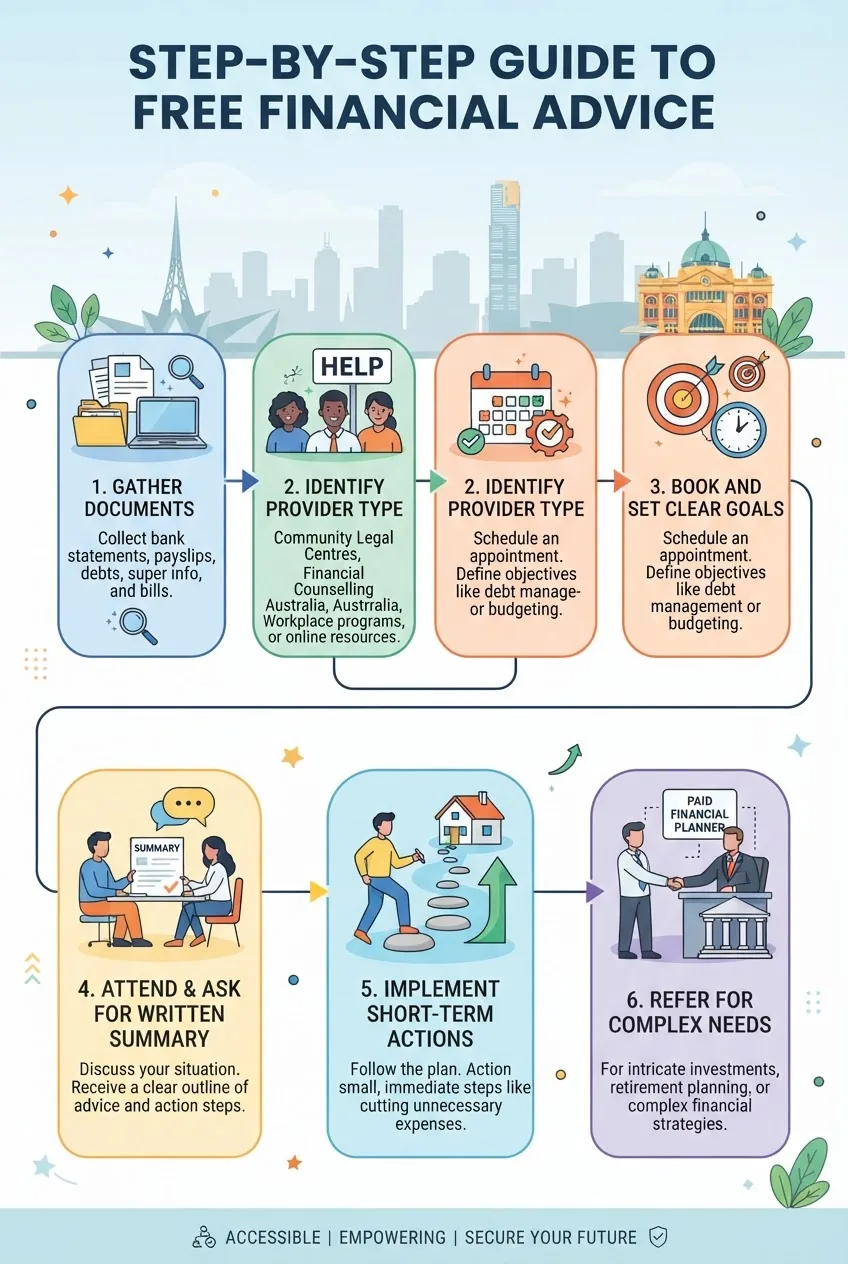
Preparation checklist before the session:
- Documents: recent bank statements, payslips, utility bills, loan statements, superannuation statements and any existing insurance policies.
- Goals: write 1–3 clear objectives (e.g., reduce credit card debt to $0 in 12 months, build three-month emergency fund, understand superannuation consolidation).
- Questions: prepare specific questions about fees, conflicts, timelines, and what you can implement yourself.
- Expectations: confirm whether the session will produce a written summary and whether product recommendations are part of the scope.
During the session, request:
- A clear statement of what the adviser is authorised to do.
- Any referrals or follow-up actions in writing (email or printed document).
- Names and positions of supervisors if the adviser is a student or volunteer.
After the session, prioritise the actionable items, track progress monthly, and escalate to a paid, licensed planner if you encounter complex tax, investment or estate decisions.
Worked example: building a budget and emergency fund with free advice
Answer: A free advisor can help create a zero-based budget and a staged emergency fund by reallocating recurring discretionary spending and setting automatic transfers to a savings account; this example shows precise numbers and timelines.
Scenario:
- Single Melbourne resident, net monthly income: $4,200.
- Monthly fixed costs: rent $1,600; utilities and phone $220; groceries $600; transport $200; minimum debt payments $450.
- Discretionary: eating out $350; subscriptions $80; entertainment $120; unexpected spending buffer $50.
Objective: build a 3-month emergency fund (target = 3 × essential fixed costs excluding discretionary = 3 × (rent + utilities + groceries + transport + debt payments) = 3 × ($1,600+$220+$600+$200+$450) = 3 × $3,070 = $9,210.
Free advisor actions and calculations:
- Zero-based budget: allocate every dollar: start with net income $4,200 and subtract fixed essentials $3,070 = $1,130 remaining.
- Reduce discretionary: propose cutting eating out from $350 to $150 (saving $200) and pause two subscriptions ($40 saved) and reduce entertainment by $50. Total discretionary savings = $290.
- Allocate full remainder and savings to emergency transfers: $1,130 + $290 = $1,420 per month to savings.
- Time to target: $9,210 ÷ $1,420 ≈ 6.5 months — rounding to 7 months to include small irregularities.
Outcome: with these changes implemented via automatic weekly transfers to a high-interest savings account, the client reaches the 3-month emergency fund in ~7 months without paying for a planner; a paid planner could refine tax or investment placement once the emergency fund is complete.
Worked example: debt repayment plan using free financial advice
Answer: Free advice can produce a prioritised repayment plan (snowball or avalanche), negotiate hardship arrangements, and project savings from interest reduction; this example compares two payoff strategies with exact numbers.
Scenario:
- Credit card A balance $6,000 at 18% p.a. interest; minimum payment 2% or $120.
- Personal loan B balance $10,000 at 8% p.a.; minimum payment $220.
- Available extra repayment capacity from budget changes: $500/month.
Compare two strategies:
| Strategy | Order | Estimated payoff months | Approx interest saved |
|---|---|---|---|
| Avalanche (highest rate first) | Pay Card A first, then Loan B | Card A ~5 months, Loan B additional ~20 months | Higher interest saved vs snowball (est. several hundred dollars) |
| Snowball (smallest balance first) | Pay Card A then Loan B | Similar timing for these balances; behaviourally easier | Slightly less interest saved but higher motivation |
Simple calculation for avalanche: allocate minimums ($120 + $220 = $340) plus extra $500 = $840 to high-rate account first (Card A). Monthly payment to Card A becomes $120 + $500 = $620. Using an amortisation approximation, $6,000 at 18% with $620/month finishes in ~11 months if ignoring compounding details—however, more realistic calculators show ~10–12 months; the free adviser will use exact calculators and negotiate hardship rates if needed.
Worked example: retirement savings plan with free advice and when to upgrade
Answer: Free advice can project a retirement shortfall using simple growth assumptions and recommend contribution changes or consolidation; pay for a licensed planner when tax optimisation and specific product choices become material.
Scenario:
- Age 40, current super balance $80,000, current annual employer contributions 9.5% on salary $85,000 (approx $8,075), personal after-tax contributions $0, five-year goal to increase voluntary contributions to $3,000/year.
- Assume nominal growth 5% p.a. net of fees and inflation ignored for simplicity.
Projection using free guidance:
- Use a compound growth formula: Future value = Present × (1+r)^n + contributions × [((1+r)^n – 1)/r].
- Present super: $80,000 × (1.05)^25 ≈ $80,000 × 3.386 = $270,880.
- Employer annual contributions: $8,075 × [((1.05)^25 – 1)/0.05] ≈ $8,075 × 52.72 ≈ $425,866.
- Voluntary contributions after 5 years moving to $3,000/year: conservatively estimate additional $3,000 × 52.72 ≈ $158,160 over 25 years if starting immediately; if staged, proportions adjust.
- Estimated total at retirement ≈ $855,000 (approximate and illustrative).
Free advice value: gives a high-level projection and actions such as increasing voluntary contributions, consolidating multiple super funds to reduce fees, and reviewing insurance through super. Upgrade to paid planning when you need tax-effective strategies (concessional vs non-concessional caps), transition-to-retirement tactics, or personalised asset allocation given risk tolerance.
What are the legal and regulatory considerations in Australia for free financial advice?
Answer: Check whether advisers hold or operate under an Australian Financial Services (AFS) licence, understand disclosure obligations, and use ASIC and FASEA guidance to confirm qualifications and complaint pathways like AFCA.
AFS licence: authorisation issued to firms allowing provision of financial services in Australia under supervision and reporting obligations to ASIC.
Important points:
- Licensed status: regulated product advice must be provided by someone operating under an AFS licence; free advisers may provide general information without licence but must avoid specific product recommendations unless authorised.
- FASEA and training: financial planners must meet education and ethical standards; ask whether the adviser meets current FASEA requirements when seeking personal advice.
- Complaint resolution: regulated advice clients can use the Australian Financial Complaints Authority (AFCA) for disputes; free, unregulated advice from volunteers may not be covered by the same remedies.
For authoritative guidance on licensing and consumer protections, consult the regulator: https://asic.gov.au.
Are there costs or catches to ‘free’ financial advice I should know about?
Answer: Yes — free advice may include conflicts of interest, limited scope, upselling, product referrals with commissions, or data harvesting; always confirm disclosures and get a written summary before implementing major changes.
Common catches and mitigations:
- Referral commissions: free advisers may refer you to paid services that provide the adviser with referral fees; ask for explicit disclosure.
- Limited liability: volunteers or students may not carry professional indemnity comparable to paid advisers.
- Data privacy: free online tools may collect financial data; review privacy policies before uploading statements.
- Upselling: expect offers for paid upgrades — evaluate independently before purchase.
Mitigate risk by verifying provider credibility, avoiding immediate product purchases during the first session, and comparing any product recommendation from a paid, licensed adviser before committing large sums.
What are best practices to prepare for and follow up after a free advice session?
Answer: Prepare documents and clear objectives, record the session’s actionable steps in writing, set short-term milestones, and schedule a review; escalate to paid advice if complexity or product recommendation arises.
Before the session:
- Collect bank statements, payslips, loan accounts, mortgage summary, superannuation statements and ID.
- Set precise short-term goals (3–12 months) and one long-term goal.
- List three priority questions to use the session time efficiently.
During the session:
- Ask for scope, supervision, conflicts and expected deliverables.
- Request a short written action plan or email summary.
After the session:
- Implement one high-impact action within seven days (e.g., set up an automatic transfer, contact a lender for hardship options).
- Track progress in a simple spreadsheet or app and schedule a follow-up or referral if necessary.
- If product recommendations are made, take 48–72 hours to seek a second opinion from a licensed adviser or comparison resources.
How to protect yourself from poor or fraudulent advice when using free services
Answer: Verify credentials, insist on written scope and disclosures, avoid immediate product purchases, never give account access, and use regulator or community-recommended services.
Practical safeguards:
- Verify the organisation: government, registered charity, university or employer programs are usually safer than unknown commercial ads.
- Insist on written scope: what is included, who supervises, and what follow-up is provided.
- Never share login credentials or authorise fund transfers during a free session.
- Check the regulator’s registers or look for institutional logos (e.g., local council, university clinic) and confirm via the institution’s official website.
What tools and free resources should I use alongside a free financial advisor?
Answer: Use budgeting apps, free retirement calculators, ASIC’s MoneySmart tools, robo-advisor simulators, and government or non-profit financial counselling hotlines to validate advice and implement actions.
Recommended tool categories:
- Budget and cash-flow apps — track spending and automate transfers.
- Retirement and superannuation calculators — high-level projections you can show your adviser.
- Debt payoff calculators — compare avalanche vs snowball strategies numerically.
- Online investment simulators — for simple portfolio education before committing funds.
- ASIC MoneySmart resources and community legal centre directories for Australian consumers.
Link to related guides on this site for in-depth how-to and calculators: see our Personal Finance Tips and Money Management Advice Guide, the 735 Credit Score Guide, and the Debt Management Program Overview.
What common questions should I ask during a free financial advice session?
Answer: Ask about the adviser’s authority, scope of the session, conflicts of interest, whether you’ll get a written summary, follow-up options, and referral pathways to licensed planners.
Suggested question list:
- Are you a licensed adviser or supervised by a licensed firm?
- What exactly will we cover in this session and what is excluded?
- Will I receive a written summary or action list?
- Do you receive commissions or referral fees for products you recommend?
- Can you provide references or confirm your supervision/training?
- What are your recommended next steps if I need product-specific advice?
How to transition from free advice to paid financial planning if needed
Answer: Use free advice to prepare documents and clarify goals, obtain a formal referral or summary, request fee estimates from at least two licensed planners, and compare scope, credentials and value before engaging.
Transition steps:
- Gather the written summary from the free session and list outstanding questions requiring regulated advice.
- Request referrals to licensed planners or use the FPA/ASIC directories for qualified professionals.
- Ask potential paid planners for a clear fee structure, sample SoA outline and references.
- Compare costs vs expected financial benefit before committing to a comprehensive plan.
Keep your free adviser’s short-term actions active while you evaluate paid options; many clients benefit from a staged approach rather than immediately purchasing a comprehensive plan.
Where can I find more learning resources and deeper reading on financial planning?
Answer: Read regulators’ guides (ASIC MoneySmart), professional association resources, and targeted guides on this site such as our pillar page and sibling articles for credit, debt and investing basics.
Internal resources:
- Personal Finance Tips and Money Management Advice Guide — pillar resource for broader financial literacy.
- 735 Credit Score Guide — credit score context and improvement steps.
- Debt Management Program Overview — structured programs and requirements.
- Investment Basics Guide — beginner investment concepts and accounts.
External official resources: ASIC MoneySmart and the Australian Financial Complaints Authority (AFCA) provide guidance on consumer rights, complaint pathways and licensed adviser registers; consult those sites when verifying providers.
Frequently Asked Questions
What exactly can a free financial advisor do for me in one session?
They can review your immediate financial picture, create a basic budget or debt-priority list, provide educational guidance, and give referrals; expect a written summary only if the provider offers one and avoid expecting product-specific recommendations unless formally licensed.
Is online robo-advice truly free and safe for Melbourne residents?
Many robo-advisors offer free educational tools and basic portfolio suggestions; safety depends on the platform’s licensing and data protections—use platforms with clear disclosure, and treat free robo-advice as high-level guidance, not tailored financial planning.
Can a free financial advisor negotiate with my lenders or creditors?
Free financial counsellors often negotiate hardship arrangements and payment plans on your behalf; confirm the service’s remit and any need for written authorisation, and prefer accredited financial counselling organisations for formal negotiations.
When is it necessary to hire a paid financial planner instead of using free advice?
Hire a paid planner when you need tailored tax strategies, product selection, retirement optimisation, estate planning, or ongoing portfolio management—complexity and potential financial impact are key triggers for paid advice.
Are there privacy risks with uploading documents to free online advice services?
Yes; free platforms can collect and store financial data—always read privacy policies, avoid uploading full account logins, and prefer anonymised or summary data when using free tools to reduce exposure.
How do I confirm a free adviser’s credentials or supervision?
Ask who holds the AFS licence, whether a licensed supervisor reviews the advice, the adviser’s training level, and request contact details for the supervising organisation; university clinics and registered charities should provide clear supervision details.
Can free advice include investment choices or insurance recommendations?
Not usually; product-specific recommendations typically require licensing and often involve fees; free sessions provide high-level comparisons and referrals rather than direct purchase advice for investments or insurance.