



What you’ll have by the end, time required and assumed skill level
By the end of this guide you will have selected the right type of investment account for your short- and long-term goals, opened that account online, funded it with a clear first deposit (I show exact amounts), placed your first trades or invested into your first managed fund or ETF, and put in place a 12-month monitoring and tax-record system. Realistic time: 90–180 minutes to research and open one account and make an initial investment; ongoing learning and investing habit takes weeks and months. Assumes beginner level: comfortable using internet banking, uploading ID photos and reading numerical summaries (no prior investing experience required).
Before you start
- Valid Australian photo ID (passport or driver licence) and Medicare card if you have one.
- Australian bank account details (BSB and account number) for deposits and withdrawals.
- Personal details: Tax File Number (TFN) or intention to provide TFN within 28 days, residential address and employment status.
- Email address and mobile phone for 2FA (set up SMS or authenticator app).
- Minimum starting cash: plan A — AU$500; plan B — AU$2,000 for access to a wider range of funds and to reduce percentage-fee impacts.
- Spreadsheet or expense-tracking app for simple record-keeping (Excel, Google Sheets recommended).
- Calculator or smartphone calculator for allocations, percentages and fees.
- 30–90 minutes set aside with stable internet and a charged device.
How to use this guide
This is a hands-on step-by-step procedure. Follow steps in the numbered sequence. I include exact fee thresholds, sample allocations, and worked examples using AU$1,000 and AU$10,000 starting amounts so you can adapt to your situation. I also link to deeper reading inside the same financial literacy cluster on this site.
Core procedure: open, fund and use an investment account (step-by-step)
-
Decide your primary goal and time horizon (1–20+ years).
Write down one concrete objective in one sentence. Examples: “Build an emergency-plus-growth pot of AU$10,000 in 5 years” or “Start a retirement growth account aiming to add AU$200 per month for 20+ years.” Select a time horizon: short-term = 0–3 years, medium = 3–10 years, long-term = 10+ years. Your chosen horizon determines account type (liquidity vs tax-advantaged vehicles) and asset allocation.
Worked example: If your goal is to buy a house in 4 years, choose conservative allocations (cash + term deposits + defensive ETFs) and set target portfolio volatility under 6% annualised.
-
Choose the account type that matches your goal: brokerage, managed fund, savings, or superannuation top-up.
Pick one primary vehicle now — you can add others later. Common options in Australia:
- Online brokerage account: Best for DIY trading in shares and ETFs. Minimum deposit often AU$0–AU$500. Typical per-trade fees: AU$0 (some brokers) to AU$10–AU$30; percentage fee usually 0.1%–0.6% for smaller brokers that charge percentage commissions. Recommended if you want control and low management fees.
- Managed funds / Platform account: Buy managed funds or platforms that wrap funds. Minimums range AU$500–AU$5,000. Management fees (MER) typically 0.35%–1.5% p.a. Good for passive investors who prefer set-and-forget.
- High-interest savings / term deposit: For emergency funds or short-term goals. Interest rates (October 2025 example range) 3.0%–5.5% p.a. Term deposit terms 3–24 months; check early withdrawal penalties.
- Superannuation extra payments: Use salary sacrifice or personal contributions if the goal is retirement. Tax benefits exist; consult superannuation rules and contribution caps (concessional cap commonly AU$27,500 p.a. — verify current numbers).
Internal reading: To learn how shares and ETFs work in detail, see our guide on how to invest in stocks and for platform comparisons, read online investment platforms guide.
-
Compare fees, minimums and tax reporting — list three finalists.
Create a simple comparison table with these columns: provider name, account type (brokerage/managed), minimum deposit, brokerage or entry fee, ongoing admin or platform fee (p.a.), ETF options, and whether they offer dividend reinvestment plans (DRP). Use only providers that publish fees clearly.
Provider Account type Min deposit Trade fee / MER ExampleBroker A Brokerage AU$0–AU$100 AU$0–AU$9.50 / 0.00% MER on ETFs ExamplePlatform B Managed funds AU$500 0.45%–1.20% p.a. MER + AU$5 admin Bank Saver Savings/Term deposit AU$1 Interest 3.5%–5.0% p.a. (no MER) Thresholds to watch: avoid platform fees >0.90% p.a. for DIY low-cost portfolios; choose brokers with per-trade fees under AU$10 or commission-free ETF trading to keep costs low for small monthly contributions.
-
Confirm tax and reporting implications for your chosen account.
For Australian residents: dividends are taxable in your personal tax return, with franking credits offsetting tax. Capital gains tax (CGT) applies on disposals; if you hold an asset >12 months, you may be eligible for a 50% CGT discount on assets in non-super accounts. For super contributions, different caps and tax rates apply.
Action steps: if you open a brokerage account, plan to export a transaction report & dividend summary annually. If you provide TFN during account opening, the platform will not withhold tax at the highest marginal rate. If you do not provide TFN within 28 days, platforms can withhold tax at higher rates — avoid this by providing TFN promptly.
External resource: For official rules, check Australian Government guidance at moneysmart.gov.au.
-
Open the account online: complete KYC, verify ID and supply TFN.
Follow the provider’s online form. Typical fields: full name, date of birth, residential address, Employment status, TFN, bank account for BPAY/OSKO/DirectDeposit. Upload clear ID photos: passport (photo page) or driver licence (both sides if required). Expect identity verification to take 1–48 hours; some brokers offer instant digital ID checks and allow immediate funding.
Set two-factor authentication (2FA) immediately — choose an authenticator app preferably, not SMS, for better security. Write down recovery codes and store them in your password manager or a locked physical file.
-
Fund the account with a test deposit (AU$500–AU$2,000).
Use BPAY or OSKO where possible to speed settlement. If you plan monthly contributions, set up a recurring direct debit for a precise amount (e.g., AU$200 monthly). For first-time investors a recommended starting amount is AU$1,000 to allow simple diversification into 2–4 ETFs or funds without being cost-inefficient.
Worked example: With AU$1,000 starting cash, a practical first allocation is:
- AU$400 — Australian equity ETF (40%)
- AU$350 — Global equity ETF ex-Australia (35%)
- AU$150 — Australian bond ETF or term deposit (15%)
- AU$100 — Cash buffer in linked high-interest savings (10%)
That allocation balances growth and a small defensive portion; scale proportional for AU$10,000 initial capital.
-
Place your first trade or buy your first managed fund unit(s).
If using a brokerage: search by ASX code or ETF ticker, set order type: market order (immediate execution) or limit order (set a maximum price). For beginners I recommend market orders for liquid ETFs if you trade within market hours; set limit orders if you target a specific entry price. Example instruction: Buy 10 units of ETF XYZ at market price; expected cost AU$10.25 per unit => total AU$102.50 plus any brokerage.
If using a managed fund: choose lump-sum buy for the first purchase and set automatic monthly purchases (AU$100–AU$500) thereafter. Check initial buy spreads and switching fees.
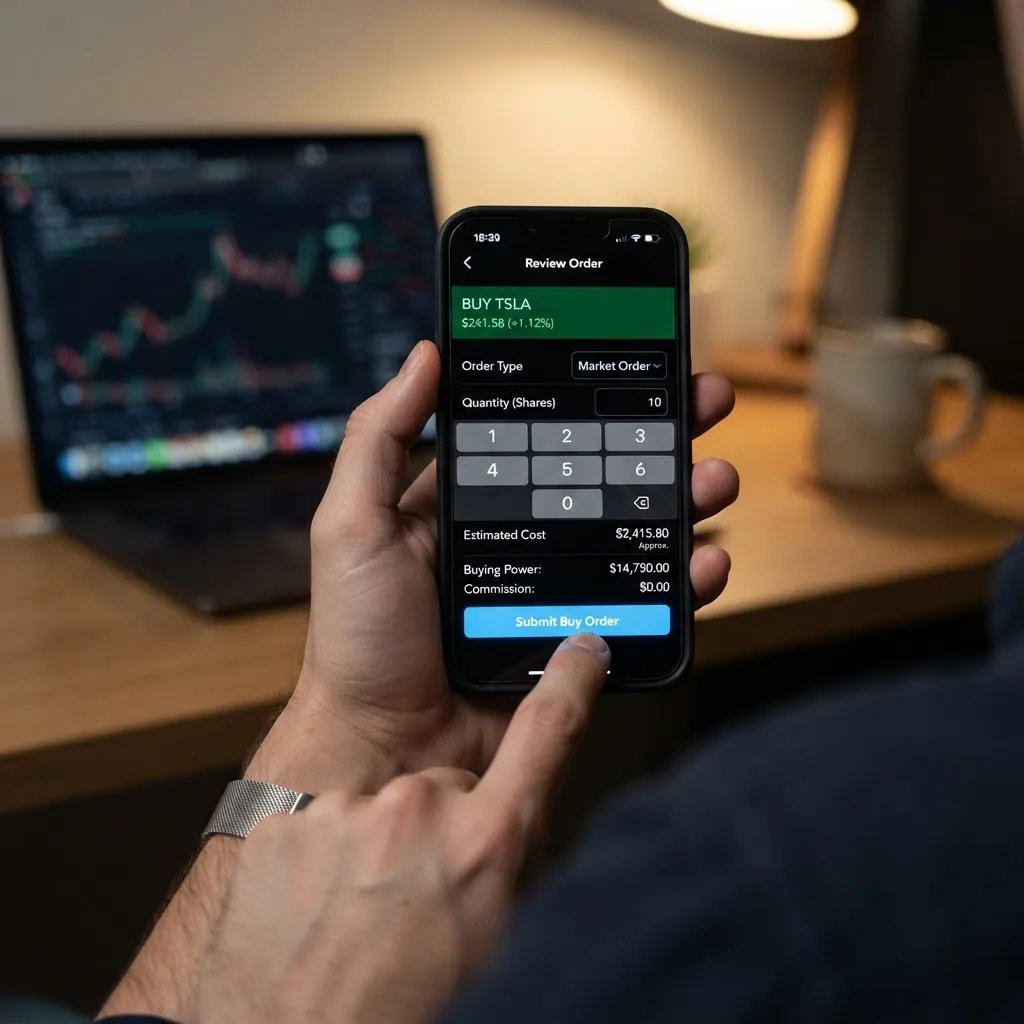
Confirm expected settlement time (T+2 for ASX equities and ETFs: trade settles 2 business days after trade date). Do not assume funds are available to sell immediately — they will be available after settlement.
-
Create a simple initial portfolio allocation and save it as a target.
Use a 3-5 asset class allocation that matches your risk tolerance. Example allocations (tailored):
- Conservative (near-term horizon 0–3 years): 20% equities / 60% fixed income / 20% cash.
- Balanced (medium 3–10 yrs): 50% equities / 35% fixed income / 15% cash.
- Growth (long 10+ yrs): 80% equities / 15% fixed income / 5% cash.
For each equity portion, split 30–60% domestic (Australian) and the remainder international. Example growth split: 40% ASX ETFs, 40% global ex-Australia ETFs, 20% small-cap or sector ETFs.
Record target percentages in your spreadsheet and compute exact units needed for each ETF given current prices. Example: AU$5,000 portfolio target 40% ASX => AU$2,000 ÷ ETF price AU$20 => buy 100 units.
-
Set up automatic contributions and dividend reinvestment if available.
Automate AU$100–AU$500 monthly depending on your budget. Automation reduces timing risk and grows habitually. If your chosen ETF or managed fund supports DRP (dividend reinvestment plan), enable it to automatically reinvest distributions — this compounds returns without incurring brokerage for each purchase in many brokerages.
Example: AU$200/month with a 7% average annual return compounded monthly becomes ~AU$4,200 after two years (roughly; use exact calculator for precise figures). Automation also helps you dollar-cost average entry over volatile markets.
-
Implement simple risk controls: position size and stop/loss rules.
For beginners I recommend position sizing maximums and mental stop-loss rules rather than active day trading stops. Guidelines:
- No single equity position should exceed 5% of total portfolio for portfolios under AU$50,000; ETFs and diversified funds can be larger.
- For individual stocks, cap exposure to any one listed company at 2%–3% of portfolio until you have experience.
- Set a mental re-evaluation threshold: if a holding falls >25% from purchase, review fundamentals and hold or add rather than automatically sell; if fundamentals degraded, consider trimming to target size.
Do not use highly-leveraged products (margin loans, CFDs) until you have multi-year experience and risk controls; these are not covered in this beginner guide.
-
Recordkeeping: name files, download reports and track performance monthly.
Create a folder structure: /Investing/2026/BrokerName/ and save at minimum these files each tax year: (1) account statements, (2) trade confirmations, (3) dividend summaries, (4) annual tax statements. Use a spreadsheet with columns: date, asset, units, price, fees, total cost, holding value, realised gain/loss, dividends received. Update monthly or use auto-export from the broker.
Example: For a $10,000 portfolio, record initial buy costs and month-end market values. Track % return = (current value + dividends received – total contributions) / total contributions * 100. Keep all PDF statements for 5 years for tax audit safety.
-
Rebalance quarterly or when allocations deviate >5 percentage points.
Set calendar reminders for quarterly reviews. Rebalancing rules:
- Automatic rule: If any asset class deviates by ±5% from target, rebalance back to target using new cash first; only sell if necessary.
- Cost-aware rule: Rebalance using new contributions to avoid frequent brokerage fees for small accounts. For example, if target is 40% ASX and currently 45% but you have AU$500 new funds, direct that AU$500 into the underweight asset instead of selling.
Worked example: a AU$5,000 portfolio with target 60% equities (AU$3,000) grows to AU$5,500 with equities now AU$3,600 (65.5%). If you have no new cash, sell AU$275 of equities and buy AU$275 of bonds to restore 60/40 (account for brokerage fees).
-
Monitor tax events and create an annual tax checklist.
Annually, collect: dividend statements, realised gain/loss register, CHESS issuer statements for share transfers, and managed fund distribution statements. Note franking credits and foreign income withholding. If your annual realised capital gains exceed AU$10,000 or you sell assets with gains, consider scheduling a consultation with a tax accountant before lodging your tax return.
Important dates: Australia’s financial year ends 30 June. Expect platforms to issue tax statements between July and September. Save all documents into the folder structure within 30 days of receiving them.
-
Educate yourself monthly: read one article, one book chapter and review your portfolio numbers.
Set a simple curriculum for the first 12 months: Month 1 — index ETFs and why they are low-cost; Month 2 — understanding fees and MER; Month 3 — tax and franking credits; Month 4 — asset allocation strategies; Month 5 — how to read a fund PDS; and repeat with deeper topics. Use our Investment Basics Guide to fill knowledge gaps.
-
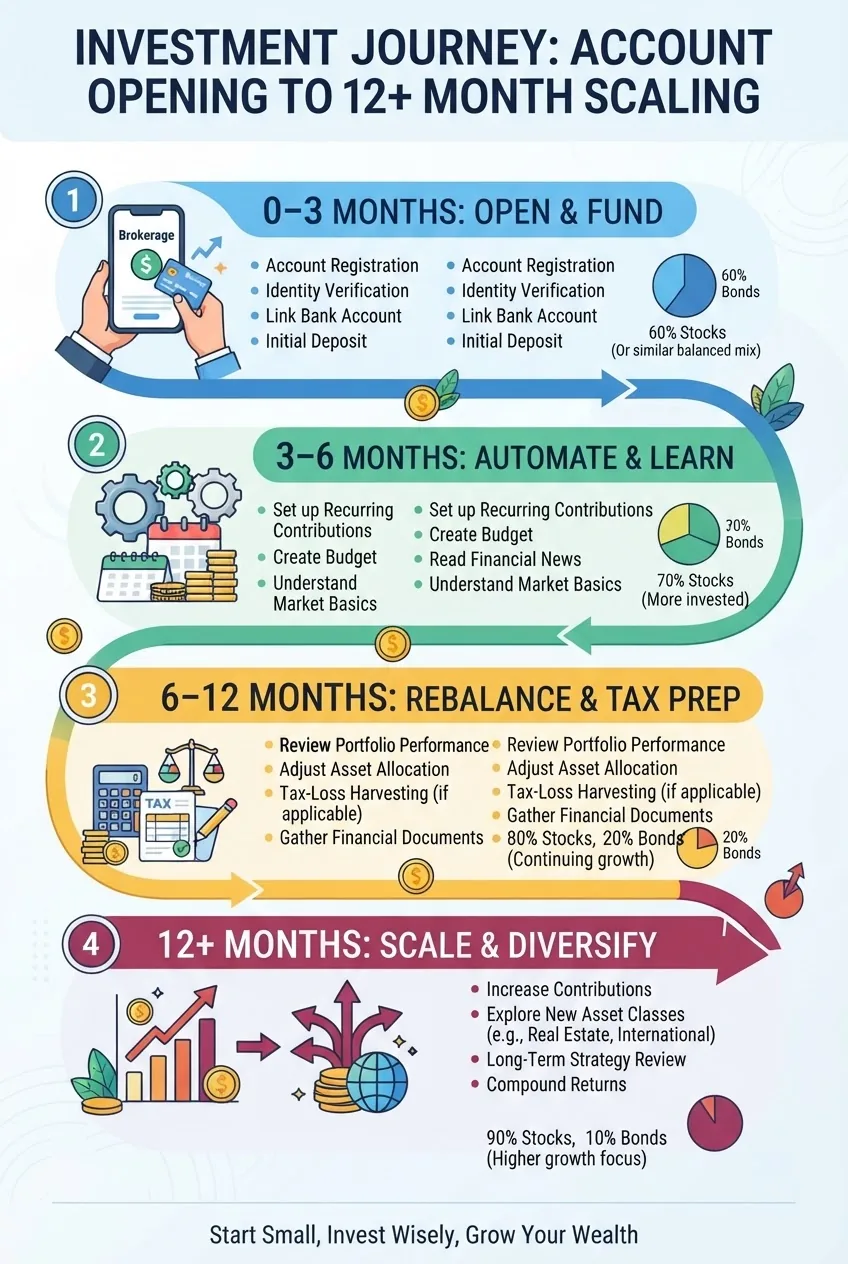
Scale and diversify after 12 months: add tilting or alternatives if appropriate.
After you have built a habit and at least AU$10,000 invested, consider small tilts: 5% allocation to small-cap equities, 5% to REIT ETFs (property), or 5% to an international emerging markets ETF. Only add these if you understand the risk profile and fee structure. Reassess your emergency fund size before adding illiquid or higher-volatility assets.
Practical worked examples with exact numbers
Example A — Starting with AU$1,000 and a commission-free ETF broker
Scenario: You have AU$1,000, a broker offering commission-free ETF buys and no platform fee.
- Allocation: 60% growth ETFs, 30% bond ETF, 10% cash.
- Portfolio amounts: AU$600 growth, AU$300 bonds, AU$100 cash buffer.
- ETF prices: Growth ETF price AU$35, Bonds ETF price AU$25.
- Units to buy: Growth ETF = floor(600 / 35) = 17 units (cost AU$595); Bonds ETF = floor(300 / 25) = 12 units (cost AU$300). Remaining cash ~AU$105 (AU$1,000 – AU$595 – AU$300 = AU$105) — keep as cash buffer or buy another small ETF.
- Fees: Commission-free; check if there is a currency conversion fee for global ETFs (typically 0.3%–0.6%).
Example B — AU$10,000 starting with a mixed brokerage and managed fund approach
Scenario: AU$10,000 initial capital. You want low-cost ETF core + one active managed fund for diversification.
- Target allocation: 50% global index ETFs (AU$5,000), 30% Australian equities ETF (AU$3,000), 15% fixed income ETF (AU$1,500), 5% managed active fund (AU$500).
- Broker fees: Broker charges AU$9.50 per trade. Plan batch trades to minimise fees. Buy global index ETF & Australian ETF & bond ETF in three trades = 3 × AU$9.50 = AU$28.50. Managed fund initial entry fee = 0% but MER = 0.95% p.a.
- Annual cost estimate: ETF MER average 0.12% for index ETFs and bond ETF 0.20% — weighted MER ≈ 0.15% on AU$9,500 = AU$14.25 p.a. + managed fund MER AU$500 × 0.95% = AU$4.75 p.a. + broker fees one-off AU$28.50 = first-year total ≈ AU$47.50. This is far cheaper than a platform charging 0.8% p.a. on AU$10,000 = AU$80 p.a.
Common mistakes and how to avoid them (from my experience)
I once watched a new investor repeatedly buy single stocks with AU$50 at a time paying AU$10 commission per trade — the fees ate more than the returns. After advising them, we changed to commission-free ETFs and an automated AU$200 monthly plan. Avoid tiny single-stock trades that incur fixed commissions.
I have seen accounts left unmonitored with stale allocations — one client had 90% in domestic banks after a long market shift. I recommend quarterly reviews and rebalancing when allocations drift by ±5 percentage points to prevent this.
I spoke to someone who forgot to provide their TFN and lost 47% of a dividend payment to withholding temporarily. Always give your TFN within 28 days of opening paperwork to avoid excessive withholding rates.
How to avoid other common failures:
- Do not chase ‘hot tips’ or concentrate >10% in a single stock without due diligence.
- Don’t ignore fees: compare MER and brokerage across the first 3 years and include platform fees when calculating expected returns.
- Avoid margin or leveraged products as your first investment experience; I recommend gaining 12 months of experience with ETFs or funds first.
Checklist: Verify your work
- I have a written investment goal and time horizon (entered at top of my spreadsheet).
- I chose one account type and have compared at least three providers with documented fees.
- I uploaded valid ID and provided my TFN (or committed to provide TFN within 28 days).
- I funded the account with at least AU$500 (recommended) and set a plan for monthly contributions.
- I placed my first trades or bought my first managed fund units and saved confirmations to my folder.
- I recorded target allocations and initial holdings in my spreadsheet and set quarterly reminders to rebalance.
- I enabled 2FA and stored recovery codes securely.
- I have a basic tax and recordkeeping folder and a plan to gather annual tax statements after 30 June.
When to call in a professional
Seek a certified financial planner or tax professional when:
- You have complex tax circumstances (foreign income, capital losses carried forward, trust structures).
- Your investable assets exceed AU$200,000 and you want a personalised asset allocation with tax optimisation and estate planning.
- You are considering margin lending, gearing, complex derivatives or sophisticated managed funds.
- You need superannuation strategy advice that interacts with retirement planning and contribution caps.
For a small one-off fee you can get a targeted review of your plan and a prioritized list of improvements. Use a licensed financial adviser (AFSL) and verify credentials via the Financial Adviser Register in Australia before paying for advice.
Additional practical tips and Melbourne-specific considerations
Local investor notes: Melbourne investors can attend community financial literacy events from local councils and libraries — these offer free introductions to investing basics and superannuation. Bank branch hours may still be relevant if you prefer face-to-face ID verification for some brokers, but nearly all major providers allow 100% online ID verification.
Currency and overseas ETFs: if you buy international ETFs priced in USD, expect FX spreads of 0.2%–0.6% when converting AUD to USD via your broker. For small portfolios under AU$10,000, consider preferring AUD-listed ETFs that hold international securities to avoid double currency conversions.
Insurance and holdings: do not use investment accounts as a substitute for appropriate life and income protection insurance if your dependants rely on your income. Keep at least 3–6 months of essential living costs in cash before moving substantial funds into higher-risk investments.
Glossary of important terms (quick reference)
- ETF — Exchange-Traded Fund, trades like a share on the ASX, usually low MER (0.05%–0.30%).
- MER — Management Expense Ratio, annual fee charged by funds as a percentage of assets.
- Brokerage — Fee charged by a broker per buy/sell transaction.
- DRP — Dividend Reinvestment Plan, option to automatically use dividends to buy more units.
- TFN — Tax File Number, provide to avoid higher withholding rates.
- T+2 — Settlement period: trade executed today settles 2 business days later on ASX.
Resources and internal further reading
For continuing education linked to this cluster, read the pillar overview on Personal Finance Tips and Money Management Advice Guide and our related pieces on Investment Basics and Online Investment Platforms. For credit-related context that affects borrowing against investments, our 735 Credit Score Guide explains credit health basics.
Frequently Asked Questions
What is the best investment account for beginners in Australia?
The best beginner account is usually a low-cost online brokerage that offers commission-free ETF trades and no platform fee, with easy BPAY funding and DRP options. Start with AU$500–AU$2,000, automate monthly AU$100–AU$500 contributions, and choose diversified ETFs to reduce single-stock risk.
How much money do I need to start investing online?
You can start with AU$50 on some platforms, but I recommend AU$500 as the minimum to diversify ETFs sensibly; AU$1,000 is preferable to buy multiple funds without being dominated by fixed brokerage costs. Set AU$100–AU$200 monthly as an achievable contribution target.
Are managed funds or ETFs cheaper for beginners?
ETFs are usually cheaper: index ETF MERs commonly range 0.03%–0.30% versus managed fund MERs 0.45%–1.50% p.a. Managed funds sometimes add value via active management, but for beginners ETFs offer lower cost and straightforward tax reporting.
How do taxes and franking credits work on investment accounts?
Dividends are taxable in your personal return. Australian dividends may include franking credits that offset tax; foreign dividends may have withholding tax. Capital gains tax applies on disposals, with a 50% discount typically available for assets held more than 12 months in non-super accounts.
How often should I rebalance my investment portfolio?
Rebalance quarterly or when any asset class deviates by more than ±5 percentage points from its target. Use new contributions to rebalance when possible to reduce brokerage costs; otherwise rebalance by selling the overweight asset after factoring in fees and tax consequences.