



Investment securities are tradable financial claims—equities, bonds, ETFs and derivatives—that represent ownership, creditor rights or contractual payoff streams; they let investors seek income, growth or risk management by buying, selling or holding instruments through brokers or funds while balancing expected return, liquidity and regulatory rules. This guide covers types, costs, taxes and practical steps in Australia.
What exactly are investment securities?
Answer: Investment securities are legally binding financial instruments you can buy or sell that represent ownership (equities), a debt obligation (bonds), pooled exposure (funds/ETFs) or a contract (derivatives), used to transfer capital, earn returns and manage risk.
Term: investment securities: tradable financial instruments that represent ownership, creditor claims or contractual rights and can be bought or sold.
In practice, a security creates an enforceable right: a share gives voting and dividend rights; a bond gives repayment and interest rights; an ETF gives a proportional interest in a basket of assets. Securities are regulated, often issued by corporations or governments and listed on exchanges or sold over the counter (OTC).
How are investment securities classified and what are the main types?
Answer: Securities are classified into three broad categories—equity, debt and derivatives—with pooled vehicles (ETFs, managed funds) bridging those categories to provide diversified exposures.
Term: equities: shares representing ownership in a company.
Term: bonds: debt securities representing a loan from investor to issuer with scheduled interest and principal repayment.
Term: derivatives: contracts whose value is derived from underlying assets like stocks, bonds, commodities or indices.
- Equities (shares): Ordinary and preference shares traded on ASX for Australian companies or on global exchanges for international firms.
- Bonds (fixed income): Government, semi-government, corporate and municipal bonds with varying maturities and credit risk.
- Exchange-traded funds (ETFs): Basket securities that trade like shares and track indices, sectors, commodities or strategies.
- Managed funds (unit trusts): Pooled funds actively or passively managed, priced by net asset value (NAV) rather than intraday market price.
- Derivatives: Options, futures and swaps used for hedging, leverage or speculation.
- Hybrid securities: Convertible notes, preference shares combining equity and debt features.
What are financial securities and how do they differ from investment securities?
Answer: Financial securities is a broader term that includes investment securities plus short-term instruments (money market), deposits and insurance-linked products; in everyday investing the terms are used interchangeably when referring to tradable assets.
Term: financial securities: all monetary instruments that can be traded or transferred, including securities, money-market instruments and certain contracts.
Investment securities imply a focus on capital allocation for return; financial securities can also include cash-equivalent instruments like commercial paper or bank term deposits used for liquidity management, not strictly long-term investment goals.
How do securities generate returns for investors?
Answer: Securities produce returns from price appreciation, income (interest or dividends), and derivative payoff structures; total return equals capital gains plus reinvested income minus fees and taxes.
Term: capital gain: the increase in value of a security from purchase to sale.
Term: dividend: a distribution of company profits to shareholders.
Term: yield: income return on an investment, typically interest or dividends expressed as a percentage of current price.
- Equities: return from dividends plus share price appreciation driven by earnings and market sentiment.
- Bonds: interest payments (coupon) and principal repayment; price also changes with interest rates and credit risk.
- ETFs/Managed funds: combined returns of underlying holdings minus management fees and tracking error.
- Derivatives: asymmetric payoffs—options provide leveraged exposure while futures replicate underlying returns with margin.
How are investment securities priced and valued?
Answer: Securities are priced by markets based on supply and demand; intrinsic valuation methods—discounted cash flow for equities, yield-to-maturity for bonds, and NAV for funds—provide theoretical values for comparison with market prices.
Term: discounted cash flow (DCF): a valuation method that sums future cash flows discounted to present value at an appropriate rate.
Term: yield-to-maturity (YTM): total expected return on a bond if held to maturity.
Valuation methods:
- Equity valuation: forecast free cash flows or dividends, choose discount rate (cost of equity), compute present value; compare with market capitalisation and P/E ratios.
- Bond valuation: discount future coupon payments and principal at market yields; use credit spreads to adjust for issuer risk.
- Fund valuation: check NAV per unit for managed funds; ETFs have market price and an indicative NAV — use tracking error as a risk metric.
- Derivatives pricing: apply models (Black-Scholes for options) or futures pricing relationships based on cost of carry.
What are the key risks when investing in securities?
Answer: Principal risks include market risk, credit risk, liquidity risk, interest-rate risk, inflation risk and operational or counterparty risk; diversification and risk management tools reduce but do not eliminate these risks.
Term: market risk: the risk of losses due to overall market movements.
Term: credit risk: risk an issuer will default on obligations.
Term: liquidity risk: inability to buy or sell quickly at fair prices.
- Market/volatility: prices fall across markets; equities are typically more volatile than bonds.
- Credit/default: corporate bonds and hybrids carry higher default probabilities than government bonds.
- Interest-rate risk: rising rates reduce bond prices; duration measures sensitivity.
- Inflation risk: real returns erode when inflation exceeds nominal returns.
- Operational/counterparty risk: platform failures, settlement problems or derivative counterpart default.
How do fees, costs and taxes affect investment returns in Australia?
Answer: Fees and taxes materially reduce net returns: management fees, brokerage, spreads and transaction costs compound over time; Australian investors also pay income tax on distributions plus capital gains tax (CGT) with specific discounts for assets held >12 months.
Term: capital gains tax (CGT): tax on profit from the sale of assets, applied as part of income tax in Australia.
Term: management fee: ongoing charge by fund managers expressed as a percentage of assets under management (AUM).
| Cost type | Typical range (Australia) | Effect on returns |
|---|---|---|
| Brokerage (online) | $5–$20 per trade or 0.05%–0.5% | Reduces small-trade returns; frequent trading compounds costs. |
| ETF management fee (MER) | 0.05%–0.75% p.a. | Ongoing drag on net returns; lower for index ETFs. |
| Managed fund fees | 0.5%–2.5% p.a. plus performance fees | Higher active fees may outpace benefits unless manager outperforms net of fees. |
| Financial adviser fees | Flat or % of AUM (0.5%–1.5%) | Can add value via planning; cost must exceed DIY alternatives for net benefit. |
Tax specifics to consider in Australia:
- Capital gains: 50% CGT discount for individuals on assets held >12 months; taxed at marginal rates.
- Franked dividends: dividend imputation credits can offset income tax; include franking credits in taxable income and claim offsets where eligible.
- Trusts and managed funds: distributions may include capital gains, franked dividends and interest — check annual distribution statements.
How do I choose between equities, bonds, ETFs and managed funds?
Answer: Choose based on investment goals, time horizon, risk tolerance and cost sensitivity: equities for growth, bonds for income and capital preservation, ETFs for low-cost diversification, managed funds for active management and specialist access.
Decision factors:
- Time horizon: equities suit longer horizons (5+ years); bonds and cash suit short to medium horizons.
- Risk tolerance: higher equity allocation increases volatility; bonds reduce portfolio volatility.
- Cost and tax: ETFs are low-cost and tax-efficient; actively managed funds may justify higher fees only with consistent outperformance.
- Access and complexity: managed funds can offer specialist strategies and automatic rebalancing; ETFs require DIY rebalancing.
Compare options with a quick table of characteristics:
| Instrument | Best for | Liquidity | Typical cost |
|---|---|---|---|
| Equities (shares) | Capital growth, income | High (exchange-traded) | Brokerage, no management fee |
| Bonds | Income, capital preservation | Medium to high | Spread, sometimes brokerage |
| ETFs | Low-cost diversification | High | MER 0.05%–0.5% + brokerage |
| Managed funds | Active management, specialist access | Low to medium (daily NAV) | 0.5%–2.5% + performance fees |
How do I open an account and buy investment securities in Australia?
Answer: Open an account with an ASX broker or platform, verify identity, fund it, research securities or funds, then place market or limit orders; use platforms that provide CHESS sponsorship or custodial registration as needed.
Term: CHESS: Clearing House Electronic Subregister System, the Australian system for recording share ownership.
- Choose account type: brokerage account for direct share/ETF trading or platform/superannuation account for managed funds and multi-asset access.
- Compare brokers on brokerage fees, platform tools, CHESS sponsorship and customer service.
- Complete ID verification (driver licence, passport, tax file number optional) and link a bank account for transfers.
- Fund your account via bank transfer (BPAY, direct deposit) and wait for settlement availability.
- Place orders: market order executes at the best price, limit order executes only at your specified price or better.
- Settle and monitor: Australian ASX trades typically settle T+2 (trade date plus two business days).
Practical tips:
- Use limit orders for illiquid stocks or low-volume ETFs to control execution price.
- Check whether the broker offers CHESS sponsorship for direct ownership records or uses a custodial nominee.
- Retain transaction records for tax purposes and future CGT calculations.
What is an example portfolio allocation and how do I rebalance it?
Answer: A sample diversified portfolio uses equities for growth and fixed income for stability; rebalance when allocations drift beyond thresholds or on a scheduled basis to maintain risk profile.
Example: moderate-risk investor with 10-year horizon:
- 60% equities (40% domestic ASX shares, 20% international equities via ETFs)
- 30% bonds (government and corporate bond ETFs)
- 10% cash/alternatives (term deposits, listed REITs or commodities)
Rebalancing rules:
- Threshold method: rebalance when any asset class deviates ±5% from target.
- Calendar method: rebalance quarterly or annually to capture gains and reinvest dividends.
- Cash-flow method: use new contributions or dividends to top up underweight assets to avoid selling winners.
Can you show a worked example with numbers for investing $10,000?
Answer: Yes — a worked example below allocates $10,000 across ETFs and bonds, shows expected returns, fees, taxes and projected value after five years under conservative assumptions.
Term: expected return: assumed average annual return used for projection, not guaranteed.
Assumptions used (conservative):
- Allocation: 60% equities ETF, 30% bond ETF, 10% cash deposit.
- Expected annual returns before fees/tax: equities 6.0%, bonds 2.5%, cash 1.5%.
- Costs: equities ETF MER 0.15% p.a., bond ETF MER 0.20% p.a., brokerage nil for ETF purchases via platform with free trades, no financial adviser fees.
- Tax: effective tax on realised returns assumed 24% (example marginal rate including franking impacts; consult a tax adviser).
Step 1 — initial allocations:
- Equities ETF: $6,000
- Bond ETF: $3,000
- Cash deposit: $1,000
Step 2 — net annual returns after MER (before tax):
- Equities net: 6.0% − 0.15% = 5.85%
- Bonds net: 2.5% − 0.20% = 2.30%
- Cash net: 1.5% (no MER)
Step 3 — approximate after-tax annual returns (apply 24% tax rate):
- Equities after tax: 5.85% × (1 − 0.24) = 4.45%
- Bonds after tax: 2.30% × (1 − 0.24) = 1.75%
- Cash after tax: 1.5% × (1 − 0.24) = 1.14%
Step 4 — five-year projections using compound growth:
- Equities: $6,000 × (1 + 0.0445)^5 ≈ $6,000 × 1.244 ≈ $7,464
- Bonds: $3,000 × (1 + 0.0175)^5 ≈ $3,000 × 1.091 ≈ $3,273
- Cash: $1,000 × (1 + 0.0114)^5 ≈ $1,000 × 1.058 ≈ $1,058
Total projected value ≈ $7,464 + $3,273 + $1,058 = $11,795 on initial $10,000 after five years (approximate, illustrative).
Notes:
- Actual returns vary; franking credits, realised vs unrealised gains and CGT timing change tax outcomes.
- Trading costs, spread costs and platform fees were assumed minimal; include them in precise calculations.
How do derivatives and leverage work with investment securities and should I use them?
Answer: Derivatives are contracts (options, futures, swaps) providing exposure without direct ownership; they enable hedging or leverage but magnify gains and losses and require sophisticated risk management — generally unsuitable for most retail beginners.
Term: leverage: using borrowed funds or derivative exposure to amplify investment exposure relative to capital invested.
Common uses:
- Hedging: put options to protect equity holdings from downside.
- Speculation: buying call options or using margin to seek amplified returns.
- Arbitrage and yield enhancement: covered calls or selling futures in specialist strategies.
Risks and practical points:
- Leverage increases downside risk; margin calls may force liquidation at losses.
- Options decay (theta) means long option positions lose value over time if underlying is stagnant.
- Ensure clear understanding, limits and stop-loss rules before any derivative trades; consider paper trading or simulation first.
What regulatory protections and investor safeguards exist in Australia?
Answer: Australian investors benefit from ASIC regulation, ASX market rules, CHESS ownership records and the Australian Financial Complaints Authority (AFCA) for disputes; superannuation and managed funds are governed by prudential standards where applicable.
Term: ASIC: Australian Securities and Investments Commission, the corporate regulator for financial services and markets.
Key protections:
- Licensing: providers must hold an Australian Financial Services (AFS) licence or be authorised representatives.
- Disclosure: product disclosure statements (PDS) and continuous disclosure rules for listed entities.
- Compensation schemes: no blanket government compensation for investment losses; AFCA handles disputes and some providers may have limited client money protections.
How do I assess an issuer or fund manager’s credit and performance?
Answer: Assess issuer credit by credit ratings, balance-sheet metrics and interest coverage; evaluate fund managers by long-term track record, fees, style consistency, assets under management and turnover rates.
Term: credit rating: third-party assessment (S&P, Moody’s, Fitch) of an issuer’s default probability, often represented by letter grades.
For bonds:
- Check rating, bond covenants, maturity profile and issuer financials (leverage ratios, EBITDA).
- Consider the bond’s seniority (senior secured vs subordinated) which impacts recovery in default.
For funds/managers:
- Compare gross and net returns over multiple market cycles (5–10 years where available).
- Examine style drift, turnover (tax and cost implications) and manager tenure.
- Read PDS and annual reports for strategy alignment and fee structure transparency.
What reporting and record-keeping is required for tax and compliance?
Answer: Keep trade confirmations, annual tax statements, dividend statements, managed fund distribution statements and CHESS holding records for CGT and income tax reporting; retain documents for at least five years after tax return lodgement.
Documents you must keep:
- Trade confirmations and contract notes showing buy/sell dates, prices and brokerage.
- Distribution statements and dividend statements including franking credits.
- Managed fund or platform annual tax statements and transaction summaries.
- Records of corporate actions: splits, bonus issues, consolidations, buybacks.
How do I implement a tax-efficient selling strategy for securities?
Answer: Use CGT discount by holding at least 12 months, harvest losses to offset gains, match sales to tax years and prioritise selling higher-cost basis lots or underperforming holdings; consider income timing and franking credits for Australian dividends.
Practical techniques:
- Long-term holding to access 50% CGT discount for individuals on qualifying assets.
- Loss harvesting: sell losing positions to offset taxable gains in the same year.
- Securities identification: know which parcel you sell (first in/first out vs specific parcel identification) — record keeping matters.
What are practical steps for building a first-time investment securities portfolio in Melbourne?
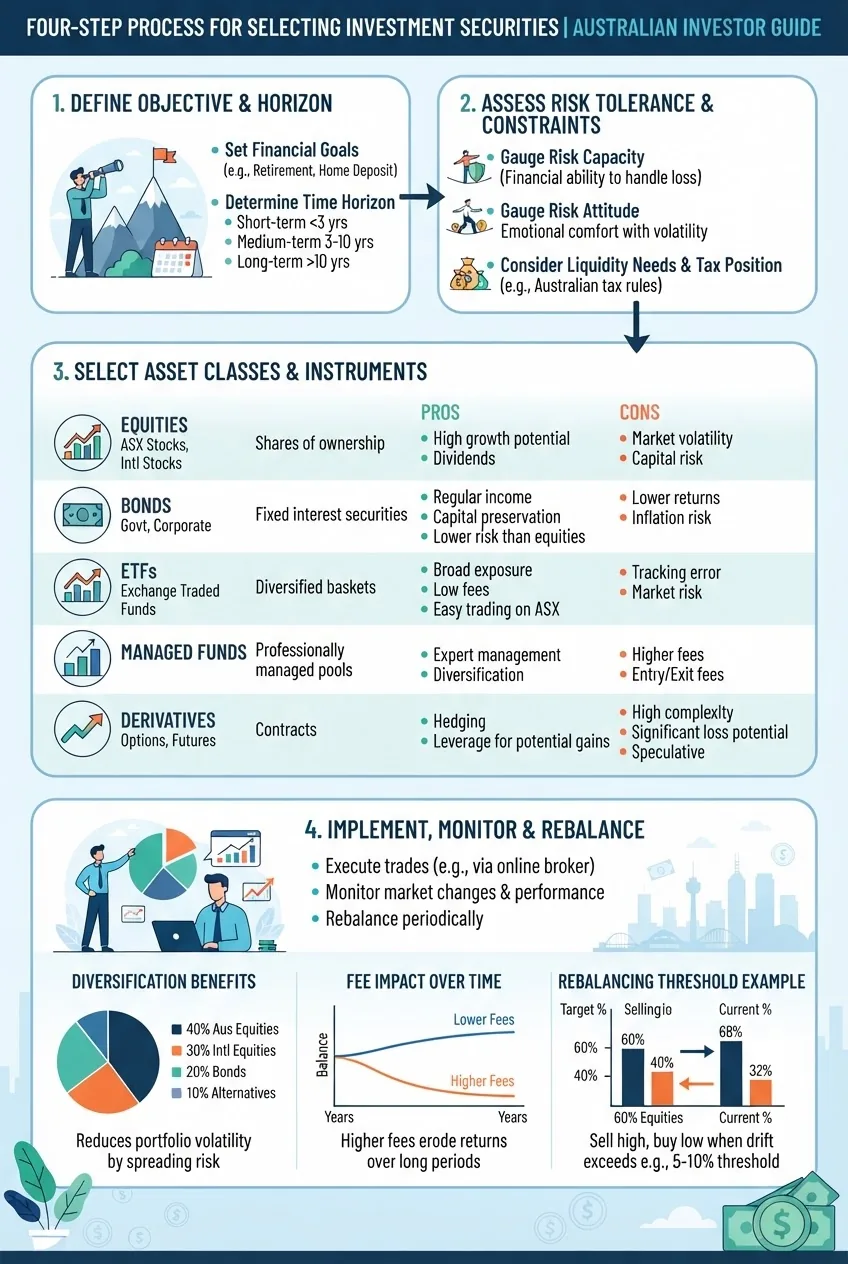
Answer: Define goals and horizon, set risk tolerance, choose tax- and cost-efficient instruments (index ETFs and term deposits for beginners), open a low-cost broker or platform, implement a diversified allocation and schedule rebalancing and review annually.
- Define measurable goals: target balance, time horizon and required annualised return.
- Set emergency buffer: hold 3–6 months of living expenses separate from investable capital.
- Choose a platform: compare brokerage, CHESS registration, ETF access and fees.
- Start simple: build core ETFs for domestic and international equities plus bond ETFs; add direct shares once confident.
- Automate contributions: dollar-cost averaging reduces timing risk.
- Document your plan and rules: rebalancing thresholds, stop-loss rules and tax event handling.
Local considerations in Melbourne:
- Seek advice from licensed advisers if you have >$250k and complex needs; use the free financial adviser guide linked below for more information.
- Use Australian ETFs for local tax transparency and franking credit flows on Australian equity exposures.
Relevant internal resources: see our broader Personal Finance Tips and Money Management Advice Guide for planning and the Investment Basics Guide for fundamentals and Investment Accounts for Beginners for platform selection.
How do ESG, sustainability and ethical screens affect securities selection?
Answer: ESG and ethical screens restrict or tilt investable universes by environmental, social and governance criteria; they can change risk/return profiles, may reduce diversification and often incur different fees or tracking error relative to broad-market benchmarks.
Term: ESG: environmental, social and governance criteria used to evaluate corporate behaviour and exposure to sustainability risks.
Implementation pathways:
- Exclusionary screening: remove tobacco, fossil fuels or weapons from the investable universe.
- Positive screening: select companies with high ESG ratings within each sector.
- Thematic investing: focus on renewable energy, gender diversity or low-carbon technology sectors.
Considerations:
- Check methodology and data sources used by ESG fund providers.
- Understand that ESG does not guarantee better returns; review historical performance and risk metrics.
What reporting metrics should investors track for their securities portfolio?
Answer: Track total return, annualised return, volatility (standard deviation), drawdown, Sharpe ratio, asset allocation percentages, turnover and expense ratio to evaluate performance and risk-adjusted outcomes.
Term: Sharpe ratio: risk-adjusted return metric dividing excess return over the risk-free rate by return volatility.
- Total return: price change plus income reinvested over the period.
- Volatility: standard deviation of returns; higher indicates larger swings.
- Maximum drawdown: worst peak-to-trough decline — important for risk tolerance assessment.
- Expense ratio/fees: recurring costs directly reduce net returns.
How can beginners reduce common investment mistakes when buying securities?
Answer: Beginners can reduce mistakes by following a written plan, avoiding market timing, minimising fees, using dollar-cost averaging, diversifying and regularly reviewing tax records and performance; education and small-scale practice trades help build confidence.
Common pitfalls and prevention:
- Chasing past winners — set rules for selection and avoid emotional trading.
- Overtrading — keep turnover low to avoid fees and tax drag.
- Ignoring fees — compare MERs and brokerage, especially for small portfolios.
- Poor record-keeping — keep all transaction and distribution documents for tax and performance calculation.
How are corporate actions and events handled for securities I own?
Answer: Corporate actions — dividends, rights issues, bonus issues, splits and buybacks — are communicated by issuers and processed by your broker or CHESS sponsor; you may need to make decisions on entitlement events like rights offers.
Action types and investor tasks:
- Dividends: receive cash or reinvestment depending on broker and DRP availability.
- Rights issues: choose to exercise, sell entitlements or let them lapse (requires payment if exercised).
- Stock splits/bonus issues: automatically adjusted in holdings and unit price.
- Takeovers: accept cash or securities offers; brokers provide notices and options.
What is the role of custody, nominees and CHESS sponsorship in ownership?
Answer: Custodians and nominee arrangements hold shares on behalf of investors for administrative simplicity, while CHESS sponsorship records direct beneficial ownership on the ASX subregister; direct CHESS holdings provide clearer ownership rights and easier corporate action handling.
Term: nominee: a custodian entity that holds securities in its name on behalf of beneficial owners, simplifying administration.
Pros and cons:
- Nominee custody: easier fractional holdings, consolidated reporting; sometimes limited voting rights handling.
- CHESS sponsorship: direct registration on the issuer register; clearer entitlement to communications and easier transfer of holdings.
How should investors approach international securities exposure and currency risk?
Answer: Use international equities to diversify sector and country risk; manage currency risk via hedged ETFs or natural hedging and understand that currency moves affect Australian-dollar returns materially.
Currency considerations:
- Unhedged international equities: returns reflect foreign asset performance and AUD exchange rate movements.
- Hedged ETFs: reduce FX volatility but add hedging costs; suitable for shorter horizons or when currency is a noise factor.
- Long-term investors often accept currency diversification as a risk reducer over time.
How can advanced investors use securities for income generation?
Answer: Advanced investors generate income with dividend-paying shares, corporate bonds, covered call strategies, listed investment trusts (LITs) and REITs, balancing yield with quality and duration to avoid income traps.
Income strategy checklist:
- Yield sustainability: check payout ratios and cash-flow coverage for dividends.
- Credit quality for bonds: higher yield often means higher default risk.
- Options overlay (covered calls): generate premiums while capping upside; requires options knowledge.
- REITs: offer real-asset income but sensitive to interest rates and property cycles.
What reporting and metrics should a portfolio review include?
Answer: A portfolio review should include allocation vs targets, performance (YTD, 1-, 3-, 5-year), income yield, fees paid, turnover, risk metrics (volatility, drawdown) and tax events; include action items and next review date.
- Compare allocation to target and flag deviations beyond thresholds.
- Report total returns and attribution by asset class and security.
- Calculate net-of-fees returns and project tax liabilities for realised events.
- List corporate actions, pending settlements and cash needs for rebalancing.
When should I consult a financial adviser about investment securities?
Answer: Consult a licensed financial adviser when you face complex tax situations, large sums to invest, estate planning needs, portfolio construction beyond basic allocations or when you need regulated advice tailored to your circumstances.
Use the free adviser guide if you want to compare options and prepare questions before meeting an adviser: Free Financial Advisor Guide.
Frequently Asked Questions
What are the safest investment securities for conservative investors?
Short answer: For conservative investors, high-quality government bonds, short-duration corporate bonds, term deposits and cash-like ETFs offer the lowest principal risk; these typically trade lower returns and are chosen to preserve capital and provide predictable income.
How much should I allocate to equities versus bonds?
Short answer: Allocation depends on age, goals and risk appetite; a common rule is 100 minus your age in equities for a rough starting point, adjusted for individual risk tolerance and investment horizon, then rebalance annually or when allocations drift significantly.
Are ETFs better than managed funds for long-term investors?
Short answer: ETFs often offer lower fees, intraday trading and tax efficiency, making them attractive for long-term passive investors; managed funds may justify higher fees when active managers show consistent outperformance or access to niche strategies.
How do franking credits affect Australian share returns?
Short answer: Franking credits attach to Australian dividends and can reduce tax payable by shareholders, improving after-tax yield for taxable investors; the benefit depends on your marginal tax rate and whether credits are refundable.
What tax records do I need to keep for CGT when selling securities?
Short answer: Keep trade confirmations, contract notes, dividend statements, managed fund distribution statements and records of corporate actions for at least five years after filing to calculate cost base, capital gains and any applicable CGT discounts accurately.
Can I use gearing or margin to buy more securities safely?
Short answer: Gearing increases exposure and potential returns but also magnifies losses and can trigger margin calls; it is generally risky for retail investors and should only be used with strict risk controls and sufficient liquidity to cover margin requirements.
How do I evaluate whether a fund manager is worth the management fee?
Short answer: Compare the manager’s net-of-fees returns against benchmark indices and similar funds over multiple market cycles, review risk-adjusted metrics like Sharpe ratio, examine consistency and manager tenure, and ensure fees are transparent in the PDS.
What happens if a broker or fund manager becomes insolvent?
Short answer: Client assets held in custody are usually segregated from the firm’s assets and protected in liquidation, but compensation is not guaranteed; confirm custody arrangements and protections in the broker or fund PDS and consider AFCA for dispute resolution.