



Investing is using money to buy assets that are expected to grow in value or produce income over time, with the aim of increasing wealth or meeting financial goals. It exchanges present purchasing power for future financial benefit, accepting some risk in return for potential higher long‑term gains than saving.
What is investing in plain terms?
Investing is allocating capital to assets or projects that generate future financial returns, either through price appreciation, interest, rent or dividends.
Investing: committing money or resources now to an asset or venture expecting future income or capital growth.
Investing differs from saving because saving typically focuses on preserving capital and liquidity with low returns, while investing deliberately takes risk to achieve higher returns. Common investment goals include retirement income, home purchase down payments, education costs, and wealth accumulation. The timeline, risk tolerance and expected return shape the choice of investments.
What does investing money mean?
Investing money means purchasing assets or instruments today that are expected to produce financial benefits later—either recurring income or a higher resale value.
Asset: anything owned that has monetary value, such as shares, bonds, property or cash equivalents.
When you invest money you accept some chance of loss for the possibility of return. You can invest directly (buying shares or property) or indirectly (managed funds, ETFs). The invested capital can earn:
- Income: interest, dividends or rent.
- Capital gains: increases in the asset’s market price.
- Tax-offset benefits: for example, franking credits on Australian dividends.
Understanding time horizon and liquidity needs helps choose the right vehicles and risk level.
How does investing work?
Investing works by buying assets expected to yield returns over time; markets and institutions provide pricing, trading and custody, and returns come from income and price changes.
Market: a platform or system where buyers and sellers trade assets, like the Australian Securities Exchange (ASX).
Mechanically, investing involves selecting an asset, placing an order through a broker or platform, and holding that asset while it produces returns or appreciates. Prices change due to supply and demand, company performance, economic data and investor sentiment. Investors monitor performance and may rebalance portfolios, sell to realise gains or cut losses, or reinvest income.
What are the main types of investments?
Main investment types are equities (shares), bonds, cash and cash equivalents, property, managed funds/ETFs and alternative assets, each with differing risk, return, liquidity and fees.
Equity (Share): ownership stake in a company that can pay dividends and rise or fall in market value.
Choosing between these types depends on your objectives and time horizon. Below is a concise comparison of common investment options including typical return ranges and liquidity.
| Investment | Typical long-term return (Australia) | Liquidity | Typical fees |
|---|---|---|---|
| Shares (individual stocks) | 6–10% p.a. (variable) | High — exchangetraded | Brokerage + spread |
| ETFs (exchange traded funds) | 5–9% p.a. (market dependent) | High — exchangetraded | Management fee (0.03–0.80%) + brokerage |
| Managed funds | 4–9% p.a. | Medium — daily pricing | Management fee (0.5–2%) |
| Bonds (government, corporate) | 1–5% p.a. | Medium | Dealer spreads, platform fees |
| Property (direct residential/commercial) | 4–8% p.a. total return | Low — illiquid | Stamp duty, agent fees, maintenance |
| Cash & term deposits | 0.5–4% p.a. | Very high | Usually none or low |
How do risk and return relate to investing?
Risk and return are linked: higher expected returns generally require accepting greater risk, including the chance of losing capital or high volatility.
Risk: the possibility that an investment’s actual return will differ from expected return, including loss of principal.
Key risk types:
- Market risk: asset prices fall across markets.
- Credit risk: borrower defaults on bonds or loans.
- Liquidity risk: difficulty selling an asset quickly at fair price.
- Inflation risk: returns don’t keep pace with rising prices.
Investors manage risk with diversification, asset allocation, and position sizing. Expected return compensates for taking risk; for example, cash offers safety but low return, while equities offer higher long-term returns with larger short-term swings.
What is compound interest and why does it matter for investing?
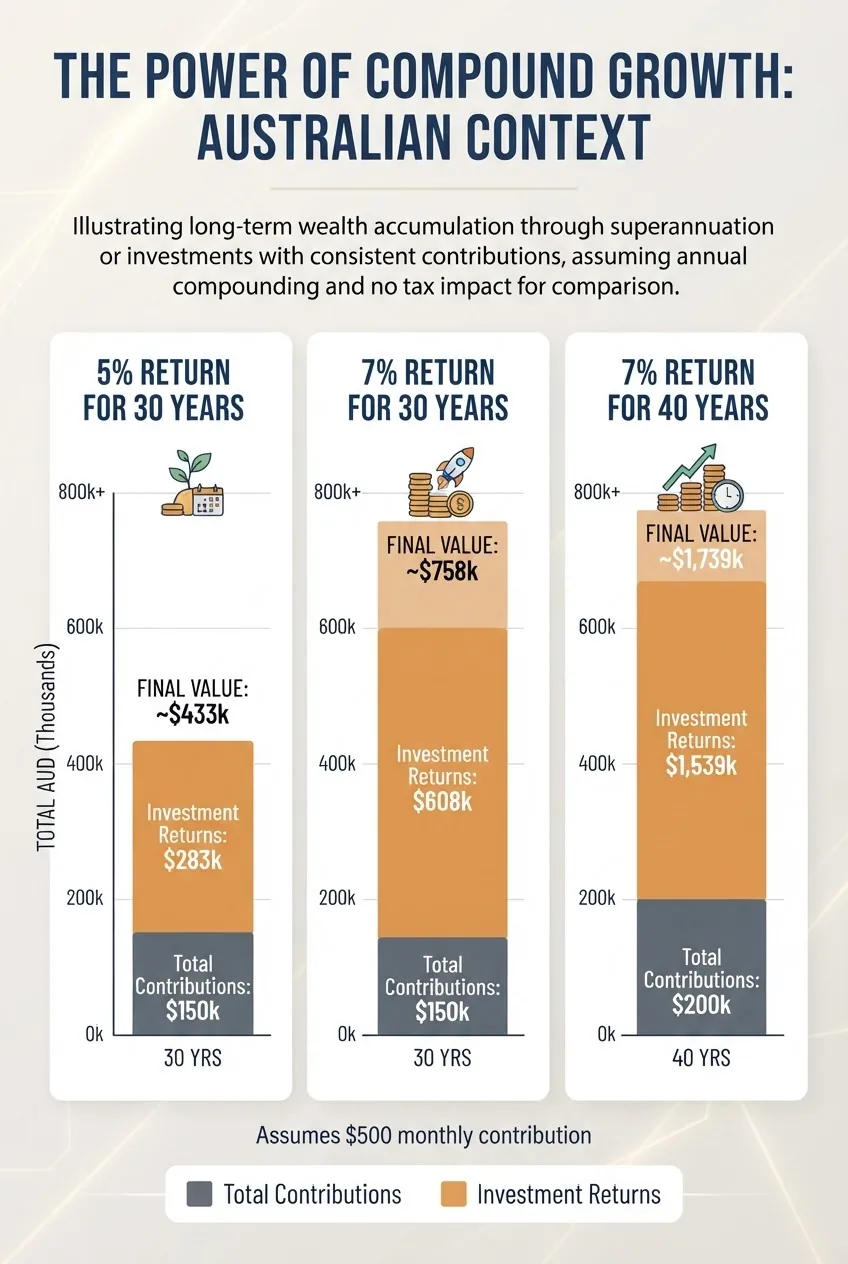
Compound interest means earnings generate earnings: reinvested returns increase the investment base so future gains grow faster over time.
Compound interest: interest or returns earned on both original capital and previously accumulated returns.
Compound growth is the primary engine of wealth accumulation. Even modest differences in annual return or added contributions produce large divergences over decades. Below are worked examples showing how compounding affects wealth over 20–40 years.
Worked examples: compounding with different rates and contributions
Assumptions used in these examples: starting capital, annual contribution at year-end, annual nominal return, and no taxes or fees to keep comparison clear.
- Example A — $5,000 start, $2,000 p.a., 5% return, 30 years: Future value ≈ 5,000*(1.05)^30 + 2,000*(((1.05)^30 -1)/0.05) ≈ $5,000*4.3219 + 2,000*66.438 ≈ $21,609 + $132,876 = $154,485.
- Example B — $5,000 start, $2,000 p.a., 7% return, 30 years: FV ≈ $5,000*7.6123 + 2,000*((7.6123-1)/0.07) ≈ $38,061 + $180,352 = $218,413.
- Example C — same as B but 40 years: 7% return, 40 years, FV ≈ $5,000*14.974 + 2,000*(((1.07)^40 -1)/0.07) ≈ $74,870 + $441,000 ≈ $515,870.
These examples show that a 2% higher annual return can grow a portfolio substantially more over long horizons; compounding accelerates with time and contributions. Fees and taxes would reduce these numbers, so aim to minimise avoidable costs.
How should I start investing in Australia (step‑by‑step)?
Start investing by defining goals and time horizon, building an emergency fund, choosing suitable accounts and low‑cost vehicles, and beginning with a small, diversified allocation that matches your risk profile.
Emergency fund: cash reserve covering 3–6 months of essential expenses kept liquid to avoid forced selling of investments.
Step-by-step checklist:
- Set clear, dated goals (retirement age, home deposit, education) and prioritise high-interest debts.
- Build an emergency fund in a high-interest savings account or term deposit.
- Choose an account: brokerage for shares/ETFs, platform for managed funds, or superannuation for long-term retirement saving.
- Select investment vehicles aligned with goals: diversified ETFs or managed funds are common starting options for beginners.
- Open an account with a licensed Australian broker or platform that lists ASX securities and provides clear fee schedules.
- Start with modest, regular contributions (dollar-cost averaging) and set automatic transfers.
- Monitor, rebalance annually, and adjust contributions if circumstances or goals change.
Platforms commonly used in Australia include full-service brokers and discount online brokers; compare brokerage fees, payment for order flow practices, and platform features. For retirement, review superannuation options and insurance within super.
What investment accounts and structures should I consider?
Consider individual brokerage accounts, managed funds platforms, wrap accounts, and Australian superannuation, each with different tax treatment, fees and suitability for time horizons.
Superannuation (Super): a tax-advantaged retirement savings structure in Australia with compulsory employer and voluntary contributions, taxed differently from personal investments.
Account options summary:
- Brokerage account — buy and sell shares, ETFs, and listed bonds; taxed on dividends and realised capital gains.
- Managed fund account — pooled investments managed by professionals; fees usually higher but simpler for diversification.
- Wrap account — consolidates investments under one platform with reporting and adviser services; often higher cost.
- Superannuation — ideal for long-term retirement saving with concessional tax rates but limited access until preservation age.
- Cash savings and term deposits — low risk, high liquidity, useful for short-term goals or emergency funds.
Choose accounts considering tax implications, access rules, and fees; for many beginners, low-cost ETFs in a standard brokerage or via regular contributions to super are practical starting points.
How do fees and costs affect investing returns?
Fees and costs reduce net returns directly; even small annual fees compound and substantially lower final wealth over decades.
Management Expense Ratio (MER): the annual fee charged by a fund manager expressed as a percentage of assets under management.
Common fees:
- Brokerage per trade.
- Management fees (MER) for funds and ETFs.
- Platform/admin fees and account subscription charges.
- Adviser fees for personalised financial advice.
- Bid‑ask spreads and transaction costs in less liquid assets.
Illustrative cost impact table over 30 years on a $50,000 starting balance with 6% gross return but differing fees:
| Fee level (annual) | Net annual return | Value after 30 years |
|---|---|---|
| 0.10% (very low-cost ETF) | 5.90% | ≈ $281,000 |
| 0.75% (average managed fund) | 5.25% | ≈ $230,000 |
| 1.50% (higher-cost advice/wrap) | 4.50% | ≈ $188,000 |
Difference between lowest and highest fee scenario above is large—over $90k—demonstrating why fee-aware decisions matter. Always read PDS (Product Disclosure Statement) and compare ongoing fees, entry/exit fees and performance fees.
What taxes apply to investments in Australia?
Investment income in Australia is taxable: interest and dividends are taxed as income, capital gains attract capital gains tax (CGT) with a one‑year discount for individuals, and franking credits may offset tax on dividends.
Capital Gains Tax (CGT): tax on the profit (capital gain) made when selling an asset; in Australia, individuals often get a 50% discount for assets held >12 months.
Key tax points:
- Dividends are assessable income; franking credits from Australian companies reduce tax payable.
- Interest income is taxed at your marginal tax rate.
- Capital gains are included in taxable income; the 50% discount applies for individuals and trusts holding assets >12 months, subject to conditions.
- Negative gearing: deducting investment losses (e.g., property) against other income can reduce tax but creates after-tax losses to evaluate.
- Superannuation has concessional tax rules—contributions and earnings inside super are taxed differently and often at lower rates.
Tax rules are complex and personal; consult a qualified tax adviser for specific planning. Official guidance is available from the Australian Taxation Office for up-to-date rules.
How do I decide what mix of assets (asset allocation) is right?
Choose asset allocation based on your goals, time horizon, risk tolerance and liquidity needs; it’s the most important decision for long-term portfolio outcomes.
Asset allocation: the distribution of capital across asset classes, like equities, bonds, property and cash, to balance risk and return.
Simple starting allocations by investor profile:
- Conservative (near-term goals): 20–40% equities, 40–60% bonds/fixed income, 0–20% property, 0–20% cash.
- Balanced (medium term): 40–60% equities, 20–40% bonds, 10–20% property/alternatives, 0–10% cash.
- Growth/Aggressive (long-term): 70–90% equities, 0–20% bonds, 10–20% property/alternatives, minimal cash.
Rebalance annually or when allocations drift beyond set tolerances (e.g., ±5%). Use low-cost, diversified ETFs or index funds for broad exposure; complement with individual securities only if you have the time to research and monitor them.
How do I measure investment performance?
Measure performance using total return, CAGR (compound annual growth rate) and risk-adjusted metrics like the Sharpe ratio; always compare against a relevant benchmark and over appropriate timeframes.
CAGR: the constant annual growth rate that takes an investment from its beginning value to its ending value over a specified period.
Practical steps:
- Use total return (price change + income) to compare investments fairly.
- Calculate CAGR for medium-to-long-term performance: CAGR = (Ending/Beginning)^(1/n) – 1.
- Compare to benchmarks (e.g., ASX 200 for Australian large caps) and peer group returns.
- Assess volatility (standard deviation) and Sharpe ratio (excess return per unit of risk) for risk-adjusted comparisons.
Short-term underperformance is common; judge managers over 5–10 year horizons where possible and account for fees and taxes when comparing net returns.
How do dividends, interest and capital gains each contribute to returns?
Total return is built from income (dividends, interest, rent) and capital gains (price appreciation); income provides current cash flow while capital gains compound future wealth.
Dividend: portion of company profits paid to shareholders, often expressed as cents per share or yield as a percentage of share price.
Equities often deliver a mix of dividends and capital growth; bonds deliver interest payments and principal repayment; property generates rental income plus potential capital appreciation. For retirees, income components are essential for cashflow; for long-term investors, reinvested income accelerates compounding and total return.
What are ETFs and managed funds, and how do they differ?
ETFs are exchange-traded funds that trade like shares and typically track an index; managed funds are pooled investments actively or passively managed and transacted through a platform or directly with the manager.
ETF (Exchange-Traded Fund): a fund that holds a basket of assets and trades on an exchange, offering intraday liquidity and generally low fees for passive strategies.
Key differences:
- Trading: ETFs trade intraday on exchanges; managed funds usually transact at end-of-day NAV.
- Costs: ETFs often have lower MERs; managed funds may charge higher active management fees.
- Minimums: ETFs can be bought in single-share lots; some managed funds have minimum investment amounts.
- Tax reporting: managed funds may distribute capital gains annually; ETFs typically have tax-efficient structures but still generate taxable events.
For many investors, ETFs provide a low-cost, flexible building block for diversified portfolios, while managed funds can be appropriate for access to specialist active managers or strategies not available in ETFs.
How should I diversify within and across asset classes?
Diversify by holding multiple assets that react differently to market events: across asset classes (equities, bonds, property), geographies, sectors and within asset classes (large/small cap, value/growth).
Diversification: spreading investments to reduce the impact of any single asset’s poor performance on the overall portfolio.
Practical diversification steps:
- Use global equity ETFs to gain exposure beyond Australia’s market concentration in financials and resources.
- Hold government and corporate bonds of different maturities and credit quality.
- Include property exposure via direct assets or listed real estate investment trusts (REITs)/real estate ETFs.
- Avoid over-concentration: cap any single position to a set percentage of the portfolio (e.g., 5–10%).
What are common investing strategies and which suit beginners?
Common strategies include passive index investing, active stock selection, dollar-cost averaging, value investing, growth investing, and dividend income strategies; beginners often benefit most from low-cost, diversified passive strategies like ETFs and regular contributions.
Dollar-cost averaging: investing a fixed amount regularly to smooth purchase price over time, reducing timing risk.
Strategy comparison:
- Passive/index investing: low cost, diversified, suitable for most beginners.
- Active stock picking: requires research and time; higher risk of underperformance and often higher costs.
- Dividend/income strategies: useful for retirement income but require attention to dividend sustainability.
- Growth investing: seeks capital appreciation but can be volatile.
Start with a simple core of diversified ETFs and add tactical allocations when you have the experience and conviction to research individual securities or active managers.
How often should I review and rebalance my investments?
Review investments at least annually and rebalance when allocations drift beyond set tolerances (commonly ±5% from targets) or when goals change.
Rebalance: realigning portfolio weights to target allocation by buying underweight assets and selling overweight ones.
Process:
- Set target asset allocation and tolerance bands (e.g., ±5%).
- Run an annual review to check performance, fees, and changes in personal circumstances.
- Rebalance when an asset class exceeds tolerance or on a scheduled basis (quarterly or annually).
- Consider tax consequences—selling winners may create capital gains tax—so use new contributions and dividends to rebalance where possible.
What are the key metrics to track for my investments?
Track total return, annualised return (CAGR), volatility (standard deviation), drawdown (largest peak-to-trough fall), fees paid, and tax-adjusted returns.
Drawdown: the percentage decline from a portfolio’s peak to its lowest subsequent trough, used to measure downside risk.
Maintain a concise tracker with:
- Year-to-date and rolling 1/3/5/10-year returns.
- Net returns after fees and taxes.
- Allocation weights and current valuations.
- Performance versus benchmarks and peer groups.
Use platform reporting tools or a personal spreadsheet to keep these metrics updated and actionable.
How much should I expect to pay for professional financial advice?
Professional financial advice costs range from a few hundred dollars for a single consultation to 0.5–1.5% p.a. for ongoing wealth management and wrap services, depending on the service level and assets under advice.
Fee-for-service: a pricing model where clients pay a fixed fee or hourly rate rather than commissions or percentage fees.
Advice fee models:
- Hourly or fixed fee for specific advice (financial plan): commonly $200–$500+ per hour or $1,000–$5,000 for a detailed plan.
- Ongoing fee based on AUM (assets under management): 0.5–1.5% p.a., sometimes sliding scale.
- Commission-based (less common post-regulation): may still exist for certain insurance products.
Compare the value delivered—tax optimisation, portfolio construction, behavioural coaching—against costs, and require written fee disclosure. For many DIY investors, low-cost passive investments reduce the need for expensive ongoing advice.
What are typical investing timelines and how do they affect choices?
Short-term (under 3 years) requires high liquidity and low risk; medium-term (3–10 years) allows more equities; long-term (10+ years) supports higher equity weighting and illiquid assets like property.
Liquidity: how quickly an asset can be converted to cash without materially affecting its price.
Match investments to timelines:
- Short-term: cash accounts, term deposits, short-dated bonds.
- Medium-term: balanced funds, ETFs, conservative allocations to equities.
- Long-term: higher equity exposure, direct property, growth-oriented funds.
Time horizon determines acceptable volatility and the ability to wait out market downturns—longer horizons favour riskier, higher-return assets.
What common investing mistakes should I avoid?
Avoid emotional trading, lack of diversification, ignoring fees and taxes, market timing, insufficient emergency savings, and not having clear goals or a written plan.
Market timing: attempting to predict market highs and lows to buy low and sell high; historically difficult and often counterproductive.
Concrete avoidance checklist:
- Don’t invest emergency funds or money needed within three years into volatile assets.
- Keep fees low and understand the impact of compounding costs.
- Automate contributions to reduce behavioural errors.
- Use diversification and rebalancing to manage risk.
- Document your plan and stick to evidence-based strategies rather than headlines or social media tips.
What role does superannuation play in an investing plan?
Superannuation is the primary long-term retirement savings vehicle in Australia, offering tax concessions and compulsory contributions, and should be central to retirement planning alongside other investments.
Preservation age: the age at which you may access superannuation benefits, depending on your birth year and conditions of release.
Key considerations:
- Employer contributions (SG) automatically add to super; review your fund’s fees, insurance and investment options.
- Salary sacrifice or personal concessional contributions can be tax-efficient for some people.
- Choice of investment option within super (default, balanced, growth) impacts long-term outcomes; compare funds and MERs.
- Be aware of contribution caps and tax rules for excess contributions.
How can I implement a simple, low‑cost investing plan?
Implement a low‑cost plan by selecting a diversified mix of broad-market ETFs, setting a regular contribution schedule, minimising fees, and rebalancing annually.
Practical implementation:
- Decide target allocation (e.g., 60% global equities, 30% bonds, 10% REITs).
- Choose 2–6 ETFs to cover global equities, Australian equities, bonds and property.
- Open a brokerage account, fund it with an initial amount, and set recurring contributions.
- Use DRP (dividend reinvestment plans) or automatic reinvestment to compound returns.
- Review holdings and rebalance once per year or when allocations diverge beyond tolerances.
Low-cost, evidence-based portfolios minimise the two largest costs to returns: fees and poor market timing.
How can I assess my risk tolerance practically?
Assess risk tolerance by evaluating financial capacity (time horizon, emergency savings, income stability) and emotional tolerance for loss; use a short questionnaire to quantify comfort with volatility and drawdowns.
Risk tolerance questionnaire: a brief tool asking about loss-aversion, investment horizon and reaction to market falls to map you to conservative/moderate/aggressive profiles.
Sample questions to score yourself:
- If your portfolio fell 20% in a year, would you sell, hold or buy more?
- How long can you leave invested money without needing it (years)?
- Do you have an emergency fund covering at least 3 months of living expenses?
- What is your primary goal: capital preservation, income, or growth?
Quantify responses to place yourself on a 0–100 risk scale and match allocation templates accordingly; review when life circumstances change.
When should I use leverage or margin in investing?
Use leverage only if you fully understand the amplified risks, have a robust risk management plan, and access to sufficient liquidity to meet margin calls; for most retail investors, leverage is unnecessary and risky.
Margin/leverage: borrowing money to invest, which magnifies both gains and losses and can lead to forced selling if collateral falls below required levels.
Considerations:
- Leverage increases potential returns but also increases the probability of substantial losses and margin calls.
- It requires strict limits, stop-loss rules, and an emergency reserve.
- Alternatives to leverage for higher returns include extending time horizon, increasing contributions, or reallocating to higher-return assets within risk tolerance.
How do I evaluate an individual stock for investment?
Evaluate a stock by analysing the company’s business model, earnings, cash flow, balance sheet strength, competitive advantages, valuation multiples and industry outlook.
Price-to-earnings (P/E) ratio: market price per share divided by earnings per share, used to assess valuation relative to earnings.
Checklist for stock analysis:
- Understand the business: revenue sources, customers and market position.
- Examine financials: revenue trends, profit margins, free cash flow and debt levels.
- Assess valuation: P/E, EV/EBITDA and price-to-book versus peers and historical ranges.
- Consider catalysts and risks: regulatory changes, competitive threats, management quality.
- Decide position size and exit criteria prior to purchase to manage behavioural biases.
What role do bonds play in a portfolio?
Bonds provide income, lower portfolio volatility and diversification because their returns often move differently to equities, making them useful for capital preservation and income generation.
Bond yield: the annual return on a bond based on its coupon payments and current price, expressed as a percentage.
Bond types and roles:
- Government bonds: low credit risk, useful for stability and cash-like returns.
- Corporate bonds: higher yields, carrying credit risk depending on issuer quality.
- Inflation-linked bonds: protect purchasing power by linking payments to inflation measures.
Bond allocation depends on interest rate outlook and duration considerations; long-duration bonds are more sensitive to rate changes, while short-duration bonds reduce interest rate risk.
What is a financial plan and do I need one?
A financial plan documents your goals, cashflow, investments, insurance and tax strategies; it is highly recommended because it aligns actions to objectives and guides rational decisions under market stress.
Financial plan: a structured roadmap for achieving financial goals that includes budgeting, investing, retirement planning and risk management.
Elements of a practical plan:
- Goal list with timelines and required savings rates.
- Current net worth and cashflow forecast.
- Investment strategy, asset allocation and risk management rules.
- Insurance review (life, income protection, TPD) and estate planning basics.
- Tax and superannuation strategies tailored to your situation.
You can produce a basic plan yourself using templates or engage a certified financial planner for a comprehensive strategy; clarify costs and scope before engaging an adviser.
How do I protect my investments from major losses?
Protect investments by maintaining an emergency fund, diversifying, setting sensible position limits, using stop-loss rules sparingly, and holding an allocation to lower-risk assets like cash or bonds.
Stop-loss: a pre-set instruction to sell a security if its price falls to a specified level, used to limit losses.
Practical protection measures:
- Keep three-to-six months’ living expenses in liquid assets.
- Diversify across uncorrelated assets and geographies.
- Avoid excessive leverage and margin exposure.
- Use insurance and legal structures where appropriate (trusts, super) for personal risk management.
How do investing and inflation interact?
Investing aims to outpace inflation, which erodes purchasing power; real returns equal nominal returns minus inflation rate, so choose assets that historically beat inflation over your horizon.
Real return: nominal return adjusted for inflation, representing the true increase in purchasing power.
Inflation considerations:
- Cash and low-yield deposits can lose purchasing power when inflation exceeds interest rates.
- Equities and property historically outperform inflation over long periods, though with greater short-term volatility.
- Inflation-linked bonds explicitly protect purchasing power by adjusting payments with inflation indexes.
What documentation and records should I keep as an investor?
Keep records of account statements, transaction confirmations, dividend statements, tax documents and any advice or disclosure documents for tax time and ongoing portfolio management.
Critical records:
- Trade confirmations and monthly/annual statements.
- Dividend and interest statements (for tax reporting).
- Cost base records for capital gains tax calculations.
- Product Disclosure Statements (PDS) and adviser fee agreements.
Retention: keep records for at least five years for tax purposes and longer for cost base tracking on long-held investments; digital copies are acceptable if securely stored.
How do I learn to become a more confident investor?
Become confident by studying core concepts (diversification, risk-return, compounding), using small real-money experiments, following reputable educational resources and evaluating outcomes objectively over time.
Recommended learning steps:
- Read core personal finance and investing guides and regulator resources (ASIC MoneySmart in Australia).
- Use demo accounts or small allocations to practice trading mechanics and emotional responses.
- Track performance and mistakes in a journal to learn systematically.
- Start with low-cost index funds then layer in more advanced strategies as skills improve.
Where can I find help and trustworthy resources?
Use government guides (ASIC MoneySmart), licensed financial advisers for personalised advice, and reputable financial education sites and peer-reviewed literature for independent learning.
Internal resources on this site:
- Start with our pillar guide: Personal Finance Tips and Money Management Advice Guide for budgeting and planning context.
- For practical investment steps see Investment Basics Guide with Options and How Investing Works.
- If you want to learn about stocks specifically, read How to Invest in Stocks Guide for Beginners.
How long will it take for investing to meet my financial goals?
Time to reach goals depends on the savings rate, expected net return (after fees and tax), starting capital and goal amount; use a future-value calculation to estimate timelines under different return scenarios.
Simple planning formula: Future value needed = current savings*(1+r)^n + contributions*(((1+r)^n -1)/r), solve for n or contributions given r.
Worked example: To grow $50,000 to $300,000 at a 6% net return with $5,000 annual contributions, solve the future value equation to find n ≈ 25 years; increasing annual contributions or expected return shortens the timeline.
What should I do when markets crash or correct sharply?
During market crashes, avoid panic selling, review your time horizon and strategy, consider opportunistic buying if you have spare cash, and stick to pre-defined rebalancing or stop-loss rules.
Action plan in a market downturn:
- Check emergency fund and liquidity—do not sell needed cash flows at a loss.
- Review asset allocation and rebalance using cash or by trimming overweight winners.
- Use periodic contributions to buy assets at lower prices (dollar-cost averaging).
- Resist market timing; historically, missing the best recovery days greatly reduces long-term returns.
How do sustainable or ESG investments fit into a strategy?
ESG and sustainable investments integrate environmental, social and governance factors into investment selection and can align investments with values while delivering competitive returns, but due diligence on exposures and fees is essential.
ESG: investment criteria evaluating environmental, social and governance factors alongside financial analysis.
Implementation options:
- Choose ESG-labelled ETFs or managed funds with transparent screens and reporting.
- Check holdings for greenwashing and assess performance versus non-ESG peers.
- Decide whether to use ESG as a filter on the entire portfolio or as a portion alongside conventional investments.
What steps protect me from investment scams?
Protect yourself by dealing only with licensed providers, verifying AFSL status, avoiding unrealistic guaranteed-return promises, and never sending money to unknown offshore entities without verification.
Red flags and prevention:
- Unlicensed advisers, guaranteed high returns with no risk, pressure to act immediately.
- Check ASIC’s registers for licensed advisers and companies.
- Use secure, reputable platforms for trading and custody; verify bank details before transferring funds.
- Report suspected scams to ASIC and local authorities promptly.
How does estate planning interact with investing?
Estate planning ensures investments transfer to intended beneficiaries, including wills, binding nominations for super, beneficiary designations on accounts and tax-efficient structures to minimise estate risk and costs.
Estate actions to take:
- Maintain an up-to-date will and consider testamentary trusts where appropriate.
- Set binding death benefit nominations for superannuation accounts.
- Document your investment holdings and access details securely for executors.
- Consult an estate lawyer for complex holdings, foreign assets or discretionary trusts.
How can I apply these investing principles to build wealth steadily?
Build wealth steadily by starting early, contributing regularly, choosing diversified low-cost investments, keeping taxes and fees low, and staying disciplined through market cycles.
Practical roadmap:
- Define measurable goals and timeline.
- Automate savings and invest consistently into diversified core assets (e.g., global equities ETF + bond ETF).
- Minimise fees and turnover; prioritise tax-efficient accounts.
- Review annually and adjust allocations as goals shift toward spending horizons.
Where can I read more advanced topics after this guide?
After basics, study portfolio theory, asset pricing, fixed income strategies, options and derivatives, tax-efficient portfolio construction, and behavioural finance to deepen skill and strategy choice.
Recommended next reads on this site:
- Investment Basics Guide with Options and How Investing Works for deeper mechanics.
- How to Invest in Stocks Guide for Beginners for company and valuation analysis.
Frequently Asked Questions
What is investing and how is it different from saving?
Investing is using capital to buy assets expected to produce income or appreciate in value over time, accepting risk for higher potential returns. Saving prioritises capital preservation and liquidity with low returns; investing assumes variability and time to seek growth beyond inflation.
How much money do I need to start investing?
You can start investing with small amounts: many ETFs and brokerages allow purchases with amounts under $100, while regular contributions (even $50–$200 monthly) and automation are more important than a large initial sum to build meaningful portfolios over time.
What is the safest investment?
No investment is completely safe, but short-term government bonds and high-quality term deposits are among the lowest-risk options for capital preservation and liquidity; they typically offer lower returns and may not protect fully against inflation over time.
How do I pick the right ETF or managed fund?
Pick funds by checking their objective and benchmark, MER (management fee), tracking error for ETFs, historical performance versus benchmarks, liquidity, and the fund manager’s reputation; prioritise low-cost passive ETFs for broad exposure unless you have conviction in active managers.
How much can I expect to earn investing in shares long term?
Long-term average equity returns in developed markets have historically been around 6–10% nominal annually, but outcomes vary widely; realistic planning uses conservative return estimates adjusted for fees and taxes and emphasises diversification to manage volatility.
When should I use a financial adviser?
Consider a financial adviser if you need personalised tax and estate planning, complex portfolio construction, behavioural coaching, or have significant assets to manage; ensure they are licensed and disclose fees and conflicts before engaging.
How do dividends affect my tax return in Australia?
Dividends are taxable as income, but Australian franking credits attach to fully or partially franked dividends and can reduce tax payable; include dividends and credits in your tax return and keep dividend statements for accurate reporting.
What should I do if I’m afraid of market volatility?
Build an emergency fund, choose a conservative allocation matching your risk tolerance, use dollar-cost averaging to reduce timing risk, and focus on long-term goals—risk decreases with longer horizons and disciplined contributions.